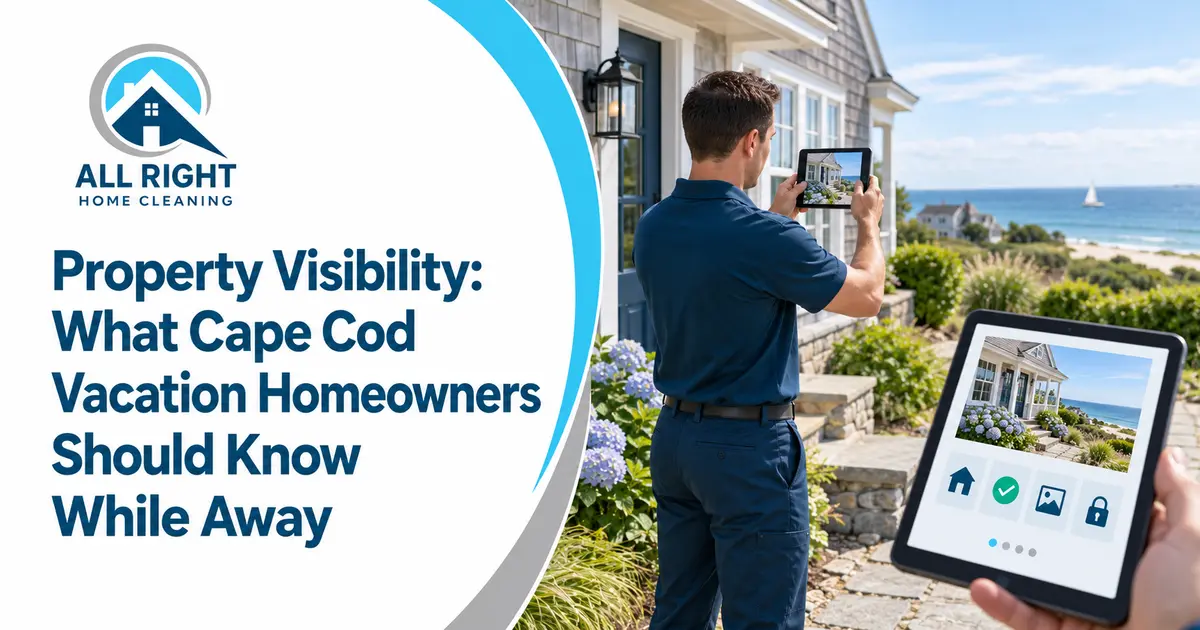
Property visibility gives absent homeowners reliable information about the condition, cleanliness, readiness, and security of their Cape Cod vacation home before small concerns become unpleasant surprises.
By All Right Home Cleaning | Cape Cod, Massachusetts
Property visibility means knowing what is happening inside your vacation home while you are not physically present. It requires more than a security camera, smart thermostat, or occasional message from a neighbor. True visibility combines scheduled access, condition checks, documented cleaning, photo updates, issue reporting, and verification that the property was secured after each visit.
This matters in Cape Cod because a seasonal home can remain closed for weeks or months while moisture, dust, odors, sand, pest evidence, ventilation problems, and storm related conditions develop unnoticed. A house may appear secure from the outside while its interior becomes progressively less ready for your return.
A reliable Deep Cleaning Service can restore cleanliness and reveal visible warning signs during the work. However, cleaning should be one component of a broader property visibility process. The objective is not simply to receive a clean house. It is to know what was found, what was completed, what requires attention, and whether the home is genuinely ready for your family or guests.
For an absent homeowner, visibility replaces assumption with verified information. That is how distance becomes manageable.
What Does Property Visibility Mean for a Cape Cod Vacation Home?
Property visibility is the ability to understand the current condition of your home without being there. It answers five practical questions:
- When was the property last accessed?
- What condition was each important area in?
- What cleaning or preparation was completed?
- Were any unusual conditions discovered?
- Was the home properly closed and secured afterward?
A smart lock can confirm that someone entered. A thermostat can display temperature. A camera can show selected exterior areas. None of these tools can tell you whether a bathroom has developed a musty odor, a window track contains moisture, a cabinet shows pest evidence, or dust has accumulated across rooms that remained closed.
That distinction is important. Remote monitoring shows data. Property visibility provides context.
Professional Cleaning Services can contribute to that context because trained professionals move through kitchens, bathrooms, bedrooms, living areas, floors, fixtures, baseboards, and other surfaces. During a structured service, they may notice visible conditions that isolated devices cannot detect.
Cleaning professionals should not diagnose mold, repair plumbing, evaluate electrical systems, or replace licensed property inspectors. Their proper role is to clean, observe, document, communicate, and report visible concerns so the homeowner can decide what type of specialist is needed.
Why Does Visibility Decline When a Vacation Home Stays Empty?
A vacation home does not remain frozen in the condition in which the owner left it. Time continues to affect the property even when nobody is using it.
Everyday occupancy normally provides constant feedback. Someone notices a new odor, condensation on a window, dust around an air vent, an insect near a door, or water beneath a sink. When the house is empty, that feedback disappears.
The owner may still receive information from connected devices, but most devices monitor one narrow condition. They do not evaluate the relationship between cleanliness, indoor moisture, ventilation, property access, storm exposure, and arrival readiness.
EPA guidance explains that elevated indoor humidity increases the likelihood of mold and recommends maintaining indoor relative humidity below 60 percent when possible, ideally between 30 and 50 percent. (epa.gov) This does not mean every closed Cape Cod house will develop mold. It means moisture deserves attention because extended absence can delay discovery.
Visibility commonly declines for four reasons:
- Nobody is observing gradual change
- Different vendors report information inconsistently
- Technology monitors systems rather than complete rooms
- Visits occur only after the owner suspects a problem
These gaps create uncertainty. The property may be fine, but the owner cannot confirm that it is fine. That uncertainty is the beginning of losing visibility over your vacation home.
What Can Change Inside a Cape Cod Home While You Are Away?
The most important risks are not always dramatic emergencies. Small changes matter because they can affect comfort, cleanliness, indoor air quality, and the first hours of a planned vacation.
This comparison exposes a common mistake: cleanliness and readiness are not identical. A room can look generally clean while still requiring detailed preparation. Likewise, a cleaning visit can improve the home without confirming the condition of systems that fall outside the cleaning scope.
Reliable remote property visibility therefore depends on clear boundaries. The homeowner should know what was cleaned, what was visually checked, what was documented, and what was not evaluated.
Why Are Cape Cod Properties Different From Primary Residences?
Cape Cod vacation homes combine several conditions that make consistent oversight valuable:
- Extended periods without occupants
- Seasonal opening and closing routines
- Coastal weather and humidity
- Sand and outdoor debris
- Guest or contractor access
- Long travel distances for owners
- Arrival dates that leave little time to correct problems
Coastal storms can also affect access, utilities, exterior conditions, and the surrounding property. Nor’easters are most frequent and strongest from September through April, according to the National Weather Service. (weather.gov) A storm does not automatically mean the interior has been damaged, but it creates a rational reason to verify conditions instead of relying on assumptions.
The practical issue is not that every Cape Cod home is constantly at risk. The issue is that an owner living in Boston, New York, Connecticut, New Jersey, or another state cannot personally confirm what happened after weather events, vendor visits, or long periods of vacancy.
That is why property visibility should be treated as a repeatable operating process, not an occasional favor from someone nearby.
A Practical Example of Visibility Versus Assumption
Consider a homeowner planning to arrive in Cape Cod on Friday evening. The house has been empty for eight weeks. The thermostat shows a normal temperature, the exterior camera shows no obvious damage, and the doors appear locked.
Those signals are useful, but they do not answer whether:
- The house has a stale or musty odor
- Bathrooms are ready for immediate use
- Dust has collected on furniture and fixtures
- Linens are properly arranged
- The kitchen is clean and prepared
- Any visible moisture or pest evidence is present
- Contractors left residue after a recent visit
A documented Deep Cleaning Service completed before arrival can address accumulated dirt and support a visual review of accessible areas. The homeowner then receives confirmation of what was completed and notification of visible conditions that may require separate attention.
The result is not merely a cleaner property. It is a more predictable arrival because the homeowner is making decisions with current information instead of hope.
How Can Vacation Homeowners Maintain Visibility From a Distance?
Cape Cod vacation homeowners can maintain visibility by creating a repeatable property review process instead of relying on occasional visits, informal messages, or disconnected smart devices.
An effective process should establish what needs to be checked, who is responsible, when visits should occur, how conditions will be documented, and what happens when an unusual condition is discovered.
The process can be organized into six steps:
- Create a property baseline
Document the expected condition of every important room before leaving. Photos of kitchens, bathrooms, bedrooms, floors, entrances, windows, and utility areas provide a useful reference for future visits.
- Define the purpose of each visit
A cleaning visit, storm check, maintenance appointment, and arrival preparation service have different objectives. The homeowner should know exactly what each professional is expected to evaluate.
- Use a consistent checklist
A structured checklist reduces forgotten areas and creates a repeatable standard. It also helps the homeowner compare one visit with another.
- Request visual confirmation
Photos should show relevant areas after the service, not just attractive closeups. The objective is verification, not presentation.
- Establish an issue reporting process
Visible moisture, unusual odors, pest evidence, damaged items, access concerns, or unexpected changes should be reported clearly.
- Confirm that the property was secured
The final update should confirm doors, windows, alarms, lights, keys, thermostats, and access systems when those tasks are included in the agreed scope.
This sequence turns an isolated service into a dependable information system. The homeowner gains more than proof that someone entered the house. The homeowner receives evidence that the expected work was completed and that accessible areas were left in the agreed condition.
What Should a Property Visit Report Include?
A useful property visit report should be concise enough to review quickly but specific enough to support decisions. A vague message stating that everything looks good does not provide meaningful visibility.
A practical report may include:
- Date and time of access
- Name of the person or team completing the visit
- Reason for the visit
- Rooms or areas serviced
- Tasks completed
- Visible conditions that deserve attention
- Photos of agreed areas
- Items that could not be checked
- Confirmation that the home was secured
- Recommended next action when necessary
A report should separate completed cleaning tasks from observations. For example, removing residue from a bathroom is a cleaning task. Reporting discoloration that returned near the ceiling is an observation. Diagnosing the cause requires a qualified professional with the appropriate expertise.
Why Does This Separation Matter?
Clear categories prevent homeowners from assuming that a cleaning company inspected systems outside its professional scope.
A Deep Cleaning Service may provide access to areas that have received little attention and may reveal visible signs of a concern. It does not replace a licensed electrician, plumber, HVAC technician, pest control professional, mold assessor, home inspector, or property manager.
That boundary makes the information more credible. A responsible provider reports what was observed without pretending to diagnose what cannot be confirmed.
How Often Should a Cape Cod Vacation Home Be Checked?
There is no responsible universal schedule for every property. The appropriate frequency depends on season, location, property condition, occupancy, weather, mechanical systems, insurance requirements, and upcoming arrival dates.
A waterfront home with a history of moisture concerns may need a different schedule from a newer inland home with reliable monitoring systems. Likewise, a property used every weekend requires a different approach from one that remains closed for several months.
Instead of selecting a frequency by habit, homeowners should consider both scheduled and event based visits.
A calendar alone is not enough. The strongest approach combines planned visits with clear triggers for additional verification after unusual weather, repairs, guest stays, or long periods without access.
Which Tools Improve Remote Property Visibility?
Technology is valuable when it answers a specific question. It becomes misleading when homeowners treat individual devices as proof that the entire property is fine.
Smart Locks and Access Logs
A smart lock can record when a door was opened and which access code was used. This helps owners monitor vendors, contractors, guests, and service providers.
However, an access log confirms entry. It does not confirm what happened after entry, which rooms were reviewed, whether work met the agreed standard, or whether the house was secured correctly.
Cameras and Doorbell Systems
Exterior cameras can help document arrivals, deliveries, visible weather conditions, and activity around entrances. Interior cameras may raise privacy concerns and should be managed carefully when guests, workers, or family members use the home.
A camera only shows the area within its field of view. It cannot smell an odor, examine a cabinet, feel dampness, or determine whether a bathroom is ready for use.
Temperature and Humidity Sensors
Environmental sensors can alert homeowners to changes in temperature or relative humidity. They are particularly useful when the home is vacant and the HVAC system is expected to maintain defined conditions.
Sensor readings still require interpretation. A normal reading in one room does not confirm that every bathroom, basement area, closet, or window remains unaffected.
Leak Detectors and Water Sensors
Water sensors placed near water heaters, washing machines, sinks, toilets, or mechanical equipment can provide early notice of moisture in specific locations.
Their limitation is placement. A detector only identifies water that reaches the device or its sensing cable. It cannot replace visual observation across the property.
The best system is not necessarily the one with the greatest number of devices. It is the one that combines useful technology with human observation, clear documentation, and responsible follow through.
Technology Only Versus Professional Property Oversight
Homeowners frequently assume they must choose between connected technology and local professional support. In practice, the two approaches serve different functions and work best together.
The combined approach provides the strongest visibility because each component covers a different gap. Sensors detect selected changes. Access systems document entry. Professional Cleaning Services restore interior conditions. Human observation adds context. Reports allow the owner to decide what should happen next.
What Are the Main Advantages of a Structured Visibility Process?
A structured process improves more than cleanliness. It reduces the information gap created by distance.
The principal advantages include:
- Fewer arrival surprises
- Earlier awareness of visible concerns
- Clearer accountability among service providers
- Consistent preparation standards
- Better coordination before family or guest visits
- Documented confirmation of completed work
- Less need for the homeowner to supervise remotely
These benefits do not eliminate every property risk. They improve the owner’s ability to respond because current information is available.
What Are the Possible Disadvantages?
A structured process also requires effort and coordination.
Potential disadvantages include:
- Additional service costs
- Time spent defining responsibilities
- Too many irrelevant photos or notifications
- Overlapping vendors with unclear roles
- False confidence when reports are vague
- Dependence on internet connected devices
- Privacy concerns involving access and cameras
These disadvantages are usually caused by poor design rather than excessive visibility. More updates do not automatically create better oversight. Homeowners need relevant information, a predictable reporting format, and a clear escalation process.
How Much Does Property Visibility Cost?
The cost depends on what the homeowner expects the system to accomplish. A basic setup using existing smart devices may cost less initially, but it cannot provide physical cleaning, room level observation, or in person verification.
Professional costs may vary according to:
- Property size and layout
- Number of bathrooms and bedrooms
- Current condition of the home
- Length of vacancy
- Required cleaning depth
- Frequency of visits
- Access complexity
- Documentation expectations
- Seasonal preparation requirements
- Additional coordination with other professionals
A low price is not automatically a good value if the homeowner receives no documentation, inconsistent work, or incomplete preparation. Likewise, an expensive service is not automatically comprehensive.
The relevant question is not simply, “How much does a visit cost?” The better question is, “What will I know about my Cape Cod home after the visit that I did not know before?”
That question exposes whether the service is creating genuine visibility or merely confirming that someone was present.
How Does Deep Cleaning Improve Property Visibility?
A Deep Cleaning Service improves visibility because the cleaning team works through areas that cameras, sensors, and casual visitors rarely examine closely. The process creates an opportunity to observe the accessible condition of floors, fixtures, baseboards, cabinets, bathrooms, kitchens, window tracks, appliances, bedrooms, and other interior areas.
The value is not limited to removing accumulated dirt. A structured deep cleaning can also help answer practical questions:
- Does the property have unusual odors?
- Is visible moisture present near windows, sinks, toilets, or appliances?
- Are there signs of insects or other pests?
- Did contractors leave dust or residue?
- Are bathrooms and bedrooms ready for immediate use?
- Does any accessible area require attention from another professional?
The cleaning team should document visible concerns rather than diagnose their cause. If staining appears near a ceiling, for example, the provider can photograph and report it. Determining whether the source involves roofing, plumbing, condensation, or another condition belongs to the appropriate qualified professional.
This distinction protects both the homeowner and the service provider. It creates useful information without turning observations into unsupported technical conclusions.
What Should a Deep Cleaning Service Include for a Seasonal Home?
The exact scope depends on the property, its condition, and the agreement with the cleaning company. However, a detailed seasonal service should go beyond the surfaces covered during routine cleaning.
A comprehensive scope may address:
- Baseboards and accessible trim
- Doors, frames, and handles
- Window sills and tracks
- Ceiling fans and reachable fixtures
- Cabinet fronts and selected cabinet interiors
- Appliance exteriors and agreed interior areas
- Bathroom fixtures and accumulated residue
- Kitchen surfaces and grease buildup
- Furniture surfaces and accessible areas underneath
- Floors, corners, and edges
- Dust on decorative objects and exposed shelving
- Visible cobwebs
- Bedroom surfaces and linen preparation when included
- Final room review and property securing procedures
The service agreement should state which tasks are included, excluded, optional, or dependent on access. The phrase deep cleaning does not have one universal scope across every company. Homeowners should never assume that appliance interiors, windows, linens, basements, garages, porches, or post construction residue are automatically included.
Why Is a Written Scope More Reliable Than a Verbal Promise?
A written scope creates a shared standard. The homeowner knows what to expect, and the cleaning team knows what must be completed.
Without a documented scope, one person may interpret deep cleaning as detailed work throughout the entire home while another may understand it as a longer version of routine cleaning. That gap produces disappointment even when both parties believe they communicated clearly.
A useful written scope should identify:
- Rooms included
- Tasks expected in each room
- Areas excluded from service
- Optional tasks requiring approval
- Access instructions
- Photo or report expectations
- Conditions that could change the estimate
- Procedures for reporting visible concerns
A scope does not need to become an exhausting legal document. It needs to remove ambiguity from the service.
What Is the Difference Between Deep Cleaning and Property Inspection?
Deep cleaning and property inspection may occur during the same visit, but they are not the same service.
The information gain comes from understanding where one responsibility ends and another begins. A cleaning professional may be the first person to notice a visible change because the work requires close contact with many rooms and surfaces. That observation can trigger the correct next step, but it is not a technical diagnosis.
When Should Deep Cleaning Be Scheduled?
Deep cleaning is most useful when the home requires more than routine maintenance or when the owner needs a higher level of readiness before occupancy.
Before the Seasonal Opening
A house that remained closed for months may contain accumulated dust, stale odors, cobwebs, sand, residue, or areas that need detailed attention. Scheduling service before the first trip allows time to address visible concerns before the family arrives.
Before an Important Arrival
Deep cleaning can be appropriate before children, older relatives, friends, or other guests use the home. The service creates a defined preparation point and confirms that the agreed interior areas are ready.
After Construction or Renovation
Painting, deck work, flooring installation, kitchen remodeling, bathroom work, and other projects can spread fine dust or leave residue beyond the immediate work area.
Post construction cleaning should be discussed separately because construction dust, adhesive, paint residue, and debris may require different equipment, labor, and safety procedures from standard residential cleaning.
After an Extended Vacancy
The passage of time alone does not determine whether deep cleaning is necessary. The decision should consider the condition of the home, ventilation, previous cleaning, visible dust, odors, pest evidence, humidity, recent access, and the owner’s expectations.
After Repeated Routine Cleaning
Routine service may maintain visible surfaces while detailed areas gradually accumulate dirt. Periodic deep cleaning can reset the property to a more complete standard before regular maintenance resumes.
The correct timing depends on the property rather than an arbitrary calendar. The homeowner should schedule deep cleaning when the expected condition of the house cannot be reached through ordinary maintenance alone.
How Should Homeowners Evaluate Professional Cleaning Services?
The strongest provider is not necessarily the company with the lowest quote, the longest service list, or the most dramatic promise. For an absent homeowner, the most important qualities are trust, consistency, communication, access control, documentation, and a clear process.
Before hiring a company, ask:
- Is the company insured, and can coverage be verified?
- Who will have access to the property?
- How are keys, codes, alarms, and lockboxes managed?
- Will the same service standard be followed during every visit?
- Is the cleaning scope documented before work begins?
- How are visible concerns reported?
- Will the homeowner receive completion confirmation?
- What happens if a task is missed or cannot be completed?
- Are photos available when agreed in advance?
- Which services require a separate estimate?
The provider’s answers should be specific. Statements such as “we always do a great job” or “you can trust us” are not operational evidence. A credible company should explain how access is controlled, how work is verified, how issues are communicated, and how the property is secured before departure.
Which Warning Signs Should Homeowners Avoid?
Several warning signs indicate that a company may not provide enough accountability for a remotely managed vacation home:
- No written service scope
- Unclear access procedures
- Inability to explain insurance coverage
- No process for reporting visible concerns
- Vague pricing with undefined tasks
- Different standards from one visit to another
- Poor communication before service begins
- No confirmation after the work is completed
- Promises that exceed the company’s professional scope
One warning sign does not automatically prove that a provider is unreliable. It does justify further questions before giving someone access to a valuable property.
What Should Be Confirmed Before You Travel to Cape Cod?
The final preparation update should answer whether the home is ready for occupancy, not merely whether cleaning occurred.
Before traveling, confirm:
- The scheduled service was completed
- Agreed rooms and tasks were addressed
- Beds and linens were prepared when included
- Bathrooms and kitchen were ready for use
- Visible concerns were documented
- Unfinished tasks were disclosed
- Doors and windows were secured
- Access codes or keys were handled correctly
- Additional professional attention was requested when necessary
- Final photos or completion notes were delivered
This final verification protects the arrival experience. It gives the homeowner time to respond if another service is needed and reduces the chance of spending the first vacation day coordinating repairs, buying supplies, or cleaning rooms that should have been ready.
The real purpose of Professional Cleaning Services for an absent Cape Cod homeowner is not simply to improve how the house looks. It is to create a reliable transition from an empty property to a prepared home.
Frequently Asked Questions About Property Visibility
Can security cameras provide complete property visibility?
No. Cameras can confirm activity within their field of view, but they cannot evaluate odors, moisture inside cabinets, dust accumulation, bathroom readiness, pest evidence, or the condition of rooms outside the camera angle. Cameras are most useful when combined with physical visits and documented observations.
How often should an empty Cape Cod vacation home be checked?
The appropriate frequency depends on the property location, season, condition, vacancy period, weather, monitoring equipment, insurance requirements, and upcoming occupancy. Homeowners should combine scheduled visits with additional checks after severe weather, contractor access, guest stays, or device alerts.
Does a Deep Cleaning Service include a property inspection?
Not automatically. Deep cleaning focuses on detailed cleaning and interior preparation. A visual condition review may be included when agreed in advance, but it does not replace a formal home inspection or an evaluation by a licensed trade professional.
Can a cleaning company identify mold?
A cleaning professional may observe visible discoloration, moisture, or a musty odor and report those conditions. The company should not diagnose mold or determine its cause unless it has the appropriate qualifications. Suspected hidden mold or recurring moisture should be evaluated by an experienced professional.
Can a closed vacation home stay clean for several months?
A closed home can still accumulate dust, odors, cobwebs, insects, and moisture related residue. The actual condition depends on ventilation, filtration, previous cleaning, indoor humidity, building condition, recent access, and the length of vacancy.
What should homeowners receive after a service visit?
Homeowners should receive confirmation that the visit occurred, a summary of completed tasks, disclosure of unfinished work, relevant photos when agreed, notes about visible concerns, and confirmation that the property was secured.
When should deep cleaning be scheduled before arrival?
The service should be scheduled with enough time to complete the agreed scope and respond to unexpected conditions. The correct timing depends on property size, current condition, service availability, required preparation, and whether other professionals may be needed.
Are Professional Cleaning Services enough to manage a vacation home remotely?
Cleaning services solve an important part of the process, but they do not replace every property management function. A complete visibility system may also involve smart devices, maintenance professionals, security providers, home inspectors, pest control, and licensed contractors.
How can I verify whether a cleaning company is reliable?
Ask for a written scope, proof of insurance when relevant, access procedures, communication standards, issue reporting practices, completion verification, and an explanation of how missed tasks are handled. Reviews are useful, but operational clarity reveals how the company will work inside your property.
What is the first step toward better remote property visibility?
Create a baseline of the home’s expected condition. Then define who may access the property, what each provider must complete, what evidence should be delivered, and which conditions require immediate notification. Visibility begins with clear expectations, not additional technology.
Your Cape Cod Home Should Not Become Invisible When You Leave
Distance does not need to mean uncertainty. A Cape Cod vacation home becomes easier to manage when technology, trusted access, structured cleaning, visual observation, documentation, and issue reporting work together.
The central principle is simple: every visit should produce useful information.
You should know who entered, what was completed, what was observed, what remains unresolved, and whether the property was secured. That is the difference between assuming your home is ready and having reasonable evidence that it is ready.
A professional cleaning company should never promise to replace inspectors, property managers, or licensed contractors. Its value comes from completing a defined cleaning scope, observing accessible areas responsibly, reporting visible concerns, and preparing the interior for your arrival.
For vacation homeowners who live outside Cape Cod, this process protects something more valuable than a clean house. It protects time. Your first day should be spent enjoying the property, not discovering what happened while you were away.
Editorial and Source Review
This article was prepared for All Right Home Cleaning using the company’s ICP, buyer persona, customer journey, communication manual, service positioning, and semantic content strategy. Public factual guidance was checked against official sources from the United States Environmental Protection Agency and the National Weather Service.
The article distinguishes cleaning observations from technical inspections and avoids presenting visible conditions as professional diagnoses. This distinction supports accuracy, responsible authorship, and clear expectations for homeowners.