
Coastal homes in Cape Cod do not simply get dirty faster. They age, absorb moisture, trap salt air, collect dust, develop odors, and lose freshness faster because the local environment works against vacant and seasonal properties every day.
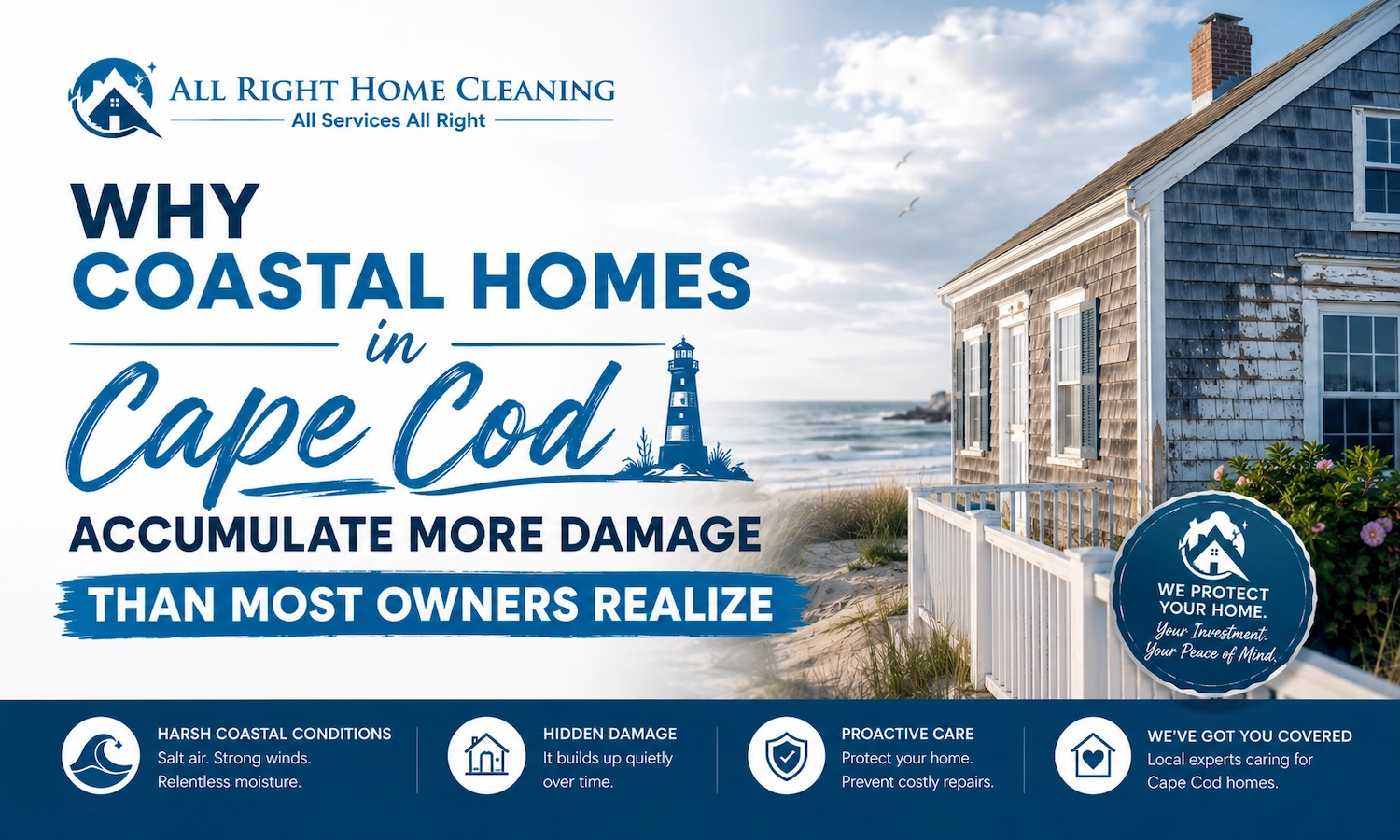
A Cape Cod coastal home faces a combination of salt air, humidity, sand, stale indoor air, closed windows, unused rooms, moisture pockets, dust buildup, and long periods without daily human activity. For seasonal homeowners, the real issue is not visible dirt. The real issue is what happens quietly while nobody is there to inspect, reset, ventilate, or verify the property.
That is why Deep Cleaning in Cape Cod, MA matters more for second homes, beach houses, waterfront properties, and vacation homes than it does for ordinary year round residences. A standard cleaning may make a home look presentable, but it often misses the hidden deterioration patterns created by the coastal environment. Professional Cleaning Services help reduce that risk by cleaning deeper zones, identifying buildup, improving home readiness, and giving owners more control over a property they may not see for weeks or months.
For seasonal homeowners, seasonal home cleaning cape cod is not just a convenience. It is part of protecting your vacation property before small problems become expensive surprises.
Why do Cape Cod coastal homes accumulate more damage than inland homes?
Cape Cod homes accumulate more damage because coastal air carries moisture, salt particles, sand, organic debris, and humidity into materials, surfaces, vents, fabrics, fixtures, and hidden corners. When a home sits closed for weeks, those elements do not disappear. They settle, react, and slowly change the condition of the property.
The mistake many homeowners make is assuming damage starts only when something looks visibly dirty. In reality, many coastal home problems begin before the owner notices anything. A faint musty smell, sticky surfaces, dull floors, gritty window tracks, dusty vents, and moisture near bathrooms or basements are early signals that the home has been absorbing environmental stress.
Cape Cod properties are especially vulnerable because many are used seasonally. A primary residence gets daily ventilation, foot traffic, cleaning routines, cooking activity, heating adjustments, and visual inspection. A vacation home does not. That absence creates blind spots.
When nobody is living in the property, small issues can sit untouched:
- Salt residue can settle on windows, floors, fixtures, and exterior entry points.
- Humidity can collect in bathrooms, closets, basements, and poorly ventilated rooms.
- Dust can accumulate in vents, baseboards, ceiling fans, and under furniture.
- Sand can grind into floors, rugs, thresholds, and entry areas.
- Stale air can make the house smell closed, damp, or neglected.
- Mildew risk can increase when moisture and poor airflow overlap.
This is why owners who arrive expecting a relaxing weekend often spend their first day opening windows, wiping surfaces, checking bathrooms, shaking rugs, calling cleaners, or trying to figure out why the house feels off. The real damage is not only cosmetic. It is the loss of control over the condition of the home.
What makes coastal damage different from ordinary dirt?
Ordinary dirt sits on the surface. Coastal damage interacts with the home. It enters through air, shoes, pets, luggage, open doors, screened porches, beach gear, HVAC circulation, and seasonal humidity changes.
A suburban home may collect dust. A Cape Cod home collects dust mixed with salt, moisture, pollen, sand, and organic particles from a coastal setting. That combination changes how surfaces age. It can make floors feel gritty, windows look hazy, fixtures lose shine, and rooms smell stale even when they appear visually clean.
What usually happens inside a closed coastal home?
| Coastal Factor | What It Does Inside The Home | Where It Shows Up First | Why Owners Miss It |
| Salt air | Leaves residue and dulls surfaces | Windows, metal fixtures, entry areas | It builds slowly and looks like normal dust |
| Humidity | Feeds musty odors and moisture pockets | Bathrooms, closets, basements, laundry rooms | It hides until odor appears |
| Sand | Scratches and grinds into surfaces | Floors, rugs, thresholds, stairs | It spreads beyond entry areas |
| Dust buildup | Settles into vents and hidden surfaces | Fans, baseboards, furniture backs | It is rarely checked deeply |
| Stale air | Makes rooms feel closed and damp | Bedrooms, closets, guest rooms | The home may still look clean |
| Mildew risk | Forms where moisture remains trapped | Shower corners, window frames, lower walls | Early signs are subtle |
A basic wipe down rarely addresses these patterns. The home may look acceptable from the doorway, but still have buildup in the places that determine how clean, fresh, and ready it feels.
Why do vacation homes deteriorate faster when nobody visits?
A vacation home deteriorates faster because it lacks daily human correction. In a lived in home, someone notices when a room smells damp, a window track is gritty, a bathroom fan is dusty, or a floor feels sticky. In an empty home, those clues sit there.
The issue is not neglect in the emotional sense. Most seasonal homeowners care deeply about their Cape Cod property. The issue is physical absence. You cannot fix what you cannot see.
When a home stays empty, three things happen at the same time:
- Environmental buildup continues
Salt air, humidity, dust, pollen, sand, and debris continue entering or settling in the home, even when nobody is there. - Detection stops
No one is walking through the property daily, opening rooms, checking corners, smelling stale areas, or noticing changes. - Correction is delayed
Cleaning, ventilation, inspection, and resetting happen too late, usually right before arrival or after a problem has become obvious.
This is the gap where Professional Cleaning Services become more valuable. The service is not only about removing dirt. It is about restoring visibility into the condition of the property.
What damage do most owners underestimate?
Most owners underestimate the damage they cannot see from a quick walkthrough. A room can look acceptable while still holding moisture, dust, odor, sand, and buildup in less visible areas.
The most underestimated coastal home problems
| Problem | Why It Matters | What Happens If Ignored |
| Musty odor | Often signals trapped moisture or stale air | The home feels unpleasant on arrival |
| Dirty vents | Circulate dust and allergens | Indoor air feels heavy or dusty |
| Salt residue | Makes surfaces feel sticky or dull | Fixtures and glass lose clarity |
| Baseboard buildup | Shows long term neglect | Rooms feel less clean even after surface cleaning |
| Window track dirt | Collects sand, bugs, salt, and moisture | Windows become harder to clean later |
| Bathroom mildew | Starts in corners and grout lines | Can become harder to remove |
| Cabinet interiors | Trap stale odors and dust | Kitchens feel closed or unused |
| Closet moisture | Holds odor in linens and fabrics | Bedrooms smell damp |
| Floor grit | Scratches finishes over time | Floors lose polish and comfort |
The blunt truth: if a Cape Cod homeowner only cleans what guests see first, the property is being managed cosmetically, not protected. That is a weak strategy for an expensive coastal asset.
Why does salt air matter inside the house?
Salt air matters because it does not stay outside. Coastal air moves through screens, door gaps, open windows, shoes, beach bags, porches, and ventilation systems. Over time, fine salt particles settle on surfaces and mix with moisture.
Inside a home, salt residue can make surfaces feel slightly tacky, create haze on glass, dull hardware, and combine with dust to create a stubborn film. This is especially noticeable near entry points, sliders, windows, decks, mudrooms, sunrooms, and ocean facing rooms.
Salt air is also deceptive. It rarely announces itself as a dramatic problem. It creates a slow decline in freshness.
Where salt residue tends to collect
- Sliding glass doors
- Window frames
- Window tracks
- Door handles
- Light fixtures
- Kitchen surfaces
- Bathroom hardware
- Entry floors
- Mudroom benches
- Porch connected rooms
These areas matter because they shape the first impression of the home. When they feel sticky, dusty, gritty, or hazy, the house feels less cared for, even if the larger rooms look organized.
Why does humidity create more than a cleaning problem?
Humidity is not just a comfort issue. It changes the way a closed home smells, feels, and ages. In Cape Cod, seasonal properties can sit through damp periods without consistent airflow. When moisture stays trapped, the home can develop musty odors, mildew spots, and stale indoor air.
Humidity tends to collect where air movement is weak:
- Bathrooms
- Basements
- Laundry rooms
- Closets
- Guest bedrooms
- Under sinks
- Closed cabinets
- Storage rooms
A homeowner may walk in and say, “It smells like the house was closed.” That smell is not random. It is usually a combination of stagnant air, moisture, dust, fabrics, wood surfaces, and rooms that have not been reset.
A deep cleaning visit does not replace proper ventilation, HVAC maintenance, or moisture control, but it does remove buildup that makes humidity problems more noticeable. It also puts trained eyes on areas the owner may not inspect during a short stay.
Why does sand cause long term wear?
Sand is small, but it acts like abrasive material inside the home. It gets carried in through shoes, towels, beach bags, pets, children, outdoor furniture, and rental guests. Once inside, it spreads beyond obvious entry points.
Sand often collects in:
- Entry mats
- Under rugs
- Floor seams
- Stair edges
- Closet floors
- Laundry areas
- Sofa edges
- Bedroom corners
- Bathroom floors
The problem is not only that sand looks messy. It can grind into hardwood floors, scratch finishes, wear down rugs, and make rooms feel dirty even after a quick vacuum.
This is where standard cleaning often fails. A basic pass may remove visible sand from the center of the room but miss edges, transitions, under furniture, and rug backing. Deep cleaning looks at the home as a system, not as isolated visible surfaces.
How does a closed home lose freshness?
A closed home loses freshness because air stops moving, fabrics hold odor, dust settles, moisture sits, and surfaces remain untouched. The result is the familiar vacation home smell: not filthy, but not fresh either.
That odor can come from several sources:
- Closed closets
- Unused bedding
- Dusty vents
- Damp bathrooms
- Trash residue
- Pet dander
- Old cooking smells
- Moisture near sinks
- Dirty filters
- Unwashed floors
Freshness is not created by fragrance. It is created by removing the source of stale air, dust, moisture, residue, and hidden buildup. Masking odor with sprays is cheap thinking. It solves nothing and often makes the home feel less premium.
For a high value Cape Cod property, freshness should be managed through cleaning depth, airflow awareness, surface detailing, and routine inspection.
What Is the Real Cost of Ignoring Coastal Home Deterioration?
Most homeowners calculate maintenance costs incorrectly.
They focus on the visible expense of a cleaning service while ignoring the hidden cost of delayed action. In coastal environments like Cape Cod, deterioration is rarely caused by one major event. It is usually the result of dozens of small issues accumulating over time.
The financial impact is often indirect:
- More intensive future cleaning
- Premature wear on finishes
- Reduced indoor comfort
- Odor remediation
- Additional maintenance visits
- Emergency preparation before guests arrive
- Lost enjoyment during personal stays
- Reduced guest satisfaction in rental properties
For many seasonal homeowners, the most expensive cost is not repair. It is arriving at a property that was supposed to be ready and discovering that it is not.
That is why many owners who initially search for Deep Cleaning in Cape Cod, MA eventually realize they are actually investing in predictability.
The Cost Comparison Most Homeowners Never Make
| Scenario | Short Term Cost | Long Term Impact |
| Reactive cleaning only before arrival | Lower initially | More buildup and deeper future cleaning |
| Regular property readiness inspections | Moderate | Better visibility and fewer surprises |
| Seasonal deep cleaning schedule | Predictable | Consistent property condition |
| Ignoring the property for months | Appears free | Hidden deterioration accumulates |
| Emergency last minute cleaning | Higher stress | Reduced scheduling flexibility |
The smartest property owners think like asset managers.
They do not wait for visible deterioration. They build systems that prevent it.
Why Deep Cleaning Matters More in Coastal Homes Than in Traditional Homes
Many homeowners assume deep cleaning is simply a longer version of standard cleaning.
That assumption is wrong.
A true deep cleaning process focuses on areas where coastal properties accumulate environmental stress. These are the places where dust, moisture, salt particles, allergens, sand, and organic buildup settle over time.
Areas Often Missed During Routine Cleaning
Interior Air and Ventilation Zones
- HVAC vents
- Return air grilles
- Ceiling fan blades
- Vent covers
- Air circulation pathways
These areas affect indoor air quality far more than most homeowners realize.
Structural Transition Areas
- Baseboards
- Door frames
- Window tracks
- Window sills
- Stair edges
These surfaces collect fine debris that remains long after visible surfaces appear clean.
Hidden High Accumulation Areas
- Under beds
- Behind furniture
- Closet floors
- Cabinet interiors
- Appliance gaps
These locations often become reservoirs for dust, odor, and allergens.
A proper Deep Cleaning in Cape Cod, MA addresses these overlooked zones because they influence how a property feels, smells, and functions when owners arrive.
The difference is substantial.
A house can look clean from the doorway while still containing months of accumulated environmental residue.
Why Standard Cleaning Often Fails Seasonal Homes
Standard cleaning works best in occupied homes.
Seasonal homes operate under different conditions.
An occupied residence benefits from:
- Daily airflow
- Frequent surface use
- Regular visual inspections
- Immediate correction of problems
- Consistent cleaning routines
A seasonal property experiences the opposite.
Standard Cleaning vs Seasonal Property Deep Cleaning
| Standard Cleaning | Seasonal Property Deep Cleaning |
| Focuses on appearance | Focuses on readiness |
| Addresses visible dirt | Addresses visible and hidden buildup |
| Designed for occupied homes | Designed for vacant and seasonal homes |
| Shorter cleaning cycle | More detailed inspection process |
| Surface oriented | Property condition oriented |
| Limited verification | Extensive verification |
This distinction is critical because many homeowners hire a cleaning company expecting property preparation and receive only surface maintenance.
The result is disappointment.
The home looks clean but does not feel ready.
That gap is where many negative experiences begin.
What Happens During Months of Property Inactivity?
A coastal property continues changing even when nobody is there.
Environmental conditions never pause.
Month One
Typical developments include:
- Light dust accumulation
- Reduced airflow freshness
- Minor humidity changes
- Sand residue settling
Most homeowners would not notice significant issues at this stage.
Month Two
Conditions begin compounding:
- Odors become more noticeable
- Dust spreads into additional areas
- Closets feel stale
- Window tracks collect debris
The home still appears acceptable in photographs.
In person, the difference becomes obvious.
Month Three and Beyond
This is where seasonal homeowners often encounter surprises:
- Noticeable musty smell
- Increased dust concentration
- Visible buildup in neglected areas
- Decline in overall freshness
- More time required to restore readiness
The longer a property remains uninspected, the wider the visibility gap becomes.
The owner assumes the house is fine.
Reality often tells a different story.
Why Coastal Air Creates a Unique Cleaning Challenge
Cape Cod properties exist inside a constantly changing environmental system.
The interaction between:
- Ocean air
- Salt particles
- Humidity
- Seasonal temperature shifts
- Wind driven debris
- Sand exposure
creates conditions that inland properties rarely experience.
Environmental Comparison
| Factor | Inland Property | Coastal Property |
| Salt exposure | Minimal | Constant |
| Sand intrusion | Low | High |
| Humidity variability | Moderate | Significant |
| Ocean air influence | None | Continuous |
| Seasonal vacancy rates | Lower | Higher |
| Vacation use patterns | Less common | Extremely common |
This is one reason why Professional Cleaning Services that understand seasonal coastal properties often outperform generic cleaning providers.
The cleaning process must reflect the environment.
Otherwise, the service addresses symptoms while ignoring causes.
How Dust Behaves Differently in Vacation Homes
Dust in an occupied home is frequently disturbed and removed.
Dust in a vacant home settles.
Over time, this creates layers of accumulation that spread beyond visible surfaces.
Common Dust Collection Points
- Ceiling fans
- Window trim
- Vents
- Decorative shelving
- Behind furniture
- Under beds
- Closet corners
- Lamp shades
- Headboards
Dust becomes especially problematic when combined with:
- Salt particles
- Moisture
- Pet dander
- Fabric fibers
- Outdoor pollen
This combination contributes to:
- Poor indoor air quality
- Stale smells
- Surface dullness
- Increased cleaning requirements
For owners returning after several weeks or months away, dust is often the first visible sign that the property has been unmanaged.
Why Indoor Air Quality Matters More Than Most Homeowners Think
Most property owners evaluate cleanliness visually.
Guests and family members experience cleanliness through the air first.
Before they notice floors or countertops, they notice:
- Smell
- Freshness
- Air movement
- Humidity
- Overall comfort
That means indoor air quality becomes one of the strongest indicators of property readiness.
Signs Indoor Air Quality Has Declined
- Rooms smell closed when first opened.
- Closets have a damp or stale odor.
- Bedding smells unused.
- Air feels heavy.
- Dust appears shortly after arrival.
- Allergy symptoms increase indoors.
These issues often originate from accumulated environmental conditions rather than obvious dirt.
Addressing them requires a more comprehensive approach than routine maintenance alone.
How Seasonal Homeowners Can Reduce Long Term Property Deterioration
The objective should not be perfection.
The objective should be visibility and consistency.
The most successful Cape Cod homeowners typically follow a layered approach.
Recommended Property Protection Strategy
- Schedule seasonal deep cleaning before peak use periods.
- Verify property condition after extended vacancies.
- Inspect moisture prone areas regularly.
- Maintain indoor air circulation whenever possible.
- Address dust accumulation before it becomes embedded.
- Prioritize property readiness over cosmetic appearance.
- Build a repeatable maintenance schedule.
This approach aligns directly with seasonal home cleaning cape cod strategies used by experienced second home owners.
More importantly, it supports the broader goal of protecting your vacation property from gradual deterioration that often goes unnoticed.
A vacation home is not maintained through occasional effort.
It is maintained through consistent visibility.
What Does Property Readiness Actually Mean?
Property readiness is one of the most misunderstood concepts among seasonal homeowners.
Many people define readiness as:
“The house looks clean.”
A better definition is:
“The house is prepared to be lived in immediately.”
Those are very different standards.
A Truly Ready Vacation Home Includes
Clean Surfaces
- Floors
- Counters
- Bathrooms
- Kitchens
Fresh Environment
- No stale odors
- No noticeable dust
- Comfortable indoor atmosphere
Functional Presentation
- Reset spaces
- Organized appearance
- Guest ready condition
Verified Condition
- No obvious buildup
- No overlooked problem areas
- No unpleasant surprises
Property readiness is the outcome.
Cleaning is only one part of achieving it.
This distinction is particularly important for owners managing homes remotely and relying on trusted professionals to maintain standards while they are away.
Why Remote Homeowners Face a Visibility Problem
The greatest challenge facing seasonal homeowners is not dirt.
It is uncertainty.
When you are hundreds of miles away, you lose direct visibility into:
- Property condition
- Environmental changes
- Cleaning quality
- Home readiness
- Maintenance needs
That lack of visibility creates anxiety because the homeowner cannot independently verify what is happening inside the property.
The result is a recurring question:
“Will everything be ready when I arrive?”
The entire purpose of Deep Cleaning in Cape Cod, MA is not simply cleanliness.
It is reducing uncertainty.
The most effective property care strategy creates confidence long before the homeowner opens the front door.
Why Many Vacation Home Owners Mistake Cleanliness for Protection
One of the biggest misconceptions in coastal property ownership is believing that a clean looking home is a protected home.
The two are not the same.
A home can have:
- Vacuumed floors
- Wiped counters
- Clean bathrooms
- Fresh linens
and still be vulnerable to issues developing behind the scenes.
Protection requires awareness of environmental conditions, property readiness, moisture risks, indoor air quality, and hidden accumulation areas.
This distinction becomes especially important in Cape Cod because many homes remain vacant for significant portions of the year.
Clean vs Protected
| Clean Home | Protected Home |
| Looks presentable | Is actively maintained |
| Focuses on appearance | Focuses on condition |
| Addresses visible surfaces | Addresses visible and hidden risks |
| Temporary result | Ongoing process |
| Reactive | Preventive |
| Surface focused | Property focused |
The homeowners who experience the fewest surprises are usually the ones who stop viewing cleaning as a task and start viewing it as part of property stewardship.
Why Coastal Homes Require a Different Maintenance Mindset
Most maintenance advice available online is written for primary residences.
Cape Cod vacation homes operate under entirely different circumstances.
A primary residence benefits from constant human interaction.
A seasonal property often experiences:
- Long vacancies
- Periodic occupancy
- Weather exposure
- Seasonal transitions
- Extended periods without inspection
This creates a unique ownership challenge.
The homeowner is responsible for a property they rarely see.
That means maintenance decisions must be proactive rather than reactive.
Traditional Homeowner Thinking
“I’ll deal with problems when I notice them.”
Successful Seasonal Homeowner Thinking
“I need systems that help me notice problems before they become expensive.”
That shift in perspective is often what separates a stress free vacation property from a recurring source of frustration.
How Seasonal Changes Accelerate Property Wear in Cape Cod
Cape Cod homes experience more environmental transitions than many inland properties.
These transitions create cycles of expansion, contraction, moisture variation, dust movement, and airborne debris accumulation.
Spring
Common issues include:
- Winter residue
- Dust accumulation
- Moisture related odors
- Seasonal reopening preparation
Summer
Common issues include:
- Increased sand traffic
- Higher occupancy
- More open windows and doors
- Elevated cleaning requirements
Fall
Common issues include:
- Organic debris
- Seasonal shutdown preparation
- Reduced ventilation
Winter
Common issues include:
- Long vacancy periods
- Reduced monitoring
- Moisture concerns
- Stale indoor conditions
Every season introduces different environmental pressures.
That is why many experienced homeowners schedule seasonal home cleaning cape cod services around transition periods rather than waiting for visible problems to appear.
Why Coastal Homes Often Feel Dirtier Than They Actually Are
This phenomenon confuses many homeowners.
A property may technically be clean but still feel dirty.
That feeling is often caused by environmental factors rather than visible mess.
Common Causes
Air Quality
When air feels stale, occupants subconsciously associate the home with poor cleanliness.
Dust Film
Even a thin layer of dust changes how surfaces reflect light.
Rooms appear less vibrant and less maintained.
Odor
Humans process smell before visual detail.
A slight musty odor can make an otherwise clean room feel neglected.
Sand Residue
Small particles underfoot immediately influence perception.
The home feels less cared for.
Humidity
Excess moisture creates a sensation of heaviness that many people interpret as uncleanliness.
This is one reason homeowners frequently underestimate the value of deep cleaning.
The goal is not simply removing dirt.
The goal is restoring freshness, readiness, and comfort.
What Areas Should Receive the Most Attention in a Cape Cod Vacation Home?
Not all areas of a home accumulate risk equally.
Certain locations consistently develop issues faster.
Priority Area 1: Entry Zones
These areas receive:
- Sand
- Salt residue
- Outdoor debris
- Moisture transfer
Examples include:
- Mudrooms
- Entry halls
- Garage transitions
- Side entrances
Priority Area 2: Bathrooms
Bathrooms naturally combine:
- Moisture
- Limited airflow
- Organic residue
This makes them prime locations for odor and mildew development.
Priority Area 3: Kitchens
Kitchens collect:
- Dust
- Grease residue
- Food related odors
- Cabinet accumulation
Even unused kitchens can develop stale conditions during long vacancies.
Priority Area 4: Bedrooms
Especially guest rooms.
Because they remain closed longer than other areas, they often develop:
- Dust buildup
- Fabric odors
- Stale air
Priority Area 5: Storage Areas
Including:
- Closets
- Utility spaces
- Basement storage
- Secondary rooms
These locations often become hidden accumulation zones.
The Hidden Relationship Between Deep Cleaning and Property Value
Most homeowners think of deep cleaning as an operating expense.
A stronger perspective is to view it as a preservation activity.
Every property contains physical assets:
- Flooring
- Fixtures
- Cabinetry
- Countertops
- Appliances
- Trim work
- Doors
- Windows
The condition of those assets influences how the home feels, photographs, and performs over time.
How Deep Cleaning Supports Long Term Property Preservation
| Area | Benefit |
| Floors | Reduced abrasive buildup |
| Bathrooms | Improved moisture management |
| Kitchens | Reduced residue accumulation |
| Air quality | Improved comfort |
| Entry areas | Less sand related wear |
| Hidden surfaces | Better overall condition visibility |
No cleaning service can eliminate natural aging.
However, consistent maintenance can slow avoidable deterioration.
For owners with substantial equity invested in Cape Cod real estate, this distinction matters.
Why Property Readiness Is Becoming More Important Than Cleaning Alone
The market is changing.
Vacation homeowners increasingly expect more than a traditional cleaning service.
They want confidence.
They want visibility.
They want verification.
They want to know that someone has looked at the property with attention to detail.
That expectation is driving demand for a broader property readiness approach.
Property Readiness Includes
- Deep cleaning
- Visual verification
- Condition awareness
- Seasonal preparation
- Arrival preparation
- Consistent standards
For absentee homeowners, this model creates a stronger sense of control.
The house is not simply cleaned.
The house is prepared.
Why Deep Cleaning Before Arrival Creates a Better Ownership Experience
Many homeowners wait until they arrive to evaluate the condition of the property.
That approach creates unnecessary stress.
When cleaning and preparation happen before arrival, the experience changes completely.
Without Preparation
Arrival often includes:
- Opening windows
- Checking bathrooms
- Removing dust
- Investigating odors
- Cleaning overlooked areas
With Preparation
Arrival becomes:
- Unpack
- Relax
- Enjoy the property
- Welcome guests
- Begin vacation immediately
This difference may seem simple.
In practice, it can determine whether the first day at a vacation home feels restorative or frustrating.
That is why many homeowners prioritize Deep Cleaning in Cape Cod, MA before major family visits, holiday weekends, summer occupancy periods, and guest arrivals.
What Role Do Professional Cleaning Services Play in Property Stewardship?
The strongest Professional Cleaning Services are not simply performing labor.
They function as an additional layer of visibility.
They help homeowners identify conditions that may otherwise remain unnoticed.
This becomes especially valuable when the homeowner lives in:
- Boston
- New York
- Connecticut
- New Jersey
- Rhode Island
or anywhere else outside Cape Cod.
The greater the distance between owner and property, the more important visibility becomes.
What Homeowners Gain
Better Awareness
More understanding of property condition.
Better Consistency
Less variation between visits.
Better Readiness
Greater confidence before arrival.
Better Control
More insight into what is happening while away.
Better Protection
A stronger foundation for protecting your vacation property over the long term.
For seasonal homeowners, those outcomes often matter far more than the cleaning itself.
The Most Common Mistakes Seasonal Homeowners Make
Many property owners unknowingly increase their own risk.
Mistake #1: Waiting for Visible Problems
By the time issues become obvious, they have often existed for weeks or months.
Mistake #2: Focusing Only on Surface Appearance
A visually clean room does not always mean a healthy, fresh, or ready room.
Mistake #3: Ignoring Seasonal Transitions
Spring openings and end of season preparation are critical maintenance moments.
Mistake #4: Treating Every Home Like a Primary Residence
Vacation homes experience different environmental pressures.
They require different maintenance strategies.
Mistake #5: Assuming Nothing Changes While the Home Is Empty
This is perhaps the biggest mistake of all.
Coastal environments continue affecting the property every day regardless of occupancy.
Recognizing these mistakes early helps homeowners move from reactive ownership to proactive property care.
Why Cape Cod Homeowners Should Think Beyond Cleaning
The most successful seasonal homeowners eventually arrive at the same realization:
The goal is not cleanliness.
The goal is confidence.
Confidence that:
- The home is ready.
- The property feels fresh.
- Hidden issues are less likely.
- Arrival will be enjoyable.
- The investment is being protected.
Cleaning is simply one of the tools used to achieve that outcome.
When viewed through that lens, services such as seasonal home cleaning cape cod, inspection driven maintenance, readiness preparation, and ongoing care become part of a broader strategy for protecting your vacation property and preserving the experience of owning a home in one of New England’s most desirable coastal destinations.
A Practical Example: Two Vacation Home Owners, Two Very Different Outcomes
Consider two homeowners who own nearly identical coastal properties in Cape Cod.
Homeowner A: Reactive Approach
This owner:
- Visits only a few times per year
- Schedules cleaning only when arriving
- Assumes everything is fine between visits
- Rarely performs readiness checks
After several months away, they arrive and discover:
- Dust accumulation throughout the home
- Musty odors in bedrooms
- Dirty window tracks
- Sand buildup near entrances
- Bathrooms that feel stale
- Extra cleaning required before guests arrive
The first day of the trip becomes a maintenance day.
Homeowner B: Property Readiness Approach
This owner:
- Uses scheduled Professional Cleaning Services
- Prioritizes inspection and readiness
- Schedules Deep Cleaning in Cape Cod, MA before seasonal transitions
- Focuses on visibility rather than assumptions
Upon arrival:
- Fresh indoor environment
- Reduced dust accumulation
- Bathrooms ready for immediate use
- Bedrooms prepared
- Cleaner presentation throughout the home
The first day becomes a vacation day.
The difference is not luck.
The difference is process.
Advantages and Limitations of Deep Cleaning for Coastal Homes
Advantages
| Advantage | Why It Matters |
| Improved property readiness | The home is prepared before arrival |
| Better indoor freshness | Reduced stale air and environmental buildup |
| Enhanced visibility | Problems become easier to identify |
| Reduced accumulation | Dust, sand, and residue are addressed earlier |
| Better guest experience | Important for family visits and rentals |
| Stronger maintenance foundation | Supports long term property care |
| Increased peace of mind | Less uncertainty while away |
These advantages matter because coastal homes are continuously exposed to environmental conditions that can quietly affect comfort and presentation.
Limitations
| Limitation | Reality |
| Does not stop weather exposure | Coastal conditions continue between visits |
| Does not replace maintenance | HVAC, plumbing, and repairs still matter |
| Cannot prevent natural aging | All homes experience wear over time |
| Requires consistency | One visit cannot solve long term neglect |
| Works best within a broader strategy | Cleaning alone is not property management |
Understanding both sides creates realistic expectations.
Deep cleaning is a powerful tool.
It is not a substitute for comprehensive property stewardship.
How Often Should a Cape Cod Coastal Home Be Deep Cleaned?
There is no universal answer because usage patterns vary.
However, the following framework works well for many seasonal homeowners.
Property Usage Based Recommendations
| Property Type | Recommended Deep Cleaning Frequency |
| Primary residence | 1 to 2 times per year |
| Seasonal home used occasionally | 2 to 4 times per year |
| High value vacation home | Quarterly |
| Luxury coastal property | Quarterly or seasonal |
| Airbnb or rental property | Based on occupancy cycles plus seasonal deep cleaning |
The ideal schedule depends on:
- Occupancy frequency
- Distance from the owner
- Exposure to coastal conditions
- Rental activity
- Presence of pets
- Guest volume
Properties located near the shoreline often benefit from more frequent evaluations due to increased exposure to salt air and environmental debris.
Signs Your Cape Cod Home Needs Deep Cleaning Sooner Than Expected
Many homeowners wait for obvious dirt.
The smarter approach is recognizing early indicators.
Warning Signs
- The home smells different when you enter.
- Dust returns quickly after routine cleaning.
- Rooms feel stale despite appearing clean.
- Window tracks contain visible buildup.
- Bathrooms feel damp or musty.
- Closets smell closed.
- Floors feel gritty underfoot.
- Guests mention cleanliness concerns.
- You spend the first day of every visit cleaning.
- The property feels less welcoming than it used to.
If multiple signs are present, the issue is usually deeper than routine maintenance can address.
Why Coastal Property Owners Should Think Like Asset Managers
Many people view their Cape Cod home as a vacation destination.
That perspective is understandable.
However, the most successful owners also view it as an asset requiring active stewardship.
An asset deserves:
- Monitoring
- Verification
- Maintenance
- Readiness planning
- Preventive care
This mindset shifts ownership from reaction to preparation.
Instead of asking:
“Is there a problem?”
The question becomes:
“What systems are in place to prevent problems from developing unnoticed?”
That subtle change often leads to better outcomes, lower stress, and greater enjoyment of the property.
A Final Perspective
The biggest threat to many Cape Cod vacation homes is not a storm, a major repair, or a dramatic event.
It is gradual deterioration that nobody notices because nobody is there.
Dust settles.
Humidity lingers.
Salt air accumulates.
Sand spreads.
Odors develop.
Visibility decreases.
The property slowly moves away from the condition the owner expects.
That is why Deep Cleaning in Cape Cod, MA is about far more than appearance. It provides a structured opportunity to restore freshness, remove environmental buildup, improve visibility, and support long term property readiness.
For seasonal homeowners, the objective is not simply maintaining a clean house.
The objective is arriving at a home that feels exactly as it should.
A home that is prepared.
A home that is comfortable.
A home that reflects the investment made in it.
Most importantly, a home that supports the larger goal of protecting your vacation property while delivering the confidence that comes from knowing it is cared for even when you are miles away.
Frequently Asked Questions
- Why do coastal homes in Cape Cod get dirty faster than inland homes?Coastal homes are exposed to salt air, humidity, wind driven debris, sand, pollen, and seasonal environmental changes. These factors create more accumulation inside the property, especially when the home remains vacant for long periods.
- Does salt air actually affect the inside of a house?Yes. Salt particles can enter through doors, windows, ventilation systems, and everyday activity. Over time, residue can settle on surfaces, fixtures, glass, and flooring, contributing to buildup and dullness.
- Why do vacation homes develop musty odors?Musty odors often develop when humidity, stagnant air, dust, fabrics, and limited ventilation combine. Homes that remain closed for weeks or months are particularly vulnerable.
- Is deep cleaning really necessary for seasonal homes?In many cases, yes. Seasonal properties experience extended vacancies that allow dust, moisture, sand, and environmental residue to accumulate in ways that standard cleaning may not fully address.
- How is deep cleaning different from regular cleaning?Regular cleaning focuses primarily on visible surfaces and routine upkeep. Deep cleaning addresses hidden accumulation zones, detailed surfaces, neglected areas, and broader property readiness concerns.
- How often should a Cape Cod vacation home be deep cleaned?Many seasonal homeowners benefit from two to four deep cleanings per year, especially around major seasonal transitions and periods of heavy occupancy.
- Can deep cleaning help improve indoor air quality?Yes. Removing dust accumulation, allergens, debris, and buildup from vents, fans, baseboards, and other overlooked areas can contribute to a fresher indoor environment.
- Why do empty homes deteriorate faster?Empty homes lack daily observation, ventilation, routine cleaning, and immediate corrective action. Small issues can continue developing without being noticed.
- What is property readiness?Property readiness refers to a home’s ability to be occupied immediately without requiring additional cleaning, preparation, or problem solving upon arrival.
- Why do homeowners search for seasonal home cleaning cape cod services?Many homeowners use seasonal home cleaning cape cod services to prepare their property before arrival, reduce environmental buildup, improve readiness, and maintain confidence in the condition of the home while away.
- How does deep cleaning support protecting your vacation property?Deep cleaning helps remove accumulated dust, moisture related residue, sand, allergens, and hidden buildup while improving visibility into the overall condition of the property. This makes it an important component of protecting your vacation property over the long term.
- Are Professional Cleaning Services worth it for second homes?For many absentee homeowners, Professional Cleaning Services provide more than cleaning alone. They help support consistency, property readiness, visibility, and peace of mind when the owner cannot be present regularly.
- Can coastal humidity damage a home even if it looks clean?Yes. Humidity related issues often begin before visible signs appear. Odors, moisture pockets, mildew development, and stale air can emerge gradually in closed environments.
- What are the first signs of hidden coastal home deterioration?Common early signs include musty smells, dust accumulation, stale indoor air, dirty window tracks, moisture around bathrooms, gritty floors, and reduced freshness throughout the property.
- Why is Deep Cleaning in Cape Cod, MA especially important before summer?Summer is typically the highest occupancy period for seasonal properties. Deep cleaning before arrival helps ensure the home is prepared, comfortable, fresh, and ready for immediate use.