
Most vacation homeowners believe the biggest risk to their Cape Cod property is dirt, moisture, or an unexpected repair. The reality is different. The biggest risk is losing visibility. When you cannot clearly see what is happening inside your home between visits, small problems become expensive, standards decline, maintenance becomes reactive, and your property slowly shifts from a source of enjoyment to a source of uncertainty. The true cost is not the cleaning bill. The true cost is the accumulation of issues that nobody notices until you arrive.
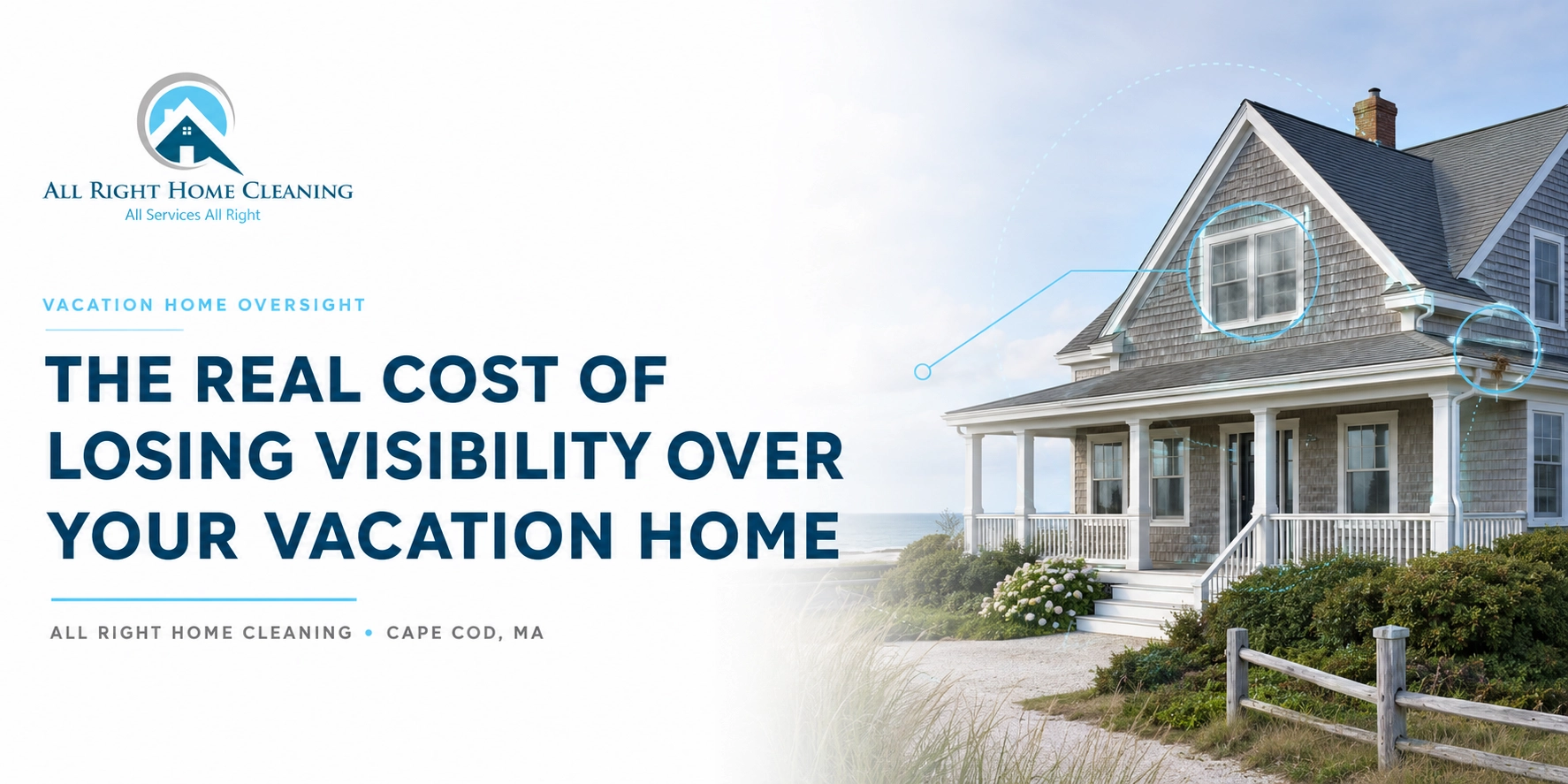
For many owners, especially those living in Boston, New York, Connecticut, or New Jersey, a Cape Cod home represents far more than real estate. It represents family memories, financial investment, seasonal traditions, and personal achievement. Yet every day the property sits empty, visibility decreases. Dust accumulates. Humidity affects indoor spaces. Salt air settles on surfaces. Minor maintenance concerns remain unseen. Cleaning standards become impossible to verify.
This is why a Deep Cleaning Service in Cape Cod, MA is often only one part of the solution. The larger challenge is maintaining awareness, control, and confidence while living hundreds of miles away. That is where Professional Cleaning Services, property readiness systems, inspections, communication protocols, and ongoing property care cape cod strategies become essential.
The goal is not simply cleaning a house.
The goal is keeping your home ready year round while preserving visibility over one of your most valuable assets.
Why Visibility Matters More Than Most Vacation Homeowners Realize
Most homeowners think about maintenance in terms of physical problems.
They think about:
- Dirt
- Dust
- Mold
- Repairs
- Wear and tear
- Cleaning requirements
The problem is that none of these issues become expensive because they exist.
They become expensive because they remain unseen.
Visibility is the mechanism that allows a homeowner to identify changing conditions before they become disruptions.
Without visibility, a property owner is forced to rely on assumptions.
Questions begin to emerge:
- Is the house actually ready?
- Did the cleaning visit happen as expected?
- Has humidity affected any rooms?
- Is there dust buildup in neglected areas?
- Have small issues appeared since the last visit?
- Will the property be ready when family arrives?
Every unanswered question increases uncertainty.
For seasonal homeowners, uncertainty becomes one of the largest hidden ownership costs.
The dominant Cape Cod homeowner profile is not looking for the cheapest cleaning company. They are looking for confidence, consistency, trust, and control over a property they cannot physically monitor every day.
What Does “Losing Visibility” Actually Mean?
Losing visibility does not mean losing access to your home.
It means losing awareness of its true condition.
A homeowner may know:
- The doors are locked.
- Utilities are functioning.
- The property is secure.
Yet still have no reliable understanding of:
- Cleanliness standards
- Indoor conditions
- Readiness status
- Property presentation
- Emerging concerns
Visibility is the difference between:
“I think everything is fine.”
and
“I know exactly what condition the property is in.”
That distinction becomes critical for second homes and vacation properties because the owner is not present to observe gradual changes.
Unlike a primary residence, there is no daily feedback loop.
Nobody notices:
- Dust collecting on surfaces
- Air becoming stale
- Moisture lingering in bathrooms
- Sand accumulating near entrances
- Cleaning inconsistencies
- Minor property deterioration
The property continues changing.
The homeowner simply stops seeing those changes.
Why Cape Cod Vacation Homes Face a Unique Visibility Problem
Not every market experiences the same challenges.
Cape Cod introduces environmental variables that increase the importance of property awareness.
Coastal Air Never Stops Affecting the Property
Even when the house is empty, the environment remains active.
Common influences include:
- Salt air exposure
- Humidity fluctuations
- Airborne sand particles
- Seasonal weather patterns
- Limited airflow
- Moisture retention
These conditions create an environment where a property can appear stable while slowly developing issues.
The homeowner often discovers the problem only after arriving.
Seasonal Occupancy Creates Long Gaps Between Observations
A primary residence benefits from daily attention.
A vacation home does not.
Many Cape Cod properties remain empty for:
- Several weeks
- Entire months
- Off season periods
- Winter intervals
During those gaps, visibility declines.
The longer the absence, the larger the information gap becomes.
Emotional Attachment Magnifies Risk
A vacation home is rarely viewed as a simple asset.
For many owners it represents:
- Family traditions
- Personal achievement
- Generational memories
- Lifestyle goals
- Long term investment
When uncertainty affects a property with emotional significance, the stress becomes much greater.
The homeowner is not just protecting a building.
The homeowner is protecting an experience.
This aligns directly with the dominant seasonal homeowner persona, whose primary concern is not dirt itself but the loss of confidence and control over the property’s condition.
The Hidden Costs Most Homeowners Never Calculate
When homeowners think about property expenses, they typically calculate visible costs.
Examples include:
- Mortgage payments
- Insurance
- Property taxes
- Utility bills
- Cleaning services
- Maintenance contracts
The visibility problem creates a completely different category of costs.
Cost #1: Lost Vacation Time
This is often the most overlooked expense.
Many families spend months planning a Cape Cod getaway.
Then arrival day becomes a troubleshooting session.
Instead of relaxing, they spend time:
- Cleaning overlooked areas
- Addressing odors
- Fixing preparation issues
- Managing service providers
- Solving preventable problems
The financial value of those lost hours is rarely measured.
The emotional value is even larger.
Cost #2: Delayed Problem Discovery
Many issues become expensive because they remain undiscovered.
Examples include:
| Early Discovery | Delayed Discovery |
| Minor moisture concern | Larger moisture damage |
| Small dust buildup | Whole home restoration cleaning |
| Localized odor issue | Widespread indoor air quality concern |
| Minor maintenance need | Larger repair requirement |
| Small cleaning inconsistency | Significant readiness failure |
The longer a problem remains invisible, the greater the likelihood that correction costs increase.
Cost #3: Property Readiness Failures
Many owners assume readiness and cleanliness are the same thing.
They are not.
A clean house may still be unprepared.
Examples include:
- Missing linens
- Unstocked essentials
- Unverified guest areas
- Overlooked rooms
- Incomplete preparation
Readiness determines whether the arrival experience feels effortless.
Cost #4: Decision Making Based on Assumptions
Poor visibility creates poor information.
Poor information creates poor decisions.
Homeowners may:
- Delay needed services
- Overpay for emergency corrections
- Misjudge property conditions
- Schedule work at the wrong time
The result is unnecessary expense and frustration.
Why Most Homeowners Focus on the Wrong Problem
The majority of vacation homeowners believe their challenge is cleaning.
The actual challenge is visibility.
Cleaning is simply one of the tools used to maintain visibility.
Consider two scenarios.
Scenario A
The home receives a deep cleaning.
No inspection occurs.
No communication follows.
No readiness confirmation exists.
The homeowner remains uncertain.
Scenario B
The home receives a deep cleaning.
The property is inspected.
Conditions are verified.
Completion is documented.
The homeowner receives confirmation.
The homeowner feels informed and in control.
The cleaning quality may be identical.
The ownership experience is completely different.
This distinction is important because the true value of a Deep Cleaning Service in Cape Cod, MA is not only cleaner surfaces.
It is the restoration of awareness.
Why Visibility Is Becoming More Valuable Than Cleaning Alone
Historically, homeowners purchased cleaning services.
Today, many seasonal property owners are purchasing something larger:
Property Readiness.
Property readiness combines:
- Cleanliness
- Inspection
- Verification
- Communication
- Consistency
- Preparation
The homeowner is not asking:
“Did someone vacuum the living room?”
The homeowner is asking:
“Can I arrive next Friday and trust that everything is exactly as expected?”
That shift changes how vacation home ownership should be viewed.
The most valuable outcome is no longer cleanliness alone.
The most valuable outcome is confidence.
Confidence comes from visibility.
Visibility comes from process.
Process creates predictability.
Predictability creates peace of mind.
Why This Topic Matters More Than Ever
The ownership model for seasonal homes has changed dramatically.
Many owners now live farther away from their properties.
Many use the homes less frequently.
Many rely on third parties for access, maintenance, cleaning, and preparation.
As distance increases, visibility becomes more important.
As visibility decreases, risk increases.
That relationship explains why more homeowners are investing in structured property care cape cod systems designed to maintain awareness between visits.
Because ultimately, the greatest threat to a vacation home is not always what is happening inside the property.
It is what is happening that nobody sees.
Why Cape Cod Vacation Homes Lose Visibility Faster Than Primary Residences
A primary residence benefits from daily observation. Someone notices dust on a table, a musty smell in a hallway, a leaking faucet, or an unusual sound from an appliance. A vacation home often goes weeks or months without that layer of human awareness.
This creates what can be called the visibility gap.
The visibility gap is the period between when a condition appears and when someone discovers it.
For seasonal homeowners, that gap can become surprisingly expensive because several environmental factors in Cape Cod continue affecting the property even when nobody is present.
Coastal Conditions Never Pause
Many owners assume that a closed home remains unchanged until the next visit.
In reality, the property continues interacting with its environment every day.
Common influences include:
- Humidity
- Salt air exposure
- Airborne particles
- Sand accumulation
- Temperature fluctuations
- Limited ventilation
- Seasonal weather patterns
These factors help explain why many homeowners arrive expecting a ready property and instead spend valuable vacation time addressing preventable issues.
Why Salt Air Creates Hidden Maintenance Challenges
One of the least discussed realities of coastal ownership is the cumulative effect of airborne salt particles.
Salt carried by ocean air can settle on:
- Windows
- Door hardware
- Light fixtures
- Exterior surfaces
- Metal components
- Glass panels
- Outdoor furniture
Over time, these deposits contribute to deterioration, staining, and increased maintenance requirements.
This does not mean every property experiences severe damage. It means that coastal homes typically require a more proactive maintenance strategy than inland homes.
That reality is one reason many owners invest in Professional Cleaning Services that understand the specific conditions affecting seasonal coastal properties.
Why Dust Behaves Differently in Vacant Homes
Most people think dust is merely a cosmetic problem.
In reality, dust accumulation can affect:
- Indoor air quality
- HVAC performance
- Surface appearance
- Furniture condition
- Guest perception
- Cleaning labor requirements
In occupied homes, regular activity often leads to frequent cleaning and quicker identification of buildup.
In vacant homes, dust can settle uninterrupted for extended periods.
Areas commonly overlooked include:
- Ceiling fan blades
- Air vents
- Window tracks
- Baseboards
- Closet shelving
- Behind furniture
- Under beds
- Cabinet tops
The longer these areas remain untreated, the more extensive the restoration effort becomes.
How Moisture Reduces Property Readiness
Moisture may be the most underestimated threat facing seasonal homes.
Even when there is no visible water intrusion, elevated humidity levels can contribute to:
- Musty odors
- Damp surfaces
- Mildew development
- Fabric odor retention
- Reduced indoor comfort
The challenge is that these conditions often develop gradually.
A homeowner visiting every weekend may notice changes early.
A homeowner arriving after two months may encounter the problem only after it has become obvious.
That difference illustrates why visibility matters more than cleaning frequency alone.
The Hidden Financial Cost of Delayed Awareness
Many homeowners focus exclusively on service pricing.
A more important question is:
What is the cost of discovering a problem too late?
The answer varies by property, but the pattern remains remarkably consistent.
Direct Costs
These are the expenses homeowners can easily identify.
Examples include:
- Corrective cleaning
- Emergency service visits
- Additional labor
- Rush scheduling fees
- Material replacement
- Odor remediation
- Deep cleaning after prolonged neglect
Indirect Costs
These costs are harder to measure but often larger.
Examples include:
- Lost vacation time
- Stress during arrival
- Family inconvenience
- Reduced guest satisfaction
- Delayed enjoyment of the property
- Increased uncertainty about future visits
Many seasonal homeowners spend thousands of dollars annually maintaining a vacation property while unknowingly sacrificing the one resource they cannot recover:
time.
Comparative Cost Analysis
| Scenario | Immediate Cost | Long Term Impact |
| Early identification | Low | Minimal disruption |
| Delayed identification | Moderate | Increased labor |
| Seasonal neglect | High | Significant corrective work |
| Repeated visibility failures | Very High | Ongoing uncertainty and escalating maintenance |
The financial lesson is simple:
Problems are usually cheapest when discovered early.
Visibility increases the probability of early discovery.
Why Most Cleaning Services Fail to Solve the Visibility Problem
Many companies focus entirely on cleaning tasks.
They advertise:
- Vacuuming
- Dusting
- Mopping
- Surface cleaning
- Bathroom cleaning
- Kitchen cleaning
Those tasks matter.
However, they do not automatically provide visibility.
The Difference Between Activity and Verification
A homeowner cannot see a completed task from another state.
The homeowner can only see evidence.
That evidence often comes from:
- Inspection procedures
- Verification protocols
- Consistent standards
- Communication systems
- Completion reporting
Without these elements, uncertainty remains.
The homeowner still wonders:
- Was everything completed?
- Were any issues discovered?
- Is the home truly ready?
- Should I expect surprises?
These questions explain why trust becomes more important than price for seasonal homeowners.
Research conducted throughout the project framework consistently shows that the core concern is not cleaning quality alone.
The deeper concern is risk reduction, predictability, and confidence in the property’s condition while the owner is away.
Signs You Are Losing Visibility Over Your Vacation Home
Many homeowners do not realize visibility is declining until a larger issue emerges.
Common warning signs include:
1. You Only Learn About Problems When You Arrive
If every visit reveals a surprise, visibility is already compromised.
Examples:
- Unexpected odors
- Dust accumulation
- Missing preparation tasks
- Unfinished cleaning work
The issue is not the surprise itself.
The issue is that nobody informed you beforehand.
2. You Have No Standardized Cleaning Process
A property without documented standards relies entirely on memory and individual interpretation.
This often creates:
- Inconsistent results
- Missed tasks
- Different outcomes every visit
Consistency requires process.
Process creates predictability.
Predictability creates trust.
3. You Cannot Verify What Was Completed
A completed service should reduce uncertainty.
If the homeowner still has questions afterward, communication may be insufficient.
4. The Property Feels Different Every Time You Arrive
This is one of the strongest indicators of poor visibility.
Examples include:
- Different cleanliness levels
- Different preparation quality
- Different room conditions
- Different standards
Consistency is one of the strongest indicators that a property care system is functioning properly.
5. You Depend on Luck More Than Process
When homeowners say:
“Hopefully everything is okay.”
They are often relying on hope rather than visibility.
Hope is not a property management strategy.
Verification is.
Why Property Readiness Is Becoming More Important Than Cleaning Alone
The market is slowly changing.
Historically, homeowners purchased cleaning services.
Today, many seasonal homeowners are looking for something broader:
Property Readiness.
Property readiness includes:
- Cleanliness
- Inspection
- Verification
- Communication
- Preparation
- Consistency
- Arrival readiness
The objective is not simply removing dirt.
The objective is ensuring the home supports a smooth arrival experience.
This aligns directly with the mindset of Cape Cod vacation homeowners who value peace of mind, predictability, trust, and remote visibility over bargain pricing.
The strongest property care cape cod strategies focus on maintaining awareness between visits rather than reacting after problems become obvious.
For many seasonal homeowners, that shift represents the difference between managing a property and merely cleaning one.
How Smart Vacation Home Owners Maintain Visibility Without Living in Cape Cod
The most successful seasonal homeowners do not try to manage every detail personally.
They build systems that create visibility, accountability, and consistency.
This is the fundamental difference between reactive ownership and proactive ownership.
Reactive ownership discovers problems after they become visible.
Proactive ownership creates processes that reveal conditions before they become disruptive.
For owners of Cape Cod vacation homes, the goal is not constant monitoring.
The goal is maintaining confidence that the property remains ready, protected, and aligned with expectations throughout the year.
The Five Layers of Property Visibility
Most homeowners think visibility is a single thing.
In reality, it consists of several interconnected layers.
If one layer fails, uncertainty begins to increase.
Layer 1: Physical Visibility
Physical visibility means understanding the actual condition of the property.
This includes:
- Surface cleanliness
- Dust levels
- Odor conditions
- Bathroom readiness
- Kitchen readiness
- Flooring condition
- Linen condition
- General presentation
Without physical visibility, the owner cannot accurately assess readiness.
Layer 2: Operational Visibility
Operational visibility answers a different question:
Did the service actually happen as expected?
This involves:
- Completed checklists
- Scheduled visits
- Scope verification
- Service documentation
- Quality review procedures
Many service failures occur not because nobody cleaned.
They occur because nobody confirmed what was completed.
Layer 3: Environmental Visibility
Environmental visibility focuses on conditions that continue evolving while the home is empty.
Examples include:
- Humidity
- Dust accumulation
- Air quality
- Moisture exposure
- Seasonal changes
- Coastal environmental impact
This category becomes increasingly important in coastal regions where homes may remain vacant for extended periods.
Layer 4: Security Visibility
Security visibility helps homeowners maintain confidence regarding access.
Questions include:
- Who entered the property?
- When did they enter?
- Why did they enter?
- Was the property secured afterward?
- Were access procedures followed?
For many seasonal homeowners, this category carries as much emotional weight as cleanliness itself.
Layer 5: Communication Visibility
Communication visibility answers the most important ownership question:
What do I know about my property right now?
Without communication, every other layer becomes less valuable.
A perfectly cleaned property still creates uncertainty if the owner receives no information.
Why Trust Is Built Through Process Rather Than Promises
Many cleaning companies focus their marketing on outcomes.
They promise:
- Better cleaning
- Superior service
- Exceptional results
- Outstanding quality
The challenge is that these statements are difficult to verify before hiring.
Trust develops differently.
Trust develops through process.
Characteristics of Process Based Trust
| Promise Based Trust | Process Based Trust |
| Relies on marketing language | Relies on documented procedures |
| Difficult to verify | Easy to verify |
| Subjective | Observable |
| Depends on belief | Depends on evidence |
| Creates expectations | Creates confidence |
For example:
Saying,
“We provide excellent service.”
creates an expectation.
Saying,
“Every visit follows a documented room by room checklist with final verification before departure.”
creates confidence.
The second statement explains how the outcome is achieved.
That distinction matters significantly for vacation homeowners who are often hundreds of miles away from their property.
The Relationship Between Deep Cleaning and Property Visibility
A common misconception is that a deep cleaning service automatically creates visibility.
It does not.
A Deep Cleaning Service in Cape Cod, MA restores areas that have accumulated dust, dirt, residue, moisture effects, and other signs of extended occupancy or vacancy.
Visibility comes from what happens before, during, and after that service.
What Deep Cleaning Solves
Deep cleaning typically addresses:
- Built up dust
- Hidden dirt
- Detailed bathroom cleaning
- Kitchen detailing
- Baseboards
- Window tracks
- Ceiling fans
- Cabinet surfaces
- Appliance detailing
- Hard to reach areas
What Visibility Solves
Visibility addresses:
- Confidence
- Verification
- Readiness
- Communication
- Predictability
- Ongoing awareness
The strongest ownership strategy combines both.
Deep cleaning restores.
Visibility maintains.
This is one reason Professional Cleaning Services that understand vacation homes often focus on inspection, preparation, and communication rather than cleaning tasks alone.
The Cost of Arrival Day Problems
Most homeowners underestimate the value of arrival day.
Arrival day sets the tone for the entire stay.
When something goes wrong immediately after arriving, the emotional impact is disproportionately large.
Common Arrival Day Frustrations
Examples include:
- Musty smells
- Dust on visible surfaces
- Unwashed linens
- Dirty refrigerators
- Sand accumulation
- Missed cleaning tasks
- Incomplete preparation
These issues often require only a few hours to fix.
Yet they can negatively affect the first one or two days of a trip that may have been planned for months.
The Hidden Vacation Tax
Many homeowners unknowingly pay what can be called a visibility tax.
This includes:
- Time spent checking rooms
- Time spent correcting mistakes
- Time spent purchasing supplies
- Time spent contacting service providers
- Time spent worrying about the property
The homeowner owns a vacation home to enjoy leisure time.
Every hour spent solving preventable readiness problems reduces the value of that ownership experience.
Why Property Readiness Is Becoming a Competitive Advantage
Historically, homeowners compared providers based on cleaning services alone.
Today, the comparison is changing.
Many homeowners increasingly evaluate providers based on:
- Reliability
- Communication
- Trust
- Consistency
- Documentation
- Readiness
- Visibility
The reason is simple.
The homeowner does not experience the cleaning process.
The homeowner experiences the result.
The result is not merely a clean countertop.
The result is confidence that the property is prepared before arrival.
Cleaning Versus Property Readiness
| Cleaning Focus | Property Readiness Focus |
| Removes dirt | Supports arrival experience |
| Task oriented | Outcome oriented |
| Measures activity | Measures preparedness |
| Ends when cleaning ends | Ends when readiness is confirmed |
| Focuses on appearance | Focuses on confidence |
This shift is especially relevant for seasonal properties because readiness directly affects the owner’s experience.
A clean home that is not prepared still creates friction.
A prepared home creates confidence from the moment the owner opens the door.
The Ownership Blind Spot Most Homeowners Never Address
One of the most overlooked risks in vacation home ownership is assuming that absence equals stability.
Many owners believe:
“Nothing is happening because nobody is there.”
In reality, the opposite is often true.
Properties continue evolving every day.
Dust accumulates.
Moisture moves.
Air circulates.
Materials age.
Environmental conditions change.
Cleaning standards drift.
Small issues develop.
The owner’s visibility decreases with every week spent away from the property.
This is why the most successful seasonal homeowners focus on keeping your home ready year round rather than preparing only for major arrivals.
Waiting until the week before arrival often means reacting to accumulated conditions instead of preventing them.
Advantages and Disadvantages of a Visibility Driven Property Care Strategy
Advantages
- Better property readiness
- Reduced surprises
- Earlier issue identification
- More predictable arrival experiences
- Stronger trust in service providers
- Improved long term property preservation
- Greater confidence from a distance
These advantages compound over time because visibility supports better decision making.
Potential Disadvantages
- More structured processes
- Additional communication requirements
- Greater emphasis on documentation
- Higher expectations for consistency
These disadvantages are operational rather than financial.
Most homeowners who prioritize confidence and predictability view them as worthwhile tradeoffs.
Comparative Analysis
| Visibility Driven Approach | Reactive Approach |
| Problems identified earlier | Problems discovered later |
| Greater predictability | Frequent surprises |
| Higher confidence | Higher uncertainty |
| Better arrival experiences | More arrival day stress |
| Stronger long term maintenance | Increased corrective work |
The real comparison is not between cleaning and no cleaning.
It is between awareness and uncertainty.
For seasonal homeowners, awareness almost always proves less expensive.
Why Property Care Is Becoming More Important Than Cleaning Categories
The cleaning industry often separates services into categories:
- Deep Cleaning
- Standard Cleaning
- Recurring Cleaning
- Move In Cleaning
- Move Out Cleaning
Those categories remain useful.
However, many homeowners increasingly think in terms of outcomes.
They want:
- Home readiness
- Property protection
- Predictability
- Visibility
- Peace of mind
This is why property care cape cod is becoming a more meaningful concept than cleaning alone.
The owner wants confidence that the home is protected between visits.
The owner wants assurance that the property remains aligned with expectations.
Most importantly, the owner wants the home to support family experiences rather than create additional responsibilities.
When viewed through that lens, keeping your home ready year round becomes less about housekeeping and more about preserving the value, usability, and enjoyment of an important asset.
Building a Year Round Visibility System for Your Cape Cod Vacation Home
The homeowners who experience the fewest surprises are not necessarily the homeowners who spend the most money.
They are the homeowners who establish systems that reduce uncertainty.
A visibility system does not require constant monitoring.
It requires consistent awareness.
The objective is to ensure that important information reaches the homeowner before minor issues become major frustrations.
For owners of seasonal properties, visibility is one of the most valuable forms of preventive maintenance.
What Should a Vacation Home Visibility System Include?
An effective visibility framework combines several operational elements working together.
Essential Components
- Property inspections
- Scheduled cleaning visits
- Readiness verification
- Consistent cleaning standards
- Communication protocols
- Access security procedures
- Seasonal preparation plans
Each component serves a specific purpose.
Cleaning maintains standards.
Inspection identifies visible concerns.
Communication creates awareness.
Verification confirms readiness.
Together, they help reduce the uncertainty that often develops when properties remain empty for long periods.
The Annual Visibility Calendar for Cape Cod Vacation Homes
Many homeowners focus only on arrival dates.
A more effective strategy considers the entire annual ownership cycle.
Spring Preparation
Spring is often the most important period for seasonal properties.
Key priorities include:
- Deep cleaning
- Dust removal
- Moisture assessment
- Seasonal readiness
- Window and surface detailing
- Bathroom preparation
- Kitchen preparation
A Deep Cleaning Service in Cape Cod, MA is frequently scheduled during this period because homes may have remained largely unused during colder months.
Summer Occupancy
During peak season, priorities shift toward maintaining standards.
Typical focus areas include:
- Recurring cleaning
- Guest readiness
- Linen management
- Kitchen upkeep
- Bathroom maintenance
- Surface sanitation
The objective is to prevent minor issues from accumulating during periods of heavier use.
Fall Transition
As occupancy declines, homeowners often prepare properties for reduced usage.
Common priorities include:
- Detailed cleaning
- Property inspection
- Inventory review
- Seasonal maintenance planning
Winter Monitoring
Winter often creates the largest visibility gap.
Many owners spend extended periods away from the property.
This increases the importance of:
- Communication
- Verification
- Inspection awareness
- Property condition visibility
The goal is maintaining confidence even when the owner is not physically present.
Questions Every Vacation Home Owner Should Ask
Before hiring any cleaning provider, homeowners should evaluate more than cleaning tasks.
Important questions include:
About Process
- Is there a documented checklist?
- How is quality verified?
- Is there a final inspection process?
- How are unusual conditions reported?
About Communication
- How will I know the work was completed?
- Will I receive updates?
- How are concerns communicated?
- Who is my point of contact?
About Consistency
- Are standards documented?
- How is consistency maintained?
- What happens if something is missed?
About Security
- How is property access managed?
- Are entry procedures documented?
- What safeguards exist for homeowner trust?
The answers to these questions often reveal more about long term reliability than pricing alone.
Why Cheap Cleaning Can Become Expensive Ownership
Price matters.
However, focusing exclusively on price often creates unintended consequences.
Lower Cost Services May Result In
- Inconsistent execution
- Minimal communication
- Limited accountability
- Reduced verification
- Higher uncertainty
Higher Value Services Often Emphasize
- Process
- Consistency
- Verification
- Communication
- Property readiness
This does not mean expensive services are automatically better.
It means homeowners should evaluate the complete ownership impact rather than comparing rates alone.
Cost Comparison Framework
| Decision Factor | Short Term Thinking | Long Term Thinking |
| Price | Lowest quote | Total ownership value |
| Cleaning | Basic tasks | Readiness and consistency |
| Communication | Minimal updates | Ongoing visibility |
| Trust | Assumed | Verified |
| Property Condition | Reactive | Preventive |
For many seasonal homeowners, the most expensive option is not paying more for service.
The most expensive option is discovering preventable problems too late.
How Visibility Supports Property Value Over Time
A vacation home is more than a place to stay.
It is also a financial asset.
Protecting that asset requires awareness.
Visibility contributes to:
- Better maintenance decisions
- Earlier issue identification
- Reduced neglect
- Stronger property presentation
- Improved guest readiness
- Better ownership experience
A homeowner who understands the condition of the property can make better decisions than one relying on assumptions.
That principle applies whether the property is a modest seasonal residence or a luxury coastal home.
The Future of Vacation Home Ownership
Vacation home ownership is becoming increasingly data driven.
Homeowners want more than completed work.
They want clarity.
Emerging expectations increasingly include:
- Property visibility
- Inspection reporting
- Verification systems
- Readiness confirmation
- Remote awareness
The trend is moving away from transactional cleaning and toward comprehensive property readiness.
This evolution reflects how homeowners actually think.
Most owners are not worried about whether a cleaner used a specific product on a countertop.
They are worried about whether the home will be ready when they arrive.
That distinction changes everything.
Common Myths About Vacation Home Maintenance
Myth 1: If Nobody Is Using The House, Nothing Is Happening
Reality:
Environmental conditions continue affecting the property every day.
Myth 2: Deep Cleaning Solves Everything
Reality:
Deep cleaning restores condition.
Visibility maintains awareness.
Both are important.
Myth 3: Problems Become Obvious Immediately
Reality:
Many issues develop gradually and remain unnoticed for extended periods.
Myth 4: Price Is The Most Important Factor
Reality:
For most seasonal homeowners, trust, consistency, communication, and predictability influence decisions more heavily than price.
Myth 5: Cleaning And Property Care Are The Same Thing
Reality:
Cleaning is one component of property care.
Property care includes readiness, inspection, communication, visibility, and confidence.
Practical Visibility Checklist for Seasonal Homeowners
Use this checklist before each arrival season.
Property Readiness Review
- Confirm deep cleaning needs
- Verify bathrooms and kitchens
- Inspect visible moisture concerns
- Check dust accumulation areas
- Confirm linen readiness
- Review guest areas
- Verify property access procedures
Visibility Review
- Confirm communication expectations
- Verify inspection procedures
- Establish readiness confirmation methods
- Review service standards
- Clarify reporting expectations
Ownership Review
- Evaluate recurring service needs
- Review seasonal maintenance priorities
- Assess property readiness goals
- Identify high risk areas
This approach supports both property care cape cod objectives and long term ownership confidence.
More importantly, it supports keeping your home ready year round, reducing the likelihood that arrival day becomes a troubleshooting exercise.
Final Thoughts
The real cost of losing visibility over a vacation home rarely appears as a single invoice.
It appears through accumulated uncertainty.
It appears when homeowners spend vacation time solving preventable problems.
It appears when small issues remain hidden long enough to become larger issues.
It appears when trust is replaced by guesswork.
For seasonal homeowners, visibility is not a luxury.
It is one of the most practical forms of property protection available.
A well maintained home is valuable.
A well understood home is even more valuable.
That is why the most effective Deep Cleaning Service in Cape Cod, MA strategies focus on more than cleanliness alone. They support readiness, communication, verification, and confidence. Combined with reliable Professional Cleaning Services, they help transform an empty property from a source of uncertainty into a home that feels prepared every time the owner arrives.
Frequently Asked Questions
- What is the real cost of losing visibility over a vacation home?
The real cost includes more than cleaning expenses. It can involve delayed repairs, property deterioration, arrival day disruptions, lost vacation time, reduced comfort, increased stress, and lower confidence in the property’s condition.
- Why do vacation homes lose visibility faster than primary residences?
Primary residences benefit from daily observation. Vacation homes often remain empty for weeks or months, increasing the time between when a problem develops and when someone notices it.
- How does a Deep Cleaning Service in Cape Cod, MA help improve visibility?
A Deep Cleaning Service in Cape Cod, MA restores areas affected by dust buildup, moisture, residue, and seasonal neglect. When combined with inspections and communication, it also supports better awareness of property conditions.
- What are the biggest risks facing empty homes in Cape Cod?
Common concerns include dust accumulation, humidity, musty odors, mildew, salt air exposure, sand buildup, pest activity, indoor air quality issues, and general property deterioration.
- What is property readiness?
Property readiness refers to the overall condition of a home before owner or guest arrival. It includes cleanliness, inspection, preparation, verification, communication, and confidence that the property meets expectations.
- How often should a vacation home be professionally cleaned?
The ideal frequency depends on occupancy, location, environmental exposure, and homeowner expectations. Many seasonal homeowners combine periodic deep cleaning with recurring maintenance visits.
- Why is communication important in vacation home care?
Communication helps owners maintain visibility while away. Updates, confirmations, inspections, and readiness notifications reduce uncertainty and improve decision making.
- Are Professional Cleaning Services enough to protect a vacation home?
Cleaning is important, but it works best when combined with inspection, readiness verification, communication, and consistent operational standards.
- What should homeowners look for when hiring a cleaning company?
Homeowners should evaluate trustworthiness, consistency, communication, documented processes, inspection procedures, insurance coverage, reputation, and experience with vacation properties.
- How can homeowners support keeping your home ready year round?
The most effective approach includes scheduled maintenance, periodic deep cleaning, property inspections, seasonal preparation, communication protocols, and a visibility focused property care strategy.