Choosing between deep cleaning and regular cleaning comes down to one question most homeowners in Cape Cod never ask correctly: is your home being maintained or recovered? One protects the standard you already have. The other restores what time, absence, salt air, and humidity quietly took away.
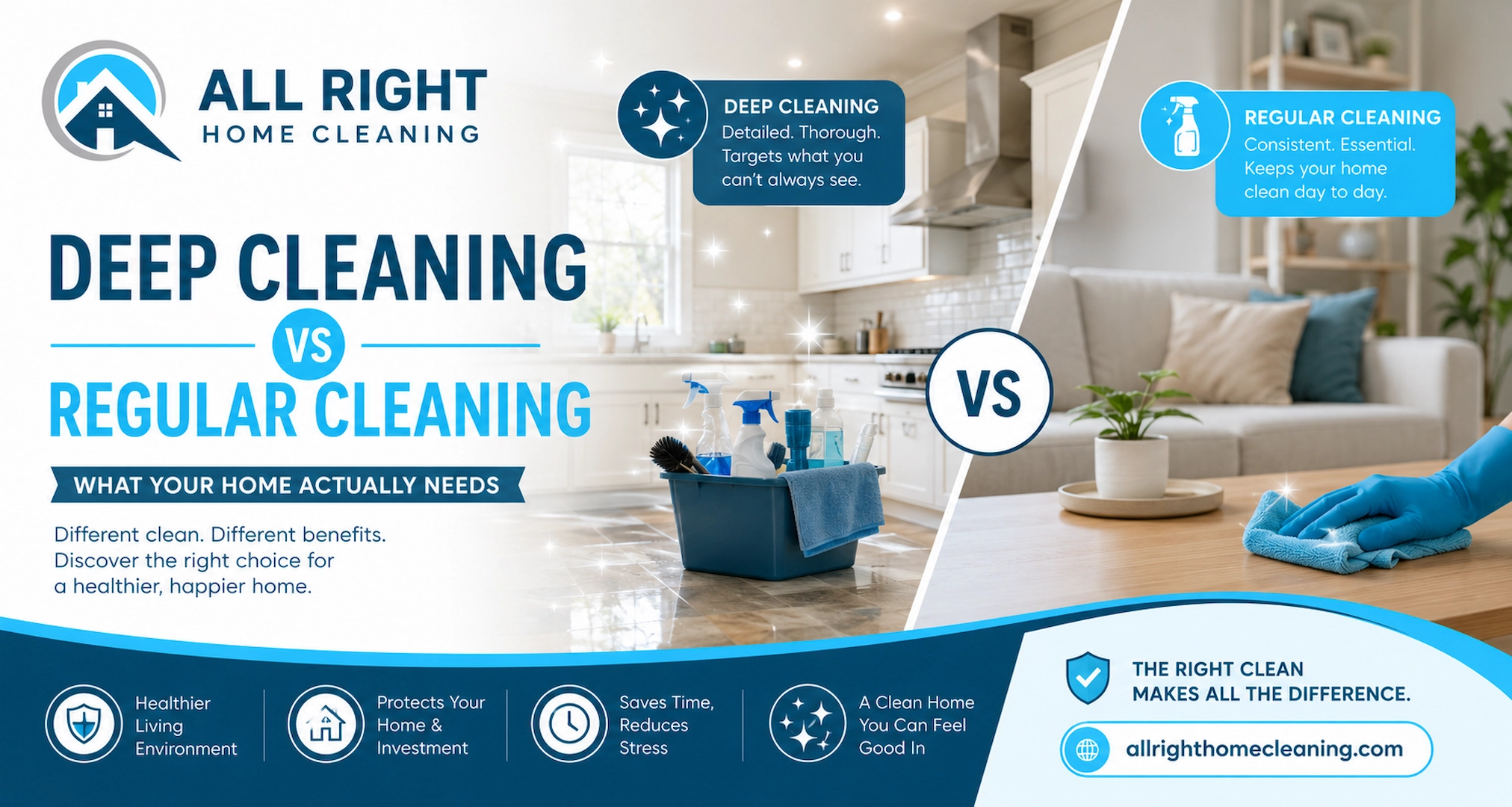
Your home needs regular cleaning when the goal is to maintain a consistent standard week after week, and it needs deep cleaning when the goal is to reset accumulated buildup that surface cleaning cannot reach. Both serve different purposes, both belong in a healthy home care plan, and neither replaces the other.
Regular cleaning is the rhythm that keeps your property predictable. It handles visible dust, kitchen surfaces, bathrooms, floors, trash, and the everyday wear of a lived-in space. It is what most Cape Cod homeowners book on a weekly or biweekly basis, especially those who travel, host guests, or split time between properties.
Deep cleaning is the reset. It reaches grout lines, baseboards, behind appliances, ceiling fans, vents, inside cabinets, and the layers a standard visit intentionally skips for time efficiency. It is what your home needs after winter, before a season opens, after long vacancies, or when a new residential cleaning services in cape cod provider starts caring for the property.
The honest answer for most homeowners is both: a deep cleaning at the start to reset baseline, followed by regular cleaning to protect that baseline. Skipping the reset means paying a maintenance crew to manage problems they were never scoped to solve. Skipping the recurrence means watching a freshly deep-cleaned home slide back into disorder within weeks.
If your Cleaning Services Company in Cape Cod, MA is doing it right, they will tell you exactly which one your home needs today, and why.
The Real Difference Between Deep Cleaning and Regular Cleaning
Most homeowners think the difference between deep cleaning and regular cleaning is about how hard the team works. It is not. The real difference is about what each service is scoped to solve. A regular visit is built to protect a standard already in place. A deep visit is built to restore a standard that has been lost over time. One is preservation. The other is recovery. Confusing the two is the most common reason Cape Cod homeowners feel disappointed with cleaning providers, especially when the property sits empty for weeks between visits.
When you understand this distinction, the question stops being “which is better” and becomes “which one does my home need right now”. That single shift saves money, time, and the frustration of paying for the wrong service at the wrong moment.
What Regular Cleaning Actually Covers in a Home
Regular cleaning is the visible layer of home care. It addresses what a household generates between visits: dust, fingerprints, soap residue, kitchen spills, bathroom moisture, floors that absorbed everyday traffic, trash, and surfaces that need to look and feel reset for the next few days. It is the rhythm of maintenance, not the act of restoration.
A standard residential cleaning visit in Cape Cod typically includes the following operational scope:
- Dusting of accessible surfaces, shelves, furniture tops, and electronics
- Vacuuming carpets, rugs, and upholstered furniture in main rooms
- Sweeping and mopping hard floors throughout the home
- Sanitizing kitchen countertops, sinks, stovetop exterior, and microwave interior
- Cleaning bathroom sinks, toilets, tubs, showers, and mirrors
- Emptying trash and replacing liners
- Making beds and tidying common areas
- Wiping down door handles, light switches, and frequently touched surfaces
Notice what is not in this scope: behind appliances, inside cabinets, baseboards in every room, ceiling fans, vent covers, grout scrubbing, light fixtures, window tracks, and interior glass beyond mirrors. That is intentional. A regular visit has a defined time window, usually two to four hours depending on home size, and it is engineered to deliver consistency, not depth.
For homeowners who already have a baseline standard and want it preserved, this is the right service. For homes that have drifted from that baseline, it will feel like a band-aid.
What Deep Cleaning Reaches That Standard Visits Cannot
Deep cleaning is the recovery service. It assumes accumulated buildup, neglected corners, mineral deposits, soap scum, dust nesting in low-traffic spots, and surfaces that have not been touched in weeks or months. It is slower, more methodical, and intentionally exhaustive.
A professional deep cleaning scope typically includes everything in a regular visit, plus the following:
- Hand-wiping baseboards and door frames throughout the home
- Detailed scrubbing of tile grout in kitchens and bathrooms
- Cleaning behind and underneath movable appliances when accessible
- Interior cleaning of the oven, refrigerator, and microwave
- Wiping inside cabinets and drawers on request
- Removing limescale and mineral buildup from faucets and showerheads
- Cleaning ceiling fans, vent covers, and light fixtures
- Spot-cleaning walls and removing scuff marks
- Detailed bathroom restoration including grout, tile, and fixtures
- Window sills, tracks, and interior glass cleaning
- Detailed dusting of decorative items, frames, and high shelves
This is not a longer regular cleaning. It is a different operation entirely, with a different checklist, different products, different time allocation, and often a larger team. A deep cleaning on an average Cape Cod home runs between five and ten hours depending on square footage, condition, and number of bathrooms.
Why These Two Services Are Not Interchangeable
Some homeowners assume that booking regular cleaning often enough will eventually equal a deep cleaning. It will not. Recurrence protects baseline, it does not reach what was never in the regular scope to begin with. Grout does not get scrubbed by accident on a weekly visit. Behind the refrigerator does not get cleaned because the team had extra time. These tasks live in a separate operational category because they require different tools, different positioning, and different time budgets.
The reverse is also true. Booking deep cleaning every visit is operationally wasteful. After a property reaches baseline, repeating a deep clean weekly costs more than it delivers. The right pattern, especially for second home owners managing properties remotely, is to reset once, then maintain consistently. That is exactly why understanding the benefits of recurring cleaning matters as much as understanding when a full reset is overdue.
Side by Side Comparison: Tasks, Frequency, Time, and Cost
A clear comparison answers the question most homeowners avoid asking out loud: am I paying for what my home actually needs, or am I paying for what the cleaning provider was easiest to schedule? The table below organizes the operational reality of both services, so the decision becomes a matter of fit, not guesswork.
Task by Task Breakdown of Each Service
| Operational Dimension | Regular Cleaning | Deep Cleaning |
| Primary Purpose | Maintain existing standard | Reset accumulated buildup |
| Typical Frequency | Weekly, biweekly, monthly | Every 3 to 6 months, or as needed |
| Average Duration | 2 to 4 hours | 5 to 10 hours |
| Team Size | 1 to 2 cleaners | 2 to 4 cleaners |
| Surface Scope | Visible and high-touch areas | Visible, hidden, structural, and detail areas |
| Dusting | Accessible surfaces | All surfaces including high and low zones |
| Floors | Vacuum and mop | Vacuum, mop, edges, corners, under furniture |
| Kitchen Appliances | Exterior wipe down | Interior and exterior including behind |
| Bathrooms | Standard sanitization | Grout, tile, fixtures, limescale removal |
| Baseboards | Quick dust only | Hand wiped throughout the home |
| Cabinets | Exterior wipe | Interior cleaning available |
| Windows | Mirrors only | Interior glass, sills, tracks |
| Ceiling Fans and Vents | Skipped | Included |
| Inside Oven and Fridge | Skipped | Included |
| Walls | Skipped | Spot cleaned |
| Best For | Ongoing property maintenance | First visit, post-winter, pre-season, post-guests |
| Ideal For Cape Cod Homes | Year-round upkeep between guest stays | Start of summer season, end of summer, after long vacancy |
Notice how the two services answer different questions. Regular cleaning answers how do I keep this home consistent. Deep cleaning answers how do I bring this home back to a standard that recurring visits can then protect. For a vacation home that sits empty between bookings or owner visits, both questions matter, and they matter in sequence.
Average Pricing Ranges in Cape Cod and What Drives Cost
Pricing in the Cape Cod cleaning market reflects square footage, condition of the home, number of bathrooms, presence of pets, and whether the visit happens during high season. The numbers below represent typical ranges seen across reliable residential cleaning services in cape cod, not promotional prices from low-tier operators.
| Home Size | Regular Cleaning (per visit) | Deep Cleaning (one-time) |
| Up to 1,200 sq ft | $140 to $190 | $320 to $450 |
| 1,200 to 2,000 sq ft | $180 to $260 | $400 to $620 |
| 2,000 to 3,000 sq ft | $240 to $340 | $560 to $850 |
| 3,000 to 4,500 sq ft | $320 to $480 | $780 to $1,250 |
| Over 4,500 sq ft | Custom quote | Custom quote, often $1,300+ |
These ranges are directional. A home that has been closed for the entire winter, has tile floors with neglected grout, and includes three full bathrooms will sit at the higher end of the deep cleaning range. A well-maintained property with hardwood floors and recent service history will sit closer to the middle.
When a quote comes in dramatically below these ranges, the question to ask is not “why is it so affordable”, it is “what is being skipped to reach that price”. A trustworthy Cleaning Services Company in Cape Cod, MA will explain scope, time allocation, and team size openly. Vague pricing is almost always a signal of inconsistent execution later.
Factors That Increase Your Cleaning Investment
- Square footage of the property, since more space requires more time and more cleaners
- Number of bathrooms, which are the most time-intensive rooms in any home
- Condition of the home at the start of service, especially after long vacancies
- Presence of pets, which adds hair, dander, and surface contact points
- Type of flooring, with tile and natural stone requiring more attention than sealed hardwood
- Frequency of recurring service, since longer gaps between visits create more buildup to address
- Seasonality, with peak summer demand in Cape Cod pushing rates upward
- Accessibility of the property, including parking, stairs, and remote locations
- Add-on requests such as interior windows, inside cabinets, or laundry service
- Special surface care, like marble, quartz, or vintage hardwood that needs specific products
Each of these factors is operational, not promotional. They reflect real time, real labor, and real products. A provider who explains these inputs is selling you a process. A provider who hides them is selling you a guess.
When Your Home Truly Needs a Deep Cleaning
Knowing when to book a deep cleaning is more valuable than knowing what it covers. Most homeowners wait too long, then expect a recurring crew to absorb months of accumulated buildup inside a regular visit window. That mismatch is where disappointment begins. A deep cleaning is not a luxury upgrade, it is a scheduled reset that protects everything you have already invested in the property.
For a second home in Cape Cod, the timing matters even more. The property sits exposed to salt air, humidity swings, long vacancies, and seasonal guest traffic. These forces do not pause because you are not in the house. They keep working, quietly, until someone resets the baseline.
Signals That a Reset Is Overdue
A home tells you it needs a deep cleaning long before it looks dirty. The signs are operational, not cosmetic. The list below covers what reliable cleaning crews look for during initial walkthroughs, and what homeowners often miss because they live with the property too closely or visit it too rarely.
- Grout lines in bathrooms or kitchens have darkened despite weekly mopping
- Soap scum and mineral buildup are visible on shower doors, faucets, and tile
- A faint musty smell appears when the home is opened after a vacancy
- Dust collects quickly after a regular visit, suggesting hidden sources were not addressed
- Baseboards, door frames, and trim show a gray or yellow film
- Ceiling fans, vents, and light fixtures carry visible dust layers
- Kitchen appliances feel sticky on top, behind, or underneath
- Bathroom corners and silicone seals show discoloration or mildew
- Carpets feel flat or smell stale even after vacuuming
- The home has not had a full reset in more than six months
When three or more of these signals appear together, the home is past the point a regular visit can recover. Booking another standard cleaning at that stage is operationally inefficient. The right move is a deep cleaning followed by a return to recurring rhythm.
Seasonal Triggers Specific to Cape Cod Properties
Cape Cod homes face conditions that inland properties do not. The combination of coastal humidity, salt particles in the air, sand carried indoors, and dramatic seasonal vacancy creates a maintenance cycle that benefits from deep cleaning at predictable moments throughout the year.
| Season | What Happens to the Home | Recommended Reset |
| Late Winter to Early Spring | Long vacancy, sealed air, dust settling, possible moisture in low-traffic rooms | Full deep cleaning before reopening for the season |
| Pre-Summer (May to early June) | Property reopens for owner stays and rentals, expectations peak | Deep cleaning to establish baseline before bookings |
| Mid-Summer Transition | High guest turnover, sand and moisture accumulation, intensive use | Mid-season deep cleaning between major booking blocks |
| Post-Season (Late September to October) | Heavy guest traffic ends, home shows wear in bathrooms, kitchens, and floors | Recovery deep cleaning before reduced winter visits |
| Pre-Holiday or Family Visits | Owner expects pristine condition for family or friends | Targeted deep cleaning ahead of arrival dates |
These four to five moments per year are when a deep cleaning earns its return. Outside of these windows, recurring visits are the smarter investment.
Life Events That Demand a Deep Reset Before Routine Returns
Some moments call for a deep cleaning regardless of the calendar. They are operational triggers, not seasonal ones, and they apply to any Cape Cod homeowner managing the property remotely or in person.
- After a long-term renter or seasonal tenant moves out
- Before listing the property for sale or for a new rental cycle
- After a renovation, painting project, or contractor work
- Before hosting a wedding, family reunion, or large gathering
- After a period of more than four months without professional cleaning
- When switching from one cleaning provider to another, to reset the baseline
- After a pest treatment, plumbing event, or any incident that disrupted the home
- Before transitioning the home from winter shutdown to active use
In all of these cases, asking a regular crew to handle the work is asking for the wrong scope. The home needs recovery first, then maintenance.
When Regular Cleaning Is the Smarter Choice
If deep cleaning is the reset, regular cleaning is the protection. It is the service that keeps a home consistent week after week, prevents the slow drift toward disorder, and removes the operational weight of property care from homeowners who are not physically present most of the time. For second home owners in Cape Cod, regular cleaning is not a convenience, it is the infrastructure that keeps the property functional between visits.
The decision to choose regular cleaning over deep cleaning is rarely about effort. It is about timing. Once a home has reached its baseline, recurrence is what defends that baseline against time, weather, and use.
The Maintenance Mindset for Second Home Owners
Homeowners who manage properties from a distance think differently than full-time residents. They are not solving a single cleaning problem, they are managing an ongoing risk. The home is empty, exposed, and judged by guests, family, or the owner during short, high-expectation visits. A surprise on arrival is unacceptable.
The maintenance mindset accepts three operational truths:
- The property is always either improving or declining, there is no neutral state
- Small problems unaddressed become large problems by the next visit
- Consistency, not intensity, is what protects the home long term
This is exactly why the benefits of recurring cleaning become the foundation of any serious property care plan. Recurring service is the only model that catches problems early, maintains predictable standards, and removes the burden of remote inspection from the owner.
How Frequency Protects Your Property Long Term
Frequency is the most underrated variable in home care. A property cleaned weekly does not just look better than one cleaned monthly, it accumulates less wear, requires fewer deep resets per year, and retains higher resale and rental value over time. Frequency compounds.
- Weekly visits prevent buildup before it forms, ideal for actively used or rented homes
- Biweekly visits balance cost and consistency, the most common choice for second homes
- Monthly visits preserve a baseline only when the home is mostly closed and unused
- Quarterly visits are not maintenance, they are spaced-out partial resets that almost always require deep cleaning later
The pattern is consistent. Homes on tighter schedules need fewer deep cleanings per year, fewer emergency interventions, and fewer unpleasant surprises during owner arrivals.
Weekly, Biweekly, Monthly: Which Cadence Fits Your Home
| Cadence | Best For | What It Protects | What It Cannot Replace |
| Weekly | Vacation rentals with frequent turnover, owners present multiple times per month | Daily wear, kitchen and bathroom freshness, guest readiness | Full deep cleaning every 4 to 6 months |
| Biweekly | Second homes used several times per season, low to moderate guest traffic | Dust accumulation, baseline consistency, predictable arrivals | Deep cleaning every 6 months |
| Monthly | Homes mostly closed, with occasional weekend use | Surface freshness, basic upkeep | Deep cleaning every 3 to 4 months |
| Quarterly or Less | Rare visits only, no rental activity | Almost nothing in operational terms | Most regular maintenance tasks, requires frequent deep resets |
The honest reading of this table is that biweekly is the cadence that fits most Cape Cod second homes, especially those with seasonal rental activity. It balances cost, consistency, and the kind of predictability that owners managing the property remotely cannot afford to lose.
The Hidden Cost of Choosing the Wrong One
The most expensive cleaning decision is not picking the more expensive service. It is picking the wrong one for the moment your home is in. Homeowners who treat deep and regular cleaning as interchangeable end up paying twice: once for the service that did not solve the real problem, and again for the recovery that should have happened first.
Why Skipping Deep Cleaning Quietly Damages Your Investment
Skipping deep cleaning does not show its cost immediately. It shows it over months. Grout darkens permanently. Mineral deposits become structural rather than surface-level. Mildew penetrates silicone seals and refuses to leave. Cabinets absorb kitchen grease that no longer wipes clean. Hardwood floors lose their finish in high-traffic zones. None of these problems are solved by booking another regular visit, because none of them were within scope to begin with.
For a Cape Cod second home, the damage compounds faster because the property is exposed to coastal conditions and intermittent occupancy. By the time the owner notices, the cost of restoration is no longer a deep cleaning, it is a renovation. That difference is not measured in hundreds of dollars, it is measured in thousands.
Why Skipping Recurrence Wastes the Deep Cleaning You Paid For
The opposite mistake is just as costly. Booking a single deep cleaning and then waiting months before any follow-up service erases the investment. A freshly deep-cleaned home returns to baseline conditions within four to six weeks in a lived-in property, and within eight to twelve weeks in a closed seasonal home. After that, the buildup begins again, and the cycle restarts at zero.
Recurrence is what preserves the value of a reset. Without it, deep cleaning becomes a recurring emergency expense rather than a strategic decision.
| Scenario | What Actually Happens | Real Cost Over 12 Months |
| Deep cleaning once, no recurrence | Home drifts back to pre-reset condition within 3 months | 2 to 3 emergency deep cleanings, no consistency |
| Recurrence only, no initial deep cleaning | Baseline never reaches acceptable level, complaints accumulate | Constant frustration, eventual provider change, eventual deep clean anyway |
| Deep cleaning plus recurring schedule | Baseline established, then protected | Lower total annual cost, predictable standards, no surprises |
The third pattern is the only one that compounds positively. It is the model that any serious Cleaning Services Company in Cape Cod, MA will recommend for second home owners, not because it sells more visits, but because it protects the home with the least operational waste.
How Professional Crews Approach Each Type of Cleaning
The difference between a professional crew and a generic operator is not the price, it is the process. A reliable team follows the same standard on every visit, documents the work, and removes the need for the homeowner to inspect, supervise, or worry. This is what separates a cleaning service from a property care partner.
The Operational Process Behind a Reliable Visit
Every well-run visit, whether regular or deep, follows a predictable operational arc. The structure below is what professional providers use internally, and what homeowners should expect when working with a serious residential cleaning services in cape cod provider.
- Pre-visit confirmation, including access details, special instructions, and arrival window
- Property walkthrough on arrival, to identify priorities and any condition changes
- Task allocation, with each team member assigned to specific zones
- Top-down execution, starting with high surfaces and finishing with floors
- Internal inspection, performed by the lead cleaner before the team leaves
- Property securing, including locking doors, resetting alarms, and confirming exit
- Post-visit notification, sent to the homeowner with confirmation and notes when needed
This sequence is not optional. It is the operational backbone that produces predictable results across dozens of visits per month. When any of these steps is missing, consistency becomes accident rather than design.
Checklist Standards That Separate Premium Service from Generic Work
A checklist is not a marketing artifact, it is the operational contract between the provider and the home. The deeper the checklist, the more reliable the outcome. Premium operators in Cape Cod work from documented, room-by-room checklists that include task counts in the dozens, not the handful that low-tier operators rely on.
| Standard Element | Generic Cleaning Provider | Premium Cleaning Provider |
| Checklist Format | Verbal or absent | Written, room-by-room, signed off |
| Task Count per Visit | 15 to 30 tasks | 60 to 120+ tasks depending on service type |
| Same Crew Each Visit | Rarely | Standard practice |
| Background-Checked Staff | Often unverified | Always verified |
| Insurance and Bonding | Inconsistent | Fully insured and bonded |
| Post-Visit Communication | None or informal | Documented confirmation, photos when applicable |
| Quality Control | Customer complaints only | Internal inspection plus customer feedback loop |
| Issue Resolution | Slow or defensive | Defined satisfaction process |
The checklist is where trust becomes operational. For homeowners not physically present, this is the single most important document in the relationship.
What to Demand from Any Provider Before Booking
Before signing with any cleaning company, especially when the property will be accessed during your absence, ask for the following in plain terms:
- A written scope of work for both regular and deep cleaning, room by room
- Confirmation of insurance, bonding, and background-check policy for all staff
- A consistent crew assignment, so the same people return on each visit
- A clear communication protocol for arrivals, departures, and any incidents
- A documented satisfaction policy, with defined response times and resolution steps
- Transparent pricing that explains what changes the price and what is included
- Reference availability or verifiable Google reviews from other Cape Cod homeowners
- A trial visit option, ideally a first deep cleaning before committing to recurring service
A provider that answers all eight points clearly is selling a service. A provider that hedges on more than two is selling a hope. The difference matters most when you are six hours away and the home is being entered without you.
Practical Example: A Cape Cod Vacation Home Across One Year
Theory becomes useful when it meets a real property. The example below follows a typical second home in Cape Cod across twelve months, showing how deep cleaning and regular cleaning work together when planned correctly. The property is a 2,400 square foot single-family home with three bedrooms, two and a half bathrooms, used by the owners during summer weekends and rented to guests for ten to fourteen weeks per season.
Spring Reset, Summer Rhythm, Fall Recovery, Winter Hold
| Period | Property Status | Service Booked | Why This Choice |
| March | Closed since late October, sealed air, dust accumulation | Full deep cleaning, 8 hours, 3-person crew | Reset baseline before season opens, prepare for first owner visit |
| April to May | Owner visits twice, no guests yet | Biweekly regular cleaning | Maintain the baseline established in March |
| June | Rental season opens, first guest arrivals | Weekly regular cleaning plus turnover cleanings | Match the operational pace of guest turnover |
| July to August | Peak rental occupancy, intensive use | Weekly regular cleaning plus turnover cleanings | Protect property through highest-pressure period |
| Mid-August | Mid-season check, visible wear in kitchen and bathrooms | Targeted deep cleaning, 6 hours, 2-person crew | Restore baseline before final weeks of rental season |
| September to October | Tapering guest traffic, occasional owner visits | Biweekly regular cleaning | Smooth transition out of high season |
| Late October | Final guests depart, home preparing for shutdown | Full deep cleaning, 7 hours, 3-person crew | Restore property before winter closure, protect surfaces during vacancy |
| November to February | Home closed, no occupancy | Monthly walkthrough and light cleaning | Catch issues early, prevent surprises during off-season |
The pattern is clear. The home received two full deep cleanings in the year, one targeted mid-season reset, and a recurring rhythm that adjusted to occupancy. The total operational cost is lower than booking emergency deep cleanings reactively, and the property remained guest-ready and owner-ready across the entire year.
This is what a serious residential cleaning services in cape cod, ma plan looks like in practice. It is not a single service decision, it is a calendar of decisions made in advance.
Benefits, Tradeoffs, and the Honest Comparison
Every service has tradeoffs. Pretending otherwise is how generic providers mislead homeowners. The honest comparison below shows what each service delivers and what each one does not, so the decision is based on operational reality, not marketing posture.
Main Benefits of Each Service
Main benefits of regular cleaning:
- Consistency across weeks, months, and seasons
- Predictability for owners managing the property remotely
- Lower cost per visit compared to deep cleaning
- Faster service windows, reducing disruption to guests and arrivals
- Early problem detection, since the same crew notices changes between visits
- Protection of the deep cleaning investment already made
- Reduced annual frequency of full resets, when paired with proper deep cleaning timing
- Operational simplicity, with a fixed schedule and predictable billing
- Trust building over time, as the same crew learns the property
Main benefits of deep cleaning:
- Reset of accumulated buildup that recurring visits cannot reach
- Restoration of grout, fixtures, appliances, and detail surfaces
- Preparation of the home for high-stakes moments like season openings and family visits
- Removal of mineral deposits, soap scum, and mildew before they become permanent
- Recovery of homes after vacancies, renovations, or provider changes
- Establishment of a baseline that recurring service can then protect
- Higher perceived value for guests during peak rental periods
- Long-term preservation of finishes, surfaces, and home value
- Operational closure of seasonal cycles, before shutdown or reopening
Each service answers a different question. Regular cleaning protects. Deep cleaning restores. Neither replaces the other, and treating them as alternatives instead of complements is the most common reason homeowners feel they overpaid for the wrong outcome.
Advantages vs Disadvantages Side by Side
| Service | Advantages | Disadvantages |
| Regular Cleaning | Predictable cost, consistent results, early problem detection, ideal for ongoing maintenance, supports remote property management, fits weekly or biweekly schedules | Cannot reach hidden buildup, limited scope by design, requires an established baseline to be effective, depends on consistent crew assignment |
| Deep Cleaning | Reaches every surface, restores neglected areas, prepares the home for important moments, addresses structural buildup, ideal after vacancies and seasonal transitions | Higher one-time cost, longer service window, more disruptive to occupied homes, must be scheduled in advance, not a substitute for ongoing maintenance |
| Both Combined | Strongest possible protection, lowest total annual cost, highest property value preservation, fewest surprises during arrivals, full operational coverage | Requires planning, requires a provider capable of both services at consistent quality, requires commitment to a recurring rhythm |
The combined approach is the only one that compounds positively over time. It is also the only one that aligns with how a serious Cleaning Services Company in Cape Cod, MA structures property care for second home owners.
How to Build the Right Cleaning Plan for Your Property
A plan is what turns isolated decisions into a system. Without a plan, homeowners react to problems. With a plan, they prevent them. Building the right plan is not complicated, but it does require honesty about how the home is used, who is responsible for managing it, and what level of consistency is acceptable.
A Simple Decision Framework
The framework below works for any Cape Cod homeowner, whether the property is a year-round residence, a summer home, a rental, or a mix of all three.
- Assess the current condition of the home. If it is below baseline, start with a deep cleaning. If it is at baseline, start with regular cleaning.
- Define the usage pattern for the next twelve months. Owner stays, guest stays, vacancy weeks, and special events.
- Match cadence to usage. Weekly for high turnover, biweekly for moderate use, monthly for mostly closed homes.
- Schedule deep cleanings at structural moments. Season openings, mid-season transitions, and pre-shutdown.
- Commit to a single provider capable of delivering both services with consistent crew assignment.
- Document the plan so every party involved understands the calendar and the standard.
- Review the plan annually, adjusting cadence based on actual usage and condition changes.
This framework removes guesswork. It also removes the emotional decision-making that leads homeowners to under-schedule cleaning, then react to problems with emergency bookings that cost more and deliver less.
Questions to Ask Yourself Before Booking
- How many weeks per year is the property occupied, and by whom?
- When was the last time the home received a true deep cleaning?
- Are there visible signs of buildup that recurring visits have not addressed?
- Who is responsible for inspecting the property between cleanings?
- How quickly can the current provider respond to a guest complaint or arrival issue?
- Is the cleaning crew consistent, or does it change week to week?
- Is there a written checklist defining what each visit covers?
- How is the property accessed, and is that access protocol documented?
- What is the satisfaction policy if a visit falls below standard?
- Is the cleaning plan reviewed at least once per year against actual use?
Honest answers to these ten questions reveal whether the property is being managed or merely cleaned. The difference matters most when the owner is hundreds of miles away and the home is being entered without supervision.
Frequently Asked Questions About Deep and Regular Cleaning
-
What is the main difference between deep cleaning and regular cleaning?
The main difference is purpose. Regular cleaning maintains an existing standard through visible surface care, while deep cleaning restores areas that have accumulated buildup over time and reaches surfaces a standard visit does not cover. Regular cleaning is preservation. Deep cleaning is recovery. -
How often should a Cape Cod second home be deep cleaned?
For most second homes in Cape Cod, two full deep cleanings per year is the operational baseline: one before the season opens and one after it closes. Homes with high rental turnover or extended vacancies often benefit from a third mid-season reset, especially during peak summer weeks. -
Can regular cleaning replace deep cleaning over time?
No. Regular cleaning protects baseline, it does not reach areas excluded from its scope by design. Grout, behind appliances, inside cabinets, ceiling fans, and detail surfaces require a different operational window, different tools, and different time allocation. No frequency of regular cleaning compensates for that gap. -
How long does a deep cleaning take in an average home?
A deep cleaning in a typical Cape Cod home runs between five and ten hours, depending on square footage, number of bathrooms, condition, and team size. A 2,400 square foot home with two bathrooms typically requires six to eight hours with a two or three-person crew. -
Is deep cleaning worth the higher cost?
Yes, when timed correctly. A deep cleaning protects every recurring visit that follows it, prevents permanent damage to grout, fixtures, and surfaces, and removes buildup that would otherwise require restoration work later. Booked at the wrong time, however, it duplicates work that recurring cleaning could have prevented. -
What does a professional cleaning checklist look like?
A professional checklist is documented, room-by-room, and counts tasks in the dozens rather than the handful. For regular cleaning, expect 40 to 60 specific tasks across a typical home. For deep cleaning, expect 80 to 120 tasks or more, including detail work on grout, baseboards, appliances, fixtures, and high surfaces. -
Should the same crew clean my home every visit?
Yes. Consistent crew assignment is one of the strongest predictors of service quality. The same team learns the property, notices changes between visits, and reduces the supervision burden on the homeowner. This is especially important for homeowners managing the property remotely. -
What happens if I skip deep cleaning entirely? Skipping deep cleaning causes gradual, invisible damage. Grout darkens, mildew penetrates seals, mineral deposits become structural, cabinets absorb residue, and finishes degrade. By the time the damage becomes visible, the cost of restoration exceeds what several deep cleanings would have prevented.
-
How do I know if my home needs a deep cleaning right now?
Look for three or more of these signs: darkened grout, soap scum on fixtures, dust returning quickly after regular visits, musty smell on reopening, gray film on baseboards or trim, dust on ceiling fans and vents, sticky surfaces near appliances, or more than six months since the last full reset. -
What is the best cleaning cadence for a vacation rental?
For most vacation rentals in Cape Cod, weekly regular cleaning plus turnover cleanings between guests is the operational standard, paired with deep cleanings at the start and end of the rental season, and a targeted mid-season reset during peak weeks. -
Are deep cleaning and move-in or move-out cleaning the same thing?
They overlap but are not identical. Move-in and move-out cleanings are deep cleanings applied at a specific transition point, often including additional tasks like interior cabinet cleaning, wall spot cleaning, and complete appliance interiors. A standard deep cleaning shares most of the scope but is typically scheduled within an occupied home maintenance cycle. -
What should I expect to pay for deep cleaning in Cape Cod?
Pricing varies by home size and condition. A 1,200 to 2,000 square foot home typically falls between $400 and $620 for a deep cleaning, while a 2,000 to 3,000 square foot home runs $560 to $850. Larger homes, neglected properties, or those with multiple bathrooms can exceed $1,000. -
Can I book deep cleaning before a family or guest arrival?
Yes, and it is one of the smartest uses of the service. Booking deep cleaning three to five days before an important arrival ensures the home is at peak condition without interfering with last-minute preparations. Many homeowners build this into their planning for holidays, family reunions, and high-value guest stays. -
How do I choose a reliable provider for both services?
Look for written scope of work, insurance and bonding, background-checked staff, consistent crew assignment, documented satisfaction policy, transparent pricing, and verifiable Google reviews from other Cape Cod homeowners. A provider who answers these clearly is operating professionally. A provider who hedges is operating informally. -
Is deep cleaning included in recurring service plans?
Not automatically. Deep cleaning is typically scoped and priced separately, then integrated into the annual recurring plan at scheduled intervals. A serious provider will recommend a deep cleaning at the start of the relationship to establish baseline, then schedule additional resets based on seasonal patterns and property usage. -
What is the operational difference between cleaning and preparing a home?
Cleaning addresses the surfaces of the home. Preparing the home addresses its readiness for a specific moment: an arrival, a guest stay, a season opening, or a special event. Preparation often combines deep cleaning with additional tasks like linen reset, inventory checks, and property inspection. It is what separates a cleaning service from a property care partner.
Final Word: What Your Cape Cod Home Is Really Asking For
A home does not need the most expensive cleaning. It does not need the cheapest one either. It needs the right cleaning at the right moment, planned in advance, executed consistently, and adjusted as the property and its usage evolve.
For homeowners managing a property in Cape Cod from a distance, the question is rarely which service is better. It is which service does my home need today, and what comes next. The honest answer almost always involves both: a deep cleaning to reset the baseline, followed by a recurring rhythm of regular cleaning that protects everything the reset accomplished. This is the model that preserves property value, removes operational weight from the owner, and turns cleaning from a reactive expense into a predictable system of care.
The homeowners who treat their property this way notice the difference immediately. Arrivals are quiet. Guests are satisfied. The home looks and feels the same on visit ten as it did on visit one. There are no surprises, no emergency calls, no inspection rituals at the door. The property is being managed, not just maintained.
That is what choosing the right cleaning service ultimately delivers. Not just a clean home, but a home that behaves predictably, regardless of how often the owner is present. For any homeowner ready to stop reacting to property problems and start preventing them, the next step is building the plan and choosing a Cleaning Services Company in Cape Cod, MA capable of executing it without supervision, every visit, every season, without exception.
A home cared for this way stops being a source of worry. It becomes what it was meant to be from the start: a place you arrive to, never a problem you arrive to solve.