The difference between a cleaned house and a prepared home is the difference between a service and a system. One leaves the surfaces shiny. The other guarantees that when you arrive at your Cape Cod property, everything works, everything smells right, and nothing surprises you. Most companies stop at the first. The cost of that gap is paid by the homeowner who lives hours away and finds out about the problem only after walking through the door.
The Short Answer: What Actually Separates Cleaning from Preparing a Home
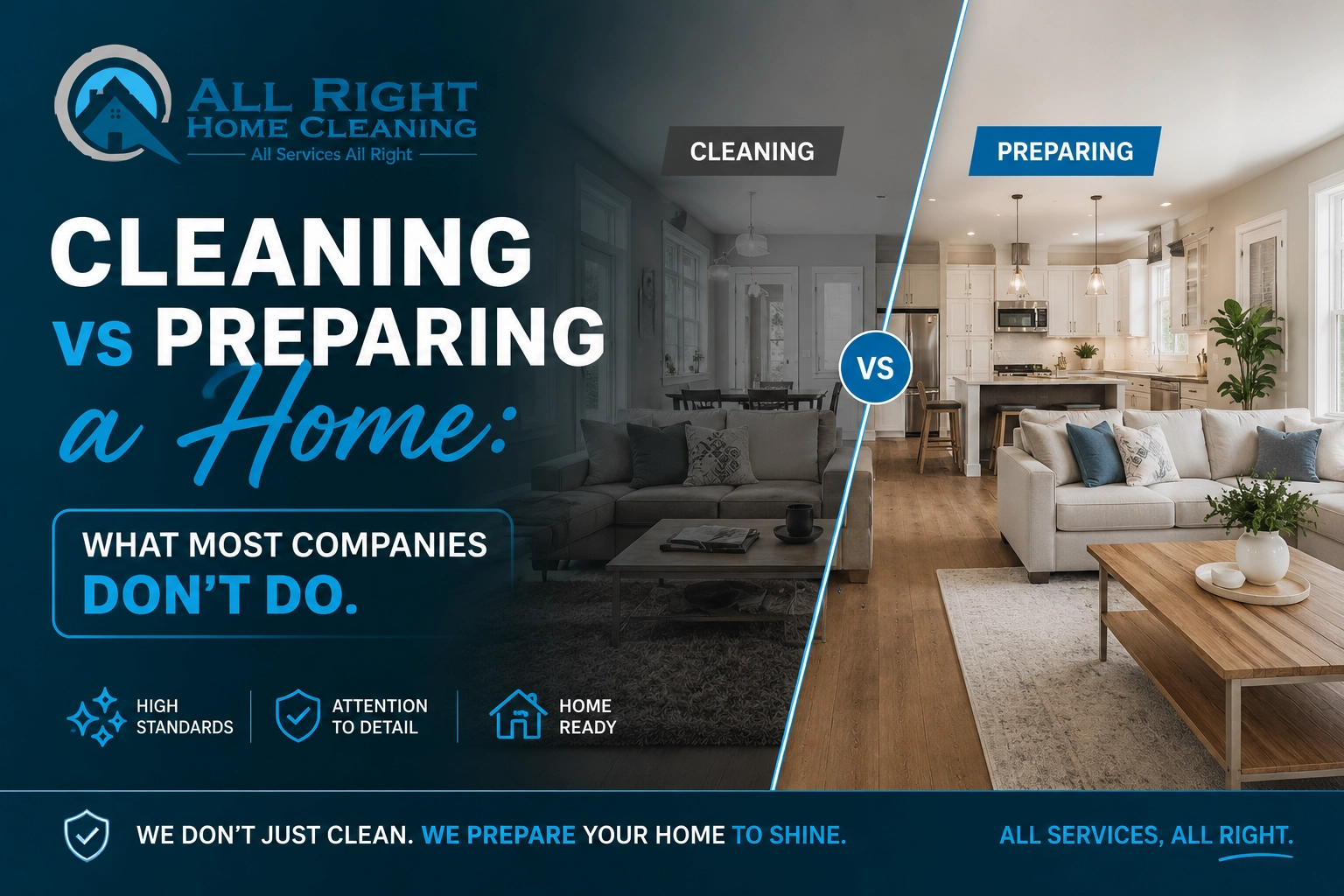
Cleaning removes visible dirt from surfaces. Preparing a home is a structured operation that combines deep residential cleaning, room-by-room inspection, linen reset, supply verification, climate check, and a documented final walkthrough before the owner or guest arrives.
A standard cleaning crew finishes when the floors are dry. A preparation team finishes only when the property is verified ready: refrigerator checked, water running clear from every tap, HVAC stable, windows secured, smoke detectors operational, kitchen restocked, beds made with fresh linen, and a photo report sent to the owner.
For a seasonal home in Cape Cod, MA, that empty for weeks at a time, this distinction is the entire conversation. A house that was only cleaned can still greet you with a musty smell, a leaking faucet under the sink, a dead light bulb in the entry, and food forgotten in the pantry. A house that was prepared greets you with nothing out of place, because someone walked through it with a checklist before you did.
A Cleaning Services Company in Cape Cod, MA that operates as a preparation system, not a labor service, is what separates a property managed at distance from a property managed by luck. That is what the rest of this article unpacks: what preparation involves, why most providers skip it, and what to look for when you compare options for Residential Cleaning Services in Cape Cod, MA.
Why This Distinction Matters More for Vacation Homes Than for Anyone Else
A primary residence is monitored daily by the people who live in it. A burnt-out bulb, a slow drain, a stale smell someone notices within hours and acts within days. A vacation home in Cape Cod does not have that feedback loop. Between visits, the property goes dark. Nobody walks the rooms. Nobody opens the windows. Nobody flushes the guest bathroom toilet.
When a cleaner shows up to a long-vacant house and applies the same routine they would apply to a lived-in suburban kitchen, the result looks fine and is not fine. The surfaces are clean. The hidden layers moisture in cabinets, dust settled inside HVAC vents, stagnation in water lines, mildew starting in the corner of a shower used three months ago are untouched. The owner arrives on a Friday night with luggage, opens the fridge, and finds the problem the cleaner never looked for.
Preparing a home solves the asymmetry between an owner who isn’t there and a property that doesn’t pause. Cleaning is reactive: it answers the question “what looks dirty?” Preparation is proactive: it answers the question “what could go wrong before the owner arrives, and how do I close every gap?”
What Most Companies Do (and Where the Gap Opens)
Most cleaning companies operate on a labor model. They charge by the hour, by the square footage, or by a flat package, and they deliver a defined task list focused on visible cleaning. The crew arrives, runs through the rooms, and leaves. The economics of that model reward speed, not verification.
This is what a typical cleaning visit looks like, in practice:
- Surface cleaning of kitchens and bathrooms counters, sinks, toilets, mirrors.
- Floor care vacuuming carpets, mopping hard floors.
- Dust removal on accessible horizontal surfaces.
- Trash removal from bins inside the home.
- Linen handling only if specifically requested, often inconsistent.
- Exit no documentation, no inspection report, no follow-up.
Nothing in that list is wrong. The gap is everything that isn’t in it. There is no verification that the home is ready, no record of what was found, no second pass to catch what the first missed, and no communication to the homeowner who is six hours away wondering whether the property is actually in order.
The result for the absent owner is structural uncertainty. You paid for the visit. You don’t know what was done. You don’t know what was missed. You don’t know if there’s a leak under the sink, a smell in the guest room, or a window left unlocked. You find out when you arrive.
What Preparing a Home Actually Involves
Preparation is a sequence, not a checklist of nouns. Each step verifies a category of risk that exists specifically because the home was empty. The categories matter more than the individual tasks, because a real preparation operation adapts the tasks to the season, the duration of vacancy, and the type of use that follows (owner stay vs guest turnover).
The full sequence covers six layers:
- Climate and air verification opening the home, ventilating closed rooms, checking HVAC operation, running dehumidifiers if needed, addressing any mildew indicators in bathrooms and basements before they spread.
- Water system check running every faucet and shower until water clears, flushing toilets, inspecting under-sink areas for slow leaks that started during vacancy.
- Deep residential cleaning full surface and floor cleaning, but layered with attention to dust accumulation in baseboards, behind furniture, inside cabinets, on top of frames, and in vents that a regular pass skips.
- Linen reset and bed staging fresh linens on every bed that will be used, towels stocked in bathrooms with verified counts, kitchen and bath textiles rotated.
- Supply verification checking pantry essentials, soaps, paper goods, light bulbs, batteries in smoke detectors, and any homeowner-specific consumables.
- Final inspection and documentation a room-by-room walkthrough, photo report, written notes on any issue found (a stain that wouldn’t lift, a bulb that needs replacement, a smell that suggests a plumbing issue), sent to the owner before they leave their primary residence.
The output of preparation is not a clean house. The output is verified readiness a document trail that proves the property is in the state the owner expects, and a clear escalation if it isn’t.
Quick Visual: Cleaning vs Preparing Side by Side
The table below frames the operational difference. Notice that “Cleaning” is not wrong it’s incomplete for the use case of an absent owner.
| Dimension | Standard Cleaning | Preparing a Home |
| Primary goal | Remove visible dirt | Verify the home is ready to enter |
| Scope | Defined task list | Full property state check |
| Verification | None | Room-by-room inspection report |
| Communication | Crew arrives and leaves | Photo report and notes to owner |
| Risk coverage | Surface-level | Climate, water, supplies, security, surfaces |
| Linen handling | On request, inconsistent | Reset and verified on every visit |
| Pre-arrival timing | Generic schedule | Synchronized to owner or guest arrival |
| Documentation | None | Written log per visit |
| Accountability | Hourly labor | Outcome-based readiness |
| Fit for vacation homes | Partial | Designed for it |
This is the gap most homeowners don’t see when they shop on price. Two quotes that look the same on paper can describe two entirely different operations.
Who Should Care About the Difference Between Cleaning and Preparing
The distinction is not academic. It maps directly to a category of homeowner whose situation makes “good enough cleaning” structurally insufficient. If you fit any of the profiles below, the gap between cleaning and preparing isn’t a preference it’s the difference between a property that runs itself and a property that breaks itself.
- Second-home owners in Cape Cod who live primarily in Boston, NYC, Connecticut, or elsewhere and visit their property seasonally or on weekends.
- Vacation rental hosts managing short-term stays via Airbnb, Vrbo, or direct booking, where every turnover affects the next review.
- Snowbirds who close the home for months and need it reopened in a verified state.
- Inherited property holders managing a family home at distance, often with sentimental value attached to its preservation.
- Owners of high-value coastal homes where salt air, humidity, and seasonal dormancy accelerate wear when unattended.
- Property managers handling multiple homes for absent owners who need consistent documentation.
What unites these profiles is a single operational fact: the person who pays for the visit is not the person who inspects the result. That asymmetry is what a preparation service exists to close. A cleaning service cannot close it, because closing it isn’t in the job description.
When Does a Home Stop Needing Cleaning and Start Needing Preparation
There is a threshold most homeowners cross without realizing it. Cleaning is enough when someone lives in the home and provides daily feedback. Preparation becomes necessary the moment the property goes more than a few days without an occupant.
The thresholds, observed across Cape Cod properties:
- Under 72 hours of vacancy a standard cleaning visit covers the need. The home is essentially still in motion.
- One to two weeks of vacancy dust settles in measurable layers, stagnant water sits in P-traps, and refrigerator contents start to age. Preparation begins to matter.
- Three to six weeks of vacancy humidity, smell, and pest indicators emerge. A standard visit will not catch these because the cleaner is not looking for them.
- Over six weeks (seasonal closure or opening) full preparation is mandatory. The home needs to be reopened as a system, not wiped down as a surface.
- Back-to-back guest turnovers preparation between stays prevents the cascading failures that produce bad reviews (missing towels, smells from prior guests, supplies not restocked).
The implicit rule: the longer the gap between visits, the wider the gap between cleaning and preparing. A property that sits empty for a month and gets only cleaning gets approximately what a primary residence would get after a single weekend away. The work is sized to the wrong problem.
Where the Differences Show Up Inside the House
Preparation isn’t a marketing label. It produces observable differences in specific rooms, on specific surfaces, in specific systems. The owner who walks through a prepared home can identify the contrast within minutes and the owner who walks through a merely cleaned one usually finds the gaps within the first hour.
The contrast, room by room:
| Area | What Cleaning Delivers | What Preparation Adds |
| Kitchen | Counters wiped, floors mopped, sink cleaned | Refrigerator checked and reset, expired items removed, faucet run, appliance interiors inspected, pantry essentials verified |
| Bathrooms | Toilets, sinks, mirrors, tubs cleaned | Drains run, ventilation confirmed, towel counts verified, soap and paper stocked, signs of mildew documented |
| Bedrooms | Surfaces dusted, floors vacuumed | Linens reset on every used bed, closet doors checked, mattresses aired if needed, lamp bulbs verified |
| Living areas | Dust and floor care | Upholstery inspected, electronics powered on and verified, throws and pillows reset to staged condition |
| Entryways | Floors and surfaces | Smoke detector batteries checked, exterior locks tested, lighting verified |
| HVAC zones | Not addressed | Thermostats reset, filters checked, vents wiped |
| Outdoor-adjacent zones | Not addressed | Sliding doors and windows tested, screens inspected, pest indicators noted |
This is what owners mean when they say the property “felt different” after switching providers. They aren’t reacting to better surface cleaning. They’re reacting to the verification layer that wasn’t there before.
How a Real Preparation Operation Runs (Step by Step)
Preparation has structure. A team that calls itself a preparation service but operates on hourly labor without documented procedure is using the word as a label, not as an operation. The difference shows up in how the visit is sequenced.
The operational flow of a proper preparation visit:
- Pre-visit briefing the team reviews owner notes, arrival schedule, special instructions, and any open issues from the prior visit.
- Arrival walkthrough initial state is observed and noted before any work begins, including any damage, smells, or anomalies that predate the visit.
- Climate and air reset windows opened where appropriate, HVAC verified, dehumidifiers checked, ventilation in bathrooms confirmed.
- Water and plumbing run every faucet, shower, and toilet activated to clear stagnant water and confirm no leaks.
- Deep residential cleaning surfaces, floors, hidden zones, vents, baseboards, inside cabinets, behind furniture.
- Linen and supply reset beds made with verified counts, bathrooms stocked, kitchen essentials placed where the owner expects them.
- Systems verification light bulbs, smoke detectors, locks, exterior doors, irrigation if applicable.
- Final inspection second pass by a lead, room by room, with checklist confirmation.
- Documentation photos of every staged room, notes on any flagged issue, written summary sent to the owner.
- Departure protocol home secured, alarm reset if applicable, key returned through the agreed protocol.
Notice that steps 1, 2, 8, 9, and 10 do not exist in a standard cleaning operation. They are the difference. Each one closes a category of risk the absent owner cannot close themselves.
A homeowner working with a real preparation service can ask, after every visit: what did you find, what did you do, and what should I know? and receive a documented answer. A homeowner working with a cleaning service can ask only: was someone there? and trust silence as confirmation.
Why Most Companies Don’t Operate This Way
The honest answer is structural, not malicious. Most cleaning companies are built around a labor economics model that rewards volume and speed. A preparation operation requires:
- Standardized procedures documented in writing and trained into every team member.
- Consistent crews assigned to the same properties to build familiarity.
- Inspection layers that add unbillable time to each visit.
- Communication infrastructure to send reports, photos, and notes to absent owners.
- Accountability for outcomes, not just hours worked.
Each of those layers adds cost and friction the typical company isn’t structured to absorb. Their pricing model, their hiring model, and their workflow are designed around throughput. Preparation breaks throughput.
A Cleaning Services Company in Cape Cod, MA that has rebuilt its operation around the absent-owner use case is operating on a different model: outcome-priced, documented, and accountable. That model exists in this market, but it isn’t the default. The default is what most homeowners get when they search and pick the first listing.
The trade-off is real and worth naming. Preparation costs more per visit. It also costs less per year, because it prevents the failures that compound: a leak caught at week two doesn’t become drywall damage at month three. A smell flagged in May doesn’t become a guest refund in July. A locked-out homeowner at 9 PM on a Friday doesn’t happen when the lock was tested on Thursday.
How Much Should a Real Preparation Service Cost in Cape Cod
Pricing is where the conversation usually breaks down, because homeowners compare on dollars and providers describe on labor. The right frame is cost per outcome, not cost per hour. A cleaning visit and a preparation visit are not the same product, and pricing them as if they were is what creates the wrong expectations on both sides.
Indicative ranges in the Cape Cod market, based on typical scope and home size:
| Service Type | Typical Range | What’s Included | Best Fit |
| Standard recurring cleaning | $150 – $280 per visit | Surface cleaning, floors, bathrooms, kitchen | Primary residences with daily occupancy |
| Deep cleaning (one-time) | $350 – $700 | Full surface, hidden zones, appliance interiors | Spring reset, post-construction, move-in |
| Vacation rental turnover | $180 – $400 per turnover | Cleaning + linen reset + restock | Active short-term rentals between guests |
| Pre-arrival preparation | $300 – $600 per visit | Deep clean + inspection + documentation + linen + supplies | Owner arrivals after weeks of vacancy |
| Seasonal opening / closing | $500 – $1,200 | Full property reactivation or shutdown protocol | Spring open, fall close, snowbird transitions |
| Recurring property maintenance | $400 – $900 per month | Scheduled visits + documentation + on-call response | Owners managing the property at distance year-round |
Ranges vary with square footage, number of bathrooms, beach proximity, frequency, and whether linen services are bundled. The numbers matter less than the principle: a preparation visit costs more than a cleaning visit because it produces a different output. The output is verified readiness, not labor delivered.
Owners who optimize for the lowest per-visit price often end up paying more per year. The math is simple one undetected leak, one mildew remediation, one bad guest review, or one wasted weekend coordinating repairs from out of state usually exceeds twelve months of the price difference between a cleaning company and a preparation operation.
Advantages of Choosing Preparation Over Standard Cleaning
The advantages compound. A single visit looks like a small premium. Twelve months of visits looks like a structural difference in how the property is managed.
The core advantages, in order of impact for an absent owner:
- Verified readiness on arrival you walk in and nothing is wrong, because someone walked through before you and confirmed it.
- Documented operations every visit produces a record you can reference, compare across months, and use to spot patterns.
- Early problem detection leaks, mildew, pest activity, and appliance issues are caught when they’re cheap to fix instead of when they’re expensive.
- Consistent guest experience for short-term rentals, every turnover meets the same standard, which stabilizes reviews and ratings.
- Same team, same standard familiarity with the property means the team notices when something is off, not just when something is dirty.
- Reduced owner overhead no calls, no checking in, no asking neighbors to drive by. The property is monitored as part of the visit.
- Predictable communication photos and notes after every visit eliminate the silence that creates anxiety for owners managing at distance.
- Trusted access protocol keys, codes, and entry are managed by an insured, accountable team, not a rotating cast of unknown freelancers.
- Continuity across seasons the same operation handles open, closing, in-between, and turnover, so nothing falls through scheduling gaps.
- Faster issue resolution when something is flagged, it’s escalated immediately to vendors or to the owner, not noticed three weeks later.
Each of these advantages exists because preparation is built around the absent owner’s reality. A cleaning service can deliver some of them by accident. A preparation operation delivers all of them by design.
Main Advantages: The Three That Actually Decide the Choice
If the ten advantages above had to compress into three, these are the ones every conversation with a Cape Cod homeowner eventually returns to. The other seven are real, but these three are the load-bearing ones.
- Operational trust the homeowner can hand over access to the property and stop monitoring whether the visit happened correctly. The team is insured, background-checked, consistent, and documents its own work. Trust stops being a leap of faith and becomes a process.
- Predictability across visits the same standard applies whether the visit is in May or November, before an owner arrival or after a guest checkout. There is no variance based on which cleaner showed up or what mood the crew was in. Same protocol, same checklist, same output.
- Control at distance the owner stays in command of the property even from hundreds of miles away. Photos, notes, and flagged issues arrive without having to be requested. Decisions about repairs, restocking, or scheduling happen with full information, not guesses.
These three are what the absent owner is actually buying. The cleaning is the visible deliverable. The trust, predictability, and control are the actual product. A provider who understands that operates differently from one who doesn’t, and the difference shows up in everything from how quotes are written to how the first visit is documented.
Advantages vs Disadvantages: An Honest Comparison
No service is free of trade-offs. Preparation has real costs the homeowner should understand before choosing it, alongside the benefits. Pretending otherwise is the kind of inflated promise that breaks trust before it’s built.
| Dimension | Advantages of Preparation | Disadvantages / Trade-offs |
| Cost per visit | Higher per-visit value through bundled inspection and documentation | Costs more per visit than basic cleaning |
| Scheduling | Synchronized to owner and guest calendars | Requires advance booking, less flexible for last-minute |
| Provider availability | Operators capable of this model are limited in Cape Cod | Fewer companies actually deliver it, so vetting matters |
| Onboarding | Detailed property profile and protocol setup at start | First-visit setup takes longer than a cleaning intake |
| Communication load | Owner receives reports and photos consistently | Owner needs to actually read them for the system to work |
| Customization | Adapted to the specific home, season, and use case | Requires more dialogue upfront, less plug-and-play |
| Annual cost | Lower total cost of ownership through prevented failures | Higher recurring line item in the budget |
| Crew | Same team across visits | Smaller pool of available crews, slower scaling |
For a primary residence with daily occupancy, the disadvantages outweigh the advantages. The owner is there, sees the home daily, and doesn’t need a verification layer. For a second home in Cape Cod managed at distance, the calculation reverses. The disadvantages become acceptable costs, and the advantages become the entire reason for hiring the service in the first place.
A Practical Example: One Property, Two Approaches
The clearest way to see the difference is to walk through a single hypothetical scenario with both operating models applied. The property: a four-bedroom home in Chatham, owned by a couple from Boston who use it on weekends in summer and rent it through Airbnb for the rest of the season.
Scenario A Standard cleaning service.
The owners book a cleaning visit for the Thursday before their Friday arrival in early June. The crew arrives at 10 AM, cleans for three hours, and leaves at 1 PM. Surfaces are clean, floors are mopped, bathrooms look fresh. The owners arrive Friday at 8 PM after a four-hour drive.
What they find: a faint musty smell in the master bedroom (window stayed closed for weeks, the cleaner didn’t open it). Two burnt-out bulbs in the living room (not noticed, not replaced). The guest bathroom drain is slow (sitting water from months of disuse, never run). The refrigerator has spoiled milk from the last visit (not opened by the cleaner). The thermostat is set to 78 (no one adjusted it for arrival). The first hour after a four-hour drive is spent fixing what should already be fixed.
Scenario B Preparation service.
The same arrival, the same property. The preparation team arrives Wednesday for a three-and-a-half-hour visit. They open windows, run every faucet and drain, check the refrigerator and remove spoiled items, replace bulbs, verify smoke detectors, reset the thermostat to 70 for Friday evening, reset linens on both used beds, restock soap and paper goods, and walk through every room with a checklist. They send a photo report and a written summary to the owner Wednesday evening.
What the owners find Friday at 8 PM: a home that smells right, lights that work, water that runs clear, beds that are made, a refrigerator they can actually use, a thermostat at the temperature they wanted, and zero tasks waiting for them. They drop their bags and start the weekend.
The cost difference between the two scenarios is roughly $150. The experience difference is roughly the entire reason they bought a vacation home in the first place. This is what a homeowner is actually paying for when they choose deep residential cleaning services cape cod that include preparation not the cleaning, but the absence of friction on arrival.
Where Preparation Connects to Other Decisions in Property Management
Preparation is not a standalone service. It sits inside a wider operating system for a vacation home, and the homeowners who get the most value from it are the ones who treat it as part of an integrated approach. The connections that matter most:
- Linkage with deep cleaning cycles preparation visits are layered on top of a deeper periodic clean (typically quarterly or seasonal), not a replacement for it. The two are complementary.
- Linkage with turnover cleaning between guest stays, a compressed version of preparation runs as turnover protocol, with linen, restock, and inspection embedded in the same workflow.
- Linkage with seasonal opening and closing the spring opening and fall closing visits are the most intensive form of preparation, with system-level checks (HVAC, water, exterior) that don’t appear in routine visits.
- Linkage with property maintenance flags items flagged in inspection reports feed into a separate maintenance workflow with vendors, not the cleaning team.
- Linkage with documented property profile every preparation visit pulls from and updates the same property profile, so context compounds across months.
A homeowner shopping for a single cleaning visit and a homeowner building a year-round system for managing their property at distance are buying different things. The second is what most Cape Cod second-home owners actually need, and most don’t realize it until they’ve cycled through two or three cleaning companies that almost worked. A reliable Residential Cleaning Services in Cape Cod, MA operation built for vacation homes solves the problem by treating preparing home before arrival as the central service and cleaning as one of its components.
Frequently Asked Questions About Cleaning vs Preparing a Home
The questions below cover what Cape Cod homeowners actually ask before they commit to a provider. Each answer is built to stand alone, so you can read any one of them without needing the others.
- What is the actual difference between cleaning and preparing a home?Cleaning removes visible dirt from surfaces. Preparing a home is a structured operation that combines cleaning with inspection, linen reset, supply verification, climate and water checks, and a documented walkthrough sent to the owner. Cleaning ends when the floors are dry. Preparation ends when the property is verified ready.
- Is preparing a home the same as deep cleaning?No. Deep cleaning is a more thorough version of cleaning hidden zones, baseboards, inside cabinets, behind furniture. Preparing a home includes deep cleaning as one of its layers, but adds inspection, documentation, and pre-arrival readiness that deep cleaning alone does not cover.
- Do I need preparation if my Cape Cod home sits empty only two or three weeks at a time?Probably yes. The thresholds where standard cleaning starts to miss real risk begin around the one to two week mark dust settles, water sits in P-traps, refrigerators age, and humidity starts to register in bathrooms. Three weeks of vacancy in coastal Massachusetts is enough time for a cleaner-only visit to leave gaps you’ll notice on arrival.
- Why don’t most cleaning companies offer preparation?Because their operating model is built around hourly labor and throughput. Preparation requires standardized procedures, consistent crews, inspection layers, documentation infrastructure, and accountability for outcomes. Each of those adds cost and friction the typical company isn’t structured to absorb. A company built for preparation operates on a different model, not a more expensive version of the same model.
- How much more does a preparation visit cost than a cleaning visit?In Cape Cod, the typical premium is between 40 and 80 percent per visit. A standard cleaning might run $180 to $280, while a preparation visit on the same property typically runs $300 to $600 depending on size, vacancy duration, and bundled services. The annual cost difference is usually offset by the failures preparation prevents.
- What goes in the inspection report I receive after a preparation visit?A proper report includes photos of every staged room, a written confirmation that the standard checklist was completed, notes on anything flagged (a slow drain, a burnt bulb, a faint smell, a stain that wouldn’t lift), and a summary of any items requiring follow-up. It arrives by email or messaging app before you leave for the property.
- Can a preparation service handle vacation rental turnovers too?Yes. Turnover cleaning between Airbnb guests is essentially a compressed version of preparation linen reset, restock, surface cleaning, and inspection in a tighter window. A provider built for preparation handles turnovers as part of the same workflow, with the same documentation standard.
- What happens if the team finds a problem during the preparation visit?A real preparation operation has an escalation protocol. Minor issues (bulbs, batteries, light restocking) are handled on the visit. Larger issues (plumbing, HVAC, appliance failure) are documented, photographed, and reported to the owner immediately, often with vendor recommendations or coordination if that’s part of the service agreement.
- How do I know the team is actually trustworthy with access to my home?Look for documented insurance, background-checked staff, a consistent crew assigned to your property, and a written access protocol (key codes, lockbox procedures, alarm handling). A provider who can’t describe their access protocol in concrete terms is a provider whose access protocol doesn’t exist.
- Will the same cleaners come every time?With a preparation operation, yes that’s part of the model. Familiarity with the property is what allows the team to notice when something is off, not just when something is dirty. A rotating cast of cleaners cannot deliver preparation, because preparation depends on context that accumulates across visits.
- Do I need preparation if I have a property manager already?Depends on what your property manager actually does. Many property managers handle bookings, rent collection, and guest communication, but subcontract cleaning to a separate vendor. If your manager doesn’t directly oversee the cleaning standard, you can have a property manager and still need a preparation-grade cleaning operation underneath.
- How far in advance should I book a preparation visit before arriving?For routine pre-arrival, 48 to 72 hours before your arrival is the standard window. For seasonal opening or after extended vacancy (over six weeks), a week of lead time is more appropriate, because the visit may need to be longer and any flagged issues need time to resolve before you arrive.
- What’s the right frequency for preparation visits when the property sits empty?For a home actively used as a short-term rental, preparation runs with every turnover. For an owner-occupied second home used seasonally, monthly or bi-monthly maintenance visits during the vacancy period are typical, with a full preparation visit before each owner arrival.
- Can I add preparation to my current cleaning service?You can ask, but most cleaning companies will not be able to deliver it as an upgrade. The protocols, documentation infrastructure, and crew consistency required aren’t features that bolt on they’re how the operation is built from the start. Switching to a provider built for preparation is usually a cleaner path than retrofitting one that wasn’t.
- Is preparation worth it if I rarely use my Cape Cod home?Often more, not less. A home that sits empty longer accumulates more risk between visits, which means a higher proportion of value comes from the inspection and verification layers exactly what preparation delivers and standard cleaning skips.
- What questions should I ask a provider before hiring them for preparation?Ask for their written inspection protocol, what their post-visit report looks like, how they handle access and keys, whether the same crew will service your property, how they document and escalate flagged issues, and what their procedure is for seasonal opening and closing. A provider who can answer all six concretely is operating at preparation grade. One who can’t is operating at cleaning grade and using the word preparation as marketing.
Where This Leaves You as a Cape Cod Homeowner
The question wasn’t really cleaning versus preparing. The real question was whether you want a service that ends when the cleaner walks out the door, or a system that ends when you walk in yours and find nothing waiting to be fixed. Two different products, two different price points, two different outcomes.
For a primary residence with daily occupancy, cleaning is enough. For a second home in Cape Cod managed at distance, preparation is what closes the gap between what you pay for and what you actually need. The premium is real. The premium is also the price of not spending the first hour of every visit fixing the property before you can enjoy it.
The homeowners who get this right tend to share a pattern: they stop comparing cleaning quotes on price and start comparing operations on protocol. They ask about inspection reports, not just hourly rates. They look for crews assigned to their property, not crews assigned to their day. And they treat the cleaning provider as a partner in property management, not a labor vendor.
If you’re at the point of choosing between providers, the framing that actually helps is to ask what each one delivers on the worst possible visit the one where something is wrong with the house. A cleaning service delivers a clean house and silence. A preparation service delivers a flagged report, a photo, a recommendation, and the chance to fix the problem before you arrive. That gap is the entire conversation, and it’s the gap a real Cleaning Services Company in Cape Cod, MA is built to close.