
Why Every Deep Cleaning Should End With a Property Inspection Report
Deep cleaning is only complete when the property has been inspected, verified, and documented. For seasonal homeowners, a report provides the visibility needed to know what was cleaned, what was found, and whether the home is truly ready.
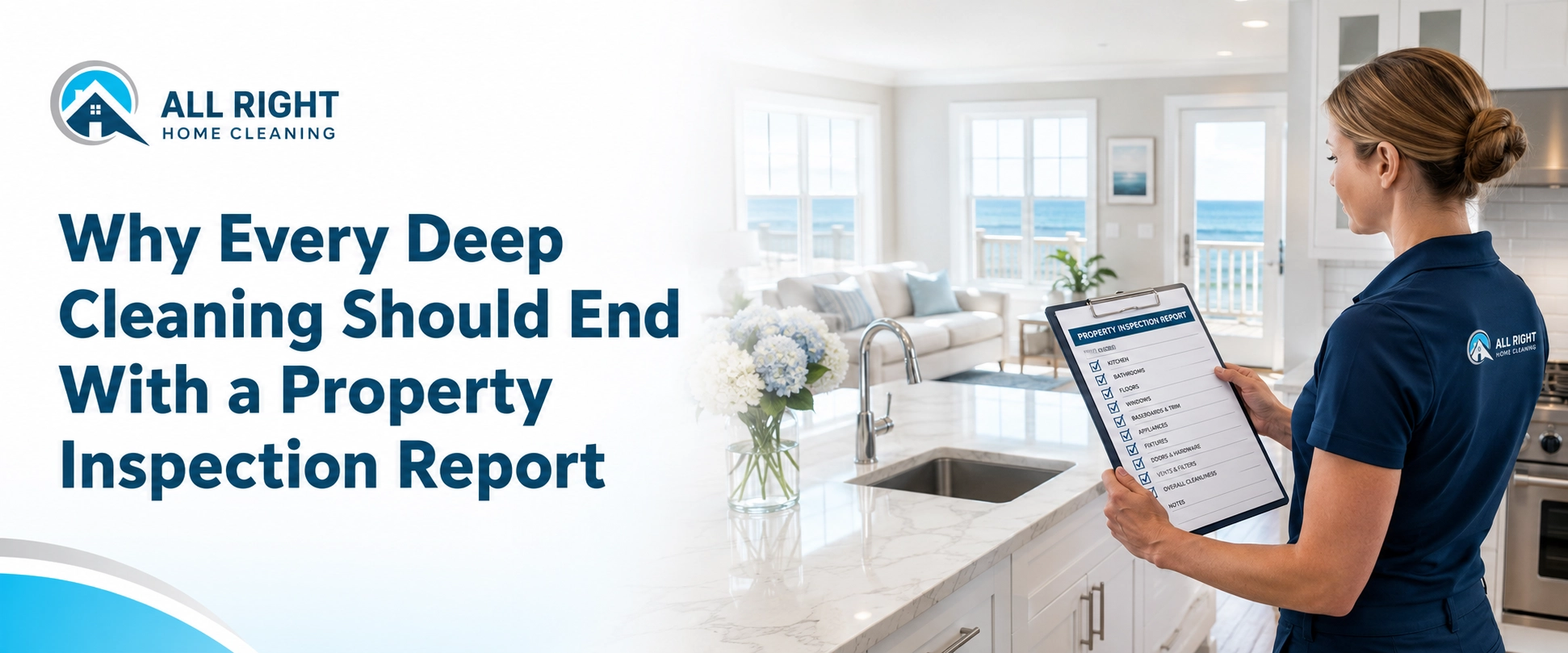
A deep cleaning should end with a property inspection report because completing cleaning tasks does not prove that the entire property meets the expected standard. A final report creates a documented connection between the work performed, the condition observed, and the result delivered.
This step is especially important for vacation homes, second homes, seasonal properties, and coastal homes whose owners may be hundreds of miles away. Without a report, the homeowner receives a completion message but has little evidence that every room was reviewed or that visible concerns were identified.
An effective inspection report should confirm:
- Which rooms and priority areas were inspected
- Whether the cleaning checklist was completed
- Whether anything requires additional attention
- Whether unusual odors, moisture, damage, or pest activity were observed
- Whether doors, windows, lights, appliances, and access points were left as instructed
- Whether the property is ready for the owner, family, guests, or renters
The report is not a formal home inspection, environmental assessment, mold evaluation, or maintenance diagnosis. It is a documented final review of the cleaning scope and visible property condition.
For homeowners who cannot personally check the work, the report transforms Deep Cleaning Services from a list of completed tasks into a verified property readiness process. It provides evidence, accountability, visibility, and a clear answer to the question that matters most: Is the home actually ready?
Why Is Cleaning Without Verification an Incomplete Process?
Cleaning and verification are different responsibilities. Cleaning removes accumulated dust, residue, grease, sand, pet hair, cobwebs, and buildup. Verification determines whether the agreed scope was completed consistently and whether the property is ready for its next use.
A technician can spend hours cleaning a home and still miss a baseboard, cabinet interior, window track, vent, appliance surface, or low traffic room. This does not always indicate negligence. Large homes contain hundreds of surfaces, fixtures, edges, corners, and access points. Without a structured final review, small omissions remain invisible until the owner arrives.
That creates a serious problem for absentee homeowners. They may receive a message saying the service is complete, but they cannot distinguish between a finished job and an unverified job.
A proper inspection and verification process closes that gap. It requires someone to review the result against the approved scope before the property is declared ready.
What Is the Difference Between Completion and Confirmation?
Completion means the cleaning team has finished performing its assigned tasks. Confirmation means the completed work has been checked against an objective standard.
The distinction matters because activity is not the same as outcome. A checklist marked complete records what workers report doing. An inspection report records what was reviewed after the work.
| Stage | Primary purpose | Question answered | Evidence produced |
| Cleaning | Remove dirt and buildup | What work was performed? | Completed service checklist |
| Quality review | Identify missed or inconsistent work | Does the result meet the cleaning standard? | Corrections and verification notes |
| Property observation | Record visible concerns outside the cleaning result | Was anything unusual observed? | Condition notes and photographs |
| Readiness confirmation | Confirm the home is prepared for use | Is the property ready for arrival? | Final property inspection report |
This separation creates accountability. If an area does not meet the expected standard, it can be corrected before the team leaves instead of becoming an unpleasant discovery for the homeowner.
What Should a Property Inspection Report Verify?
A useful report must provide more than a few attractive photographs. It should organize evidence around scope completion, quality control, visible property condition, and arrival readiness.
The report should be clear enough that a homeowner can understand the condition of the property without being physically present. It does not need excessive technical language. It needs accurate observations, relevant photographs, timestamps when available, and direct explanations.
Which Cleaning Areas Should Be Reviewed?
The final review should follow the same scope approved for the deep cleaning. This prevents the inspector from relying on memory or personal preference.
Priority areas commonly include:
- Kitchen surfaces and fixtures, including countertops, cabinet fronts, sinks, faucets, appliance exteriors, backsplash areas, and accessible buildup points.
- Bathrooms, including toilets, showers, tubs, vanities, mirrors, fixtures, floors, and visible residue around edges.
- Floors and perimeter areas, including corners, baseboards, stair edges, accessible spaces beneath furniture, and transitions between rooms.
- Dust collection points, including ceiling fans, vents, window sills, blinds, light fixtures, doors, trim, and reachable high surfaces.
- Bedrooms and living spaces, including furniture surfaces, mirrors, interior glass, closets included in the scope, and visible cobwebs.
- Entry and arrival areas, including the main entrance, mudroom, hallways, and the first spaces the homeowner or guest will see.
A final walkthrough should not merely repeat the cleaning. Its purpose is to identify omissions, inconsistencies, or conditions that require correction before completion is confirmed.
How Detailed Should the Review Be?
The level of detail should match the size of the home, the approved cleaning scope, and the reason for the service. A seasonal opening after months of vacancy requires a different review from a deep cleaning performed in an occupied primary residence.
For a Cape Cod vacation home, the review should pay particular attention to environmental conditions associated with prolonged vacancy and coastal exposure. These may include dust accumulation, stale air, musty odors, sand, salt residue, humidity indicators, visible mildew, cobwebs, insects, and signs that a room has remained closed for an extended period.
The cleaning team should report what it can visibly observe without pretending to diagnose causes. A musty odor can be documented. The source of that odor should not be declared without appropriate professional evaluation.
What Is the Limit of a Cleaning Inspection?
A cleaning inspection is not a substitute for a licensed home inspector, mold assessor, pest control professional, electrician, plumber, or heating and cooling technician.
The cleaning company can responsibly document visible observations such as:
- A water stain beneath a sink
- Condensation around a window
- A persistent musty odor
- Visible discoloration on a surface
- An appliance that did not respond during an instructed check
- Evidence of insects in an accessible area
- A damaged fixture noticed during cleaning
The report should describe what was observed, where it was observed, and whether a photograph was captured. It should not label discoloration as toxic mold, determine the source of water intrusion, or certify that a mechanical system is safe.
Why Does This Boundary Protect the Homeowner?
Clear boundaries make the report more trustworthy. Unsupported diagnoses create confusion and liability. Accurate observations allow the homeowner to decide whether a qualified specialist should investigate further.
This is the standard that turns Professional Cleaning Services into reliable property care: report what is known, distinguish it from what is suspected, and never hide an observable concern simply because it falls outside the cleaning scope.
Why Does the Report Matter More When the Owner Is Away?
An absentee homeowner cannot perform a personal walkthrough after service. That physical distance creates an information gap between the condition of the home and what the owner knows about it.
A property inspection after cleaning reduces that gap by giving the homeowner structured evidence. Instead of relying on a generic completion message, the owner receives confirmation that the property was reviewed and any visible exceptions were documented.
For a seasonal homeowner, this visibility protects more than the cleaning investment. It protects the arrival experience. Discovering a missed bathroom, persistent odor, damaged fixture, water stain, or incomplete room after a long drive turns the first day at the property into a recovery operation.
The inspection report moves that discovery earlier, when there is still time to respond. That is its most important advantage. It gives the homeowner the opportunity to make decisions before the family or guests arrive.
What Information Should a Property Inspection Report Include?
A property inspection report should tell the homeowner what was reviewed, what met the expected cleaning standard, what required correction, and what visible concerns remain. Its purpose is to replace uncertainty with organized evidence.
A generic message stating that the cleaning is complete does not provide enough information. The homeowner needs to know whether the property was reviewed room by room and whether any exception could affect comfort, safety, maintenance, or arrival readiness.
An effective report should contain the following information:
- Property identification, including the address, service date, arrival time, completion time, and type of cleaning performed.
- Approved service scope, identifying the rooms, surfaces, appliances, fixtures, and special requests included.
- Room by room verification, confirming whether each area met the expected standard.
- Corrective actions, documenting anything the team fixed during the final walkthrough.
- Visible condition notes, describing stains, odors, damage, moisture indicators, pests, missing supplies, or maintenance concerns.
- Photographic evidence, showing relevant completed areas and visible exceptions.
- Readiness status, stating whether the property is ready, ready with observations, or requires additional action.
- Recommended next steps, identifying concerns that should be evaluated by the homeowner or an appropriate professional.
This information gives the homeowner a practical record of what happened inside the property. More importantly, it separates completed cleaning work from conditions that cleaning alone cannot resolve.
How Should Room by Room Verification Be Organized?
A room by room format makes the report easier to understand and prevents important areas from disappearing inside a general summary. Each section should follow the physical layout of the property or the sequence used during the final walkthrough.
| Property area | What should be verified | Common exceptions to document |
| Kitchen | Counters, sink, fixtures, cabinet fronts, backsplash, appliance surfaces, floors | Grease buildup, damaged hardware, odors, leaks, expired food |
| Bathrooms | Toilet, shower, tub, vanity, mirrors, fixtures, floors | Mineral residue, discoloration, slow drainage, moisture, damaged caulk |
| Bedrooms | Furniture surfaces, floors, baseboards, mirrors, accessible closets | Dust, cobwebs, stale odor, stained linens, damaged blinds |
| Living areas | Floors, furniture surfaces, fixtures, windowsills, visible edges | Sand, pet hair, salt residue, marks, insect activity |
| Entry areas | Door, floor, trim, glass, arrival presentation | Debris, damaged locks, packages, moisture near entrance |
| Utility spaces | Accessible surfaces and instructed visual checks | Water stains, unusual odors, tripped controls, visible damage |
| Outdoor access points | Doors, accessible thresholds, porches included in scope | Sand, pollen, leaves, damaged screens, unsecured access |
The report should remain proportional to the property. A compact two bedroom cottage does not need the same reporting volume as a large seasonal residence with multiple bathrooms, guest rooms, storage areas, and outdoor access points.
The objective is not to produce paperwork for its own sake. The objective is to create enough detail for the owner to make informed decisions without needing to request clarification about every room.
What Types of Photographs Provide Useful Evidence?
Useful photographs should confirm meaningful results or document relevant exceptions. They should not be selected only because a polished countertop or neatly arranged pillow looks attractive.
A strong photographic record may include:
- Wide images showing the overall condition of priority rooms
- Focused images of high attention cleaning areas
- Photographs of corrected omissions discovered during verification
- Images of visible damage or unusual conditions
- Photographs showing doors, windows, or access points left as instructed
- Images of supplies, linens, or property readiness details included in the service
- Final images of the primary entrance and arrival areas
Photographs should have context. A close image of an unidentified stain has limited value if the homeowner cannot determine which room or surface it represents. Each relevant image should be associated with a location and a concise observation.
Visual evidence also needs restraint. Sending dozens of repetitive images can make the report harder to review. A homeowner needs useful visibility, not a digital photo dump.
Should Every Surface Be Photographed?
No. Photographing every cleaned surface would create an inefficient process and an unreadable report. The final documentation should focus on representative completed areas, high priority surfaces, special requests, and visible exceptions.
The report should establish reasonable evidence that the inspection and verification process occurred. It is not intended to create a forensic record of every square foot.
What Makes a Photograph Trustworthy?
A trustworthy photograph is current, relevant, identifiable, and consistent with the written observation. When available, timestamps and organized file records can strengthen accountability.
Images should not be framed in ways that hide unfinished areas. They should represent the actual condition of the property at the end of the service.
Can Photographs Replace Written Notes?
Photographs cannot fully replace written notes because an image may not communicate odor, moisture in the air, an appliance response, a loose fixture, or the context surrounding a visible concern.
The strongest report combines concise written observations with selective visual evidence. Together, they explain what was seen, where it was found, and why it may require attention.
How Does the Inspection and Verification Process Work?
The inspection and verification process should begin before the cleaning team enters the property. Verification is more reliable when the scope, expectations, access instructions, and readiness requirements are defined in advance.
A practical process follows seven stages:
- Confirm the service scope. The company reviews included rooms, excluded tasks, special requests, access instructions, and property priorities.
- Document the initial condition. Relevant concerns present before cleaning are recorded when necessary.
- Complete the deep cleaning. The team follows the approved checklist and service sequence.
- Conduct a separate final walkthrough. The completed result is reviewed against the agreed scope.
- Correct cleaning exceptions. Missed or inconsistent areas are addressed before departure whenever possible.
- Record visible property concerns. Conditions outside the cleaning scope are described without unsupported diagnosis.
- Issue the final report. The homeowner receives completion evidence, observations, photographs, and the readiness status.
This sequence prevents the inspection from becoming a rushed formality. A checklist signed immediately after the last cleaning task does not necessarily prove that a true final review occurred.
Who Should Perform the Final Inspection?
The final inspection can be performed by a trained team lead, quality control supervisor, property readiness specialist, or another designated person who understands the approved service standard.
When the same technician who performed the work conducts the review, the company should use a structured checklist that requires the technician to revisit each area from a verification perspective. Familiarity can make omissions harder to notice because the person already expects the room to be complete.
A separate reviewer may provide stronger quality control for larger homes, first time services, seasonal openings, high priority arrivals, or properties with extensive special instructions. However, the value comes from the quality of the process, not from an impressive job title.
When Should Corrections Be Made?
Cleaning related corrections should be made before the team leaves whenever the issue is within the approved scope and can be resolved safely.
Examples include:
- Residue remaining on a bathroom fixture
- Dust left on an included surface
- A missed baseboard section
- Debris remaining in a room corner
- Streaks on an included mirror
- An appliance exterior requiring another pass
- A trash container that was not reset as instructed
After identifying an exception, the reviewer should record the correction and verify the area again. This creates a closed quality loop instead of merely documenting a failure.
Visible damage, maintenance problems, pest activity, water concerns, or conditions requiring specialized treatment should be reported to the homeowner. A cleaning crew should not attempt unauthorized repairs or treatments simply to make the report appear complete.
What Is the Difference Between a Checklist and an Inspection Report?
A cleaning checklist directs the work. A property inspection report verifies the result and communicates the final property condition.
These documents support each other, but they are not interchangeable.
| Document | Main function | Created when | Primary audience |
| Cleaning checklist | Organize required tasks | Before and during cleaning | Cleaning team |
| Quality control review | Check whether tasks meet the standard | After cleaning | Team lead or reviewer |
| Inspection report | Communicate verified results and visible conditions | After final review | Homeowner or property contact |
| Maintenance report | Evaluate repair or system concerns | During a specialized assessment | Owner and qualified contractor |
A checked box confirms that a task was recorded as completed. It does not show the final condition, explain an unusual observation, or prove that a correction was made.
For this reason, homeowners evaluating Professional Cleaning Services should ask not only whether the company uses a checklist, but also what happens after the checklist is completed.
Why Is a Signed Checklist Alone Insufficient?
A signed checklist can create a false sense of certainty when there is no independent review behind it. Tasks may be marked complete even though the result is inconsistent, an inaccessible area prevented completion, or a visible concern remained unexplained.
A useful report adds context. It can state that a cabinet interior was excluded, a locked room could not be accessed, a stain remained after appropriate cleaning, or a fixture appeared damaged before service began.
That context protects both parties. The homeowner receives an honest account of the result, while the cleaning company avoids being held responsible for preexisting damage, excluded work, permanent staining, or inaccessible spaces.
What Are the Main Advantages of an Inspection Report?
The primary advantage is visibility. The homeowner gains a clearer understanding of the service result and the property condition without needing to be present.
Additional advantages include:
- Greater accountability for the approved cleaning scope
- Faster correction of missed areas
- Earlier awareness of visible property concerns
- Better communication between the company and homeowner
- Stronger documentation for seasonal properties
- Reduced risk of arrival day surprises
- Clearer distinction between cleaning issues and maintenance issues
- A documented history that may reveal recurring patterns
These benefits become more valuable over time. If reports repeatedly mention condensation near the same window, insects in the same room, or a musty odor in the same closet, the homeowner can recognize a pattern that isolated completion messages would never reveal.
What Are the Advantages and Limitations?
| Inspection report advantage | Practical value | Limitation |
| Confirms reviewed areas | Reduces uncertainty about service completion | Cannot guarantee hidden areas are problem free |
| Documents visible concerns | Supports earlier homeowner action | Does not provide professional diagnosis |
| Provides photographs | Gives remote owners visual evidence | Images cannot communicate every condition |
| Records corrections | Shows how quality issues were resolved | Depends on accurate reporting |
| Confirms readiness status | Helps owners plan arrivals | Readiness depends on the agreed scope |
| Creates service history | Reveals repeated observations over time | Records must be organized consistently |
The report increases transparency, but it does not eliminate every property risk. Walls, plumbing lines, roofing systems, electrical components, concealed mold, structural conditions, and inaccessible spaces remain outside the practical limits of a cleaning inspection.
The honest value of the report lies in what it can verify, not in pretending it can guarantee the entire home.
What Happens When a Deep Cleaning Ends Without an Inspection?
When a deep cleaning ends without verification, the homeowner assumes that every expected area was completed and that nothing unusual was observed. That assumption may remain untested until someone enters the property.
Several outcomes can follow:
- A missed area is discovered after the team has left.
- A visible maintenance concern remains unreported.
- The owner arrives believing the home is fully ready.
- Family members or guests become the first people to identify a problem.
- Responsibility becomes difficult to determine because no final record exists.
- Corrective service requires another visit, additional scheduling, and possible delay.
The financial cost of the missed detail may be small, but the practical cost can be significant. A homeowner who arrives late in the evening does not want to investigate an odor, clean an overlooked bathroom, purchase missing supplies, or coordinate an urgent return visit.
A property inspection after cleaning reduces that exposure by moving discovery to the point when the cleaning company can still respond.
What Does This Look Like in a Real Property Scenario?
Consider a seasonal homeowner scheduling Deep Cleaning Services before returning to a Cape Cod property that has remained vacant for several months.
The cleaning team completes the approved service, including the kitchen, bathrooms, bedrooms, living areas, baseboards, window sills, accessible fixtures, and appliance exteriors. During the final walkthrough, the reviewer finds three exceptions.
First, sand remains behind the entry bench. The team corrects it immediately.
Second, a bathroom window shows visible condensation and discoloration near the lower frame. The reviewer photographs the area and describes only what is visible.
Third, a guest bedroom has a persistent musty odor even though the room has been cleaned. The report states that the odor remains and recommends further evaluation if it continues after ventilation.
The final status is listed as ready with observations. The homeowner receives the report before traveling and has time to request that a property professional examine the bathroom window.
Without the inspection, the sand, discoloration, and odor might all have been discovered on arrival. With verification, the cleaning omission is corrected, the visible concern is documented, and the homeowner can make a decision before the property is occupied.
That is the practical difference between purchasing cleaning labor and receiving a verified readiness outcome.
How Much Does a Property Inspection Report Add to the Cost of Deep Cleaning Services?
The cost of a property inspection report depends on the size of the home, the depth of documentation, the number of rooms, the reporting technology, the travel requirements, and whether the inspection is included within the original cleaning package.
Some companies include basic verification within their Deep Cleaning Services price. Others charge separately for detailed photographs, room by room documentation, property readiness checks, supply verification, or post service reporting.
The following ranges are planning estimates rather than guaranteed prices:
| Reporting level | Typical scope | Possible additional cost |
| Basic completion confirmation | Final walkthrough, brief notes, limited photographs | Included or $25 to $50 |
| Detailed inspection report | Room verification, exceptions, corrections, readiness status | $50 to $125 |
| Seasonal property readiness report | Detailed inspection, photographs, access checks, visible condition notes | $100 to $250 |
| Customized absentee owner reporting | Extensive instructions, supply checks, multiple access points, detailed documentation | Priced according to scope |
A higher price does not automatically mean better verification. The homeowner should examine what the report actually includes, who performs the review, how exceptions are handled, and whether the company distinguishes cleaning observations from professional property diagnoses.
The more useful question is not, “How much does the report cost?” It is, “What could an undocumented problem cost if it is discovered only after arrival?”
Is the Additional Cost Worth Paying?
The additional cost is usually justified when the homeowner cannot personally inspect the property, when the home has remained vacant, or when an upcoming arrival leaves little time for corrections.
For a primary residence occupied every day, a short quality control review may be enough. For a seasonal home located several hours away, detailed documentation creates greater practical value because the owner cannot casually stop by and verify the result.
The report may be especially worthwhile when:
- The property is a vacation home or second home
- The owner lives in another city or state
- The house has remained closed for several weeks or months
- Guests or renters will arrive soon after cleaning
- The property has a history of humidity, odors, pests, or water concerns
- The service includes numerous special instructions
- The owner needs confirmation before authorizing additional work
- The home has multiple bedrooms, bathrooms, entrances, or storage areas
The value comes from reducing uncertainty and improving decision time. A report cannot prevent every maintenance problem, but it can expose visible conditions before they become arrival day surprises.
When Is a Detailed Inspection Report Most Necessary?
A detailed report is most necessary when physical distance, property complexity, environmental exposure, or arrival timing increases the consequences of incomplete information.
Not every cleaning visit requires the same reporting level. The verification process should be proportional to the risk surrounding the property and the purpose of the service.
Why Do Seasonal Openings Require More Verification?
A seasonal opening involves more than removing dirt. The home may have remained closed through changing temperatures, storms, humidity, pollen seasons, pest activity, and prolonged periods without regular observation.
During that time, the property can develop conditions that ordinary cleaning does not resolve, including:
- Persistent stale or musty odors
- Condensation around windows
- Sand or wind driven debris near entrances
- Salt residue on exposed glass and fixtures
- Insect activity in corners or window areas
- Water stains beneath sinks or near appliances
- Dust inside rooms that remained closed
- Damaged screens, blinds, locks, or visible fixtures
- Missing household supplies
- Linens requiring replacement or additional preparation
A final report provides a current snapshot of the home after cleaning. It tells the owner which cleaning issues were resolved and which visible conditions still require attention.
A home can be clean without being completely ready. Seasonal owners need that distinction stated clearly.
Why Does Arrival Timing Change the Required Standard?
The shorter the interval between cleaning and occupancy, the more important final verification becomes.
If the cleaning is completed several weeks before arrival, the home may accumulate new dust, insects, odors, or environmental residue before anyone uses it. In that situation, the homeowner may need both a deep cleaning and a separate arrival preparation visit closer to the occupancy date.
If the service is completed one or two days before arrival, the inspection report should confirm the condition of the property at the end of the visit and identify any action that cannot wait.
The report should never create the false impression that a property will remain unchanged indefinitely. It documents the condition observed at a specific time.
How Should Readiness Status Be Communicated?
A readiness status should provide a direct answer without hiding important qualifications inside a long message. The homeowner should be able to understand the result within seconds.
A practical report can use three primary status levels:
| Readiness status | Meaning | Homeowner response |
| Ready | Cleaning scope verified and no significant visible exceptions reported | No immediate action required within the reviewed scope |
| Ready with observations | Cleaning verified, but visible conditions or limitations were documented | Review notes and decide whether additional action is needed |
| Action required | A condition affects readiness, access, cleanliness, or planned occupancy | Resolve the identified issue before arrival when possible |
The status must be supported by written evidence. A property should not be labeled ready if an included bathroom was inaccessible, a persistent odor remains unexplained, or a required area could not be completed.
Likewise, a minor observation should not automatically cause unnecessary alarm. A loose cabinet handle and an active water leak do not carry the same urgency.
How Should Reported Concerns Be Prioritized?
Visible concerns should be categorized according to their impact on cleaning quality, property use, and the need for further evaluation.
- Cleaning correction: An included surface or area does not meet the approved standard and can be corrected by the cleaning team.
- Readiness concern: The issue may affect comfort, presentation, access, supplies, or the arrival experience.
- Maintenance observation: Visible damage or unusual property behavior may require evaluation by an appropriate professional.
- Urgent notification: Active water, unsecured access, electrical odor, significant damage, or another immediate concern requires prompt owner notification.
These categories help the homeowner respond proportionally. They also prevent routine cleaning corrections from being confused with property maintenance problems.
How Long Should Inspection Reports Be Retained?
Inspection reports should be retained long enough to create a useful service history and support future decisions. For seasonal properties, keeping reports for at least twelve to twenty four months allows the owner to compare conditions across openings, closings, guest stays, and periods of vacancy.
The record may reveal recurring patterns such as:
- Musty odors returning in the same room
- Condensation appearing around the same window
- Repeated pest evidence near one access point
- Sand collecting in a particular entry area
- Supplies consistently running low
- A fixture showing gradual visible deterioration
- The same cleaning exception appearing across multiple visits
One observation may be insignificant. Repeated observations can show that the property needs more than another cleaning visit.
Reports should be stored by property address and service date. Photographs should remain connected to the written notes so that the owner can understand the location and context later.
Can Inspection Reports Support Better Property Decisions?
Yes. A consistent reporting history can help the homeowner adjust service frequency, prioritize repairs, improve arrival preparation, and identify areas requiring specialized evaluation.
For example, repeated reports showing heavy sand near the same entrance may support the installation of better entry mats or a change in cleaning frequency. Repeated moisture observations near a window may justify evaluation by a qualified contractor. Repeated stale odors after long vacancies may indicate the need for better ventilation or humidity management.
The report does not make those technical decisions. It supplies organized observations that make better decisions possible.
How Can Homeowners Compare Professional Cleaning Services?
Homeowners should compare Professional Cleaning Services according to the strength of their process, not only the quoted price or the number of tasks shown on a checklist.
A long checklist can appear impressive while revealing nothing about training, quality control, communication, correction procedures, or property reporting.
Before hiring a company, ask the following questions:
- Do you conduct a final walkthrough after deep cleaning?
- Is the reviewer trained to compare the result with the approved scope?
- Do you provide a written property inspection report?
- What types of photographs are included?
- How do you document areas that could not be accessed?
- What happens when the final review finds missed work?
- How do you distinguish cleaning observations from maintenance concerns?
- Can the report confirm whether the property is ready for arrival?
- How quickly will I be notified about an urgent visible concern?
- Is reporting included in the price or charged separately?
- How are reports and photographs stored?
- Can special property instructions be added to the verification process?
The answers expose the difference between a company that performs cleaning tasks and one that manages a repeatable quality control process.
What Answers Should Raise Concern?
Several responses should make a homeowner question whether meaningful verification actually occurs.
| Provider response | What it may indicate |
| “We always do a great job” | Confidence without a defined verification method |
| “The completed checklist is the report” | No separation between task completion and quality review |
| “We send a few pictures” | Visual documentation without structured inspection |
| “We will notice if something is wrong” | Reliance on memory instead of a repeatable process |
| “Everything is guaranteed to be perfect” | An unrealistic promise that ignores property limitations |
| “We diagnose mold and maintenance problems” | Possible overreach beyond cleaning expertise |
| “We only report issues if the owner asks” | Visible concerns may remain undocumented |
| “The team leaves immediately after finishing” | Corrections may not occur before departure |
A reliable company should explain its process in specific language. Vague reassurance is not evidence of quality control.
What Should Be Agreed Upon Before the Cleaning Begins?
The homeowner and cleaning company should define the reporting scope before service. If expectations are discussed only after the team arrives, important details may be missed or treated as unapproved additional work.
The agreement should address:
- Rooms and surfaces included in the deep cleaning
- Areas excluded from the service
- Locked or restricted spaces
- Access instructions and key handling
- Required photographs
- Special attention areas
- Known stains, damage, odors, or maintenance concerns
- Appliance checks permitted by the homeowner
- Window and door instructions
- Thermostat or climate instructions when authorized
- Supply and linen verification if included
- Arrival date and required readiness level
- Preferred contact for urgent concerns
- Report delivery method and expected timing
This preparation creates an objective standard for the final review. Without an agreed scope, the homeowner may expect tasks the company never priced, while the cleaning team may believe the property is complete despite unresolved readiness needs.
Should the Homeowner Provide a Custom Verification List?
A custom list is useful when the property has unique features, recurring concerns, or specific arrival requirements. However, it should supplement the company’s standard process rather than replace it.
Examples of appropriate custom instructions include checking whether an included guest room was opened and cleaned, photographing a previously stained area, confirming that a particular entrance was secured, or verifying that authorized supplies were placed in the correct location.
The list should remain realistic. Cleaning professionals cannot verify structural integrity, indoor air quality, hidden moisture, plumbing safety, electrical performance, or environmental conditions without the appropriate qualifications.
How Can Reporting Improve Accountability Without Creating Conflict?
A well designed reporting process reduces conflict because it records facts before memories become uncertain.
When a missed cleaning area is found during the final walkthrough, the team can correct it immediately. When permanent staining remains after appropriate cleaning, the report can explain the limitation. When visible damage existed before the service, initial documentation can distinguish it from cleaning related damage.
This creates accountability in both directions.
The homeowner receives evidence that the approved work was reviewed. The company receives a documented record of exclusions, limitations, preexisting conditions, corrections, and final status.
Accountability does not mean promising perfection. It means creating a transparent process for identifying, correcting, and communicating exceptions.
How Does Verification Turn Cleaning Into Property Readiness?
Cleaning focuses on surfaces. Property readiness focuses on whether the home can support the owner’s next intended use.
A deeply cleaned property may still be unready because:
- A room remains locked and unverified
- An odor persists after surface cleaning
- Required linens or supplies are missing
- A visible water stain requires evaluation
- An entrance cannot be secured as instructed
- A damaged fixture affects normal use
- An appliance concern requires attention
- The cleaning was completed too far in advance of arrival
The inspection report connects cleaning quality with the broader arrival experience. It does not expand the company’s authority beyond its qualifications. It simply communicates whether the reviewed property condition aligns with the owner’s stated readiness requirements.
That is why the report should be treated as the final stage of the service rather than an optional administrative attachment. It converts completed labor into a result the homeowner can review, understand, and act upon.
Frequently Asked Questions About Property Inspection Reports After Deep Cleaning
Should Every Deep Cleaning Include a Property Inspection Report?
Yes. Every deep cleaning should include some form of final verification, although the level of reporting can vary according to the property, service scope, and homeowner’s needs.
An occupied primary residence may require a concise quality review. A vacant vacation home, second home, seasonal residence, or remotely managed property requires more detailed documentation because the owner cannot personally verify the result.
The essential standard remains the same: the service should not be considered complete until the approved cleaning scope has been reviewed and the final property condition has been communicated.
What Is a Property Inspection Report After Cleaning?
A property inspection report after cleaning is a written record confirming which areas were reviewed, whether the approved cleaning work met the expected standard, what corrections were completed, and whether any visible property concerns were observed.
The report may include:
- Property and service information
- Room verification
- Cleaning exceptions
- Corrective actions
- Photographs
- Visible condition notes
- Access limitations
- Readiness status
- Recommended next steps
The report documents the condition visible during the final review. It does not certify the condition of hidden systems, inaccessible areas, structural components, or environmental hazards.
Is a Cleaning Inspection the Same as a Home Inspection?
No. A cleaning inspection evaluates the completed cleaning scope and records visible property conditions noticed during the walkthrough. A professional home inspection evaluates building systems, structural components, electrical systems, plumbing, roofing, heating equipment, cooling equipment, and other technical elements.
A cleaning professional can report a visible water stain, persistent odor, loose fixture, condensation, insect evidence, or damaged surface. The cleaning professional should not diagnose the cause or claim that the property is structurally sound.
The distinction protects the homeowner from receiving unsupported technical conclusions.
Can a Cleaning Company Identify Mold During the Inspection?
A cleaning company can document visible discoloration, musty odors, moisture indicators, condensation, or unusual surface conditions. It should not identify a substance as mold or determine whether it presents a health risk without appropriate qualifications and testing.
The responsible wording would be:
Visible discoloration was observed near the lower bathroom window frame. A photograph was provided. Further evaluation may be appropriate.
The irresponsible wording would be:
Toxic mold was found inside the property.
Accurate observation is useful. Unsupported diagnosis creates unnecessary fear and can direct the homeowner toward the wrong response.
Can an Inspection Report Guarantee That the Property Has No Problems?
No. A property inspection report cannot guarantee that the home has no hidden damage, concealed moisture, plumbing problems, electrical concerns, pests inside walls, roof leaks, structural deterioration, or indoor air quality issues.
The report verifies the areas and conditions that were reasonably visible within the agreed service scope. It creates transparency, but it does not eliminate property risk.
Any company promising that a cleaning inspection guarantees a problem free home is overstating what its service can legitimately provide.
What Happens If the Inspection Finds Missed Cleaning Work?
If the missed work falls within the approved cleaning scope, it should be corrected before the team leaves whenever possible.
The proper process is:
- Identify the cleaning exception.
- Confirm that the area was included in the service.
- Return the area to the cleaning team.
- Complete the correction.
- Review the area again.
- Record the correction in the final report.
This process converts quality control into immediate action. Simply photographing a missed area without correcting it does not complete the quality loop.
What Happens If the Report Identifies Property Damage?
The report should describe the visible condition, identify its location, provide photographs when appropriate, and notify the homeowner according to the urgency of the concern.
The cleaning company should avoid guessing when the damage occurred unless reliable documentation exists. Initial condition photographs can help distinguish preexisting damage from conditions noticed during or after service.
If the concern appears urgent, such as active water, unsecured access, significant breakage, or an unusual electrical odor, the homeowner should receive immediate notification rather than waiting for the routine report.
Should Before and After Photographs Be Included?
Before and after photographs are useful when they document heavy buildup, permanent staining, preexisting damage, special attention areas, or meaningful changes created by the service.
They are not necessary for every surface. Excessive photography can make the report difficult to review and increase service time without creating proportional value.
Useful images should answer a specific question:
- What was the original condition?
- What cleaning result was achieved?
- What exception remained?
- Where was the concern found?
- Was the requested correction completed?
Photographs work best when they support written observations instead of replacing them.
How Many Photographs Should the Report Contain?
There is no universal number. A small home with few exceptions may require six to twelve meaningful photographs. A large seasonal property with multiple rooms, special instructions, and visible concerns may require more.
The correct number depends on:
- Property size
- Number of rooms
- Service complexity
- Condition before cleaning
- Special homeowner requests
- Visible exceptions
- Arrival readiness requirements
Image quality and context matter more than volume. Twenty repetitive photographs of clean countertops provide less value than ten organized images showing priority rooms, corrections, visible concerns, and final readiness.
How Soon Should the Homeowner Receive the Report?
The homeowner should usually receive the report on the same day as the service. Urgent concerns should be communicated immediately while the team is still at the property.
Same day delivery gives the homeowner time to:
- Review the cleaning result
- Ask questions
- Authorize additional services
- Contact a maintenance professional
- Correct access or supply problems
- Prepare for an upcoming arrival
A report delivered several days later loses much of its operational value, especially when guests, renters, or family members are expected soon.
Does a Property Inspection Report Increase the Cleaning Time?
Yes. A legitimate inspection requires additional time for the final walkthrough, corrections, written observations, photographs, and report preparation.
The additional time may range from approximately fifteen minutes for a smaller property with a simple scope to more than an hour for a large seasonal home requiring detailed documentation.
Homeowners should be suspicious of companies claiming to perform a comprehensive inspection without allocating any time for it. Verification is a separate operational stage, not a box that should be checked while workers are packing their supplies.
Is the Report Included in the Price of Deep Cleaning Services?
It depends on the provider and service package. Basic quality control may already be included in the price, while detailed room documentation, extensive photography, readiness verification, and customized observations may carry an additional cost.
The homeowner should request a written explanation of:
- What type of verification is included
- How many areas will be reviewed
- Whether photographs are provided
- Whether visible property concerns are documented
- Whether corrections occur before departure
- Whether the report confirms readiness
- Whether customized reporting costs extra
The report should be evaluated according to its substance. A branded document with little useful information is not automatically more valuable than a concise report containing accurate evidence.
Is an Inspection Report Necessary for an Occupied Home?
A final quality review remains valuable for an occupied home, but the homeowner may not need an extensive seasonal property report.
The reporting level should reflect the homeowner’s ability to inspect the result personally. Someone who returns home shortly after cleaning can identify concerns quickly. A remote owner may not enter the property for weeks or months.
Occupied homes generally benefit from:
- Scope verification
- Correction of missed areas
- Notes about permanent stains
- Documentation of accidental damage
- Confirmation of special requests
The process can be shorter, but the cleaning result should still be reviewed before completion is declared.
Why Is Reporting More Important for Cape Cod Homes?
Cape Cod properties may experience humidity, salt air, sand, pollen, storms, prolonged vacancy, temperature changes, insects, and limited ventilation. Seasonal homes can remain unoccupied long enough for minor conditions to go unnoticed.
A final report gives the owner current visibility after cleaning. It may document conditions such as:
- Salt residue near exposed glass
- Sand near entrances
- Musty odors in closed rooms
- Condensation near windows
- Visible discoloration
- Insect activity
- Water stains
- Damaged screens
- Missing supplies
- Unsecured access points
The report does not prove that coastal exposure caused a particular condition. It records what was visible so the owner can decide what should happen next.
Can a Report Confirm That a Vacation Home Is Ready for Guests?
Yes, provided that the meaning of ready was defined before the service.
Guest readiness may involve more than cleaned surfaces. Depending on the approved scope, it can include clean bathrooms, prepared bedrooms, available linens, stocked supplies, clear entrances, accessible rooms, secured windows, working lights, and an orderly arrival presentation.
A report should never confirm complete readiness when important elements were excluded or could not be verified. The appropriate status may instead be ready with observations or action required.
What If a Room Is Locked or Inaccessible?
The report should identify the inaccessible room, explain that it was not cleaned or verified, and state how the limitation affects the final readiness status.
An inaccessible area should never be silently marked complete. If the room is necessary for the owner’s arrival, guest stay, or rental turnover, the property cannot reasonably receive an unrestricted ready status.
Access instructions should be confirmed before service, especially when a home has multiple keys, alarm systems, owner closets, locked storage areas, garages, or secondary entrances.
Can the Report Be Used to Request a Recleaning?
Yes. The report can support a recleaning request when it shows that an included area did not meet the agreed standard and was not corrected before departure.
The homeowner should review the company’s service guarantee, notification window, exclusions, and correction policy before hiring. Some cleaning concerns become harder to evaluate after the property has been occupied or altered by other people.
Clear photographs, timestamps, scope documentation, and prompt communication make it easier to determine whether a return visit is appropriate.
Does a Property Inspection Report Protect the Cleaning Company?
Yes. Transparent documentation protects both the homeowner and the cleaning provider.
The report can show:
- The approved work was completed and reviewed
- A permanent stain remained after proper cleaning
- A room could not be accessed
- Damage existed before service
- A cleaning exception was corrected
- A visible maintenance concern was reported
- The homeowner declined additional work
- The property was left according to the approved instructions
This evidence reduces disputes caused by incomplete information. It does not remove accountability. It makes accountability more objective.
Should Reports Be Standardized or Customized?
The strongest process combines a standardized inspection structure with property specific instructions.
Standardization ensures that kitchens, bathrooms, bedrooms, floors, fixtures, entrances, and priority cleaning areas are consistently reviewed. Customization allows the company to account for recurring odors, previous stains, unusual access points, owner closets, guest preparation, supply requirements, and other property details.
A fully generic report may overlook unique concerns. A completely unstructured report may become inconsistent. Combining both approaches creates repeatability without ignoring the property’s actual needs.
How Can a Homeowner Know Whether the Report Is Reliable?
A reliable report contains specific observations rather than vague reassurance. It identifies the areas reviewed, records limitations, separates facts from assumptions, and uses photographs with enough context to be understood.
Warning signs include:
- Identical reports after every service
- Photographs without locations or descriptions
- Every property receiving a perfect status
- No record of corrections
- No mention of inaccessible areas
- Unsupported diagnoses
- Delayed reporting
- Missing service dates
- Vague statements such as everything looks good
A trustworthy report is willing to document exceptions. A report that never identifies a limitation may be designed for appearance rather than accountability.
What Is the Most Important Question to Ask a Cleaning Company?
The most revealing question is:
What happens after your team finishes the cleaning checklist?
A reliable provider should be able to explain who reviews the work, how included areas are verified, how missed work is corrected, how visible concerns are documented, and when the homeowner receives the final report.
If the answer consists only of reassurance, photographs, or a signed checklist, the company may not have a genuine inspection and verification process.
What Standard Should Homeowners Expect From Deep Cleaning Services?
Homeowners should expect Deep Cleaning Services to produce more than visibly improved surfaces. The service should deliver a verified outcome supported by an approved scope, a final walkthrough, correction procedures, accurate observations, and clear reporting.
The standard should include:
- A defined cleaning scope before work begins.
- A systematic cleaning process.
- A separate final quality review.
- Immediate correction of cleaning exceptions when possible.
- Documentation of visible property concerns.
- Selective photographs with context.
- A direct readiness status.
- Timely communication with the homeowner.
This standard is particularly important when evaluating Professional Cleaning Services for a vacation home, seasonal residence, second home, or remotely managed property.
The homeowner is not buying a collection of cleaning motions. The homeowner is buying confidence that the property was cleaned, reviewed, and honestly represented.
A Better Definition of Finished
A deep cleaning is not finished when the final surface has been wiped or the last vacuum has been stored. It is finished when the agreed scope has been reviewed, missed work has been corrected, visible exceptions have been documented, and the homeowner understands the current condition of the property.
That is the purpose of a property inspection report. It turns an invisible service into an accountable result.
For a remote homeowner, the difference is substantial. A simple completion message asks the owner to trust that everything went well. A structured property inspection after cleaning provides evidence of what was reviewed, what was corrected, what remains unresolved, and whether the home is ready for its next use.
No report can promise that a property has no hidden problems. No cleaning company should pretend that surface level observation replaces qualified technical evaluation. The real value comes from disciplined verification and honest communication.
When comparing providers, choose the company that can explain its process clearly. Ask what happens after the checklist is completed. Ask how exceptions are handled. Ask what the readiness status actually confirms.
A deep cleaning report should not be an optional decoration attached to the service. It should be the final proof that the work was inspected, verified, and communicated before the property was declared ready.