
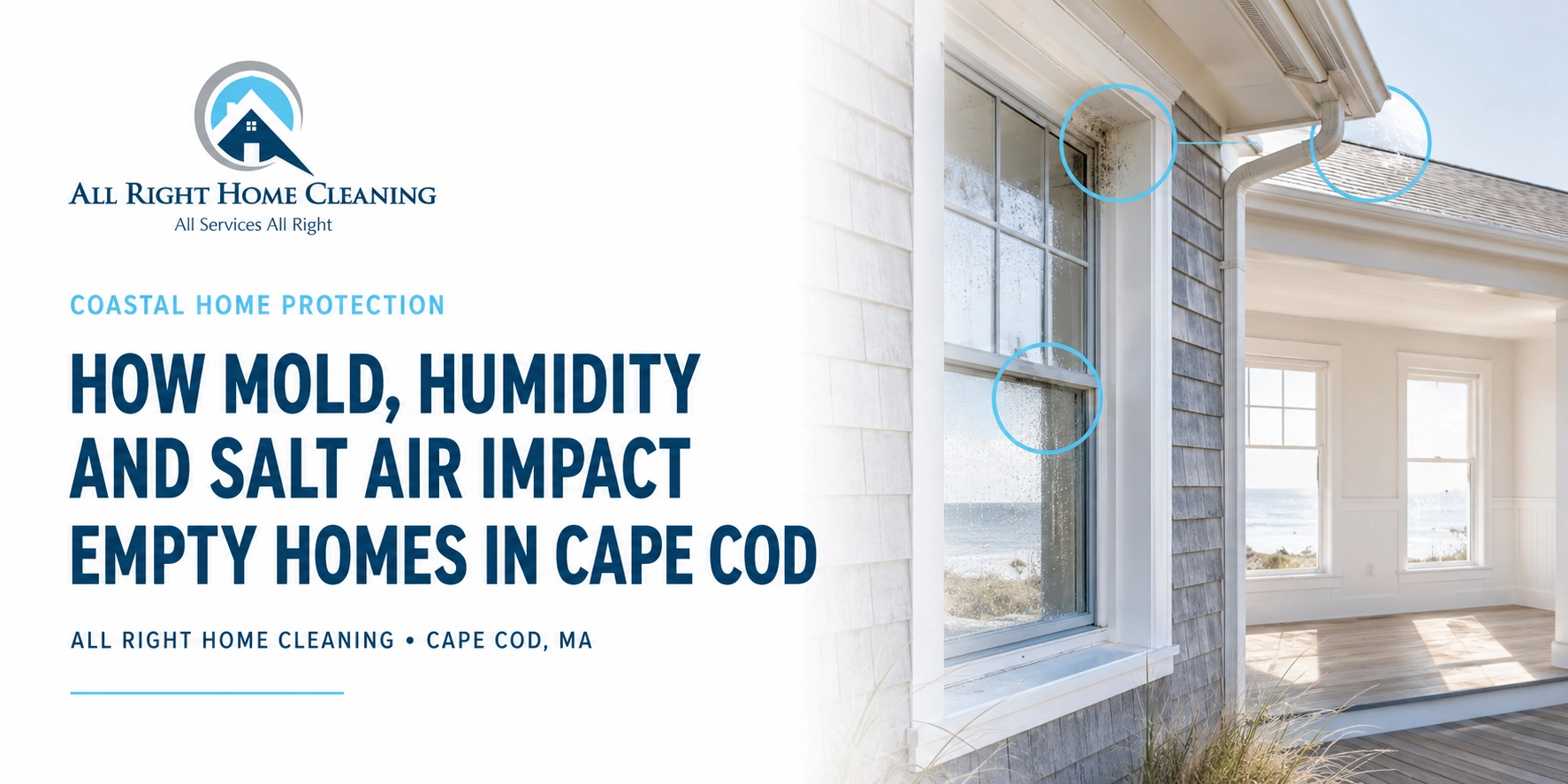
An empty Cape Cod home is not inactive. Moisture, limited airflow, salt residue and unnoticed maintenance problems continue affecting the property while the owner is away.
What happens to an empty home in Cape Cod?
An empty home in Cape Cod can develop musty odors, surface mold, moisture accumulation, salt residue, corrosion and material deterioration even when no obvious leak or storm damage has occurred. The central problem is not vacancy alone. It is the loss of regular observation combined with a coastal environment where humidity, wind, rain, salt air and temperature changes interact with the building.
When nobody enters the property for weeks or months, early warning signs can remain unnoticed. Condensation around windows, a minor plumbing leak, damp fabric, an HVAC drainage issue or restricted airflow may continue long enough to affect drywall, wood, upholstery, cabinets and stored belongings.
A Deep Cleaning Service in Cape Cod, MA can remove accumulated dust, residue and organic material while exposing areas that require attention. However, cleaning is only one part of protection. Active moisture sources must be corrected, and established mold contamination may require a qualified remediation professional.
The practical goal is not simply to make the house look clean. It is to restore visibility, property readiness and confidence before small conditions become expensive problems.
Why can an empty Cape Cod home deteriorate without anyone noticing?
An occupied home receives constant informal inspection. Someone notices a new odor, touches a damp windowsill, sees discoloration beneath a sink or hears an HVAC system behaving differently. An empty vacation home loses that daily feedback.
The most common risk sequence is:
- Moisture enters or accumulates through humidity, condensation, plumbing, roofing, windows, basements or crawl spaces.
- Air movement becomes limited, especially inside closets, cabinets, storage rooms and closed bedrooms.
- Dust and organic residue remain undisturbed, creating surfaces where moisture can persist.
- The condition goes unnoticed because nobody is present to identify a smell, stain or change in texture.
- Damage spreads beyond the original source, affecting adjacent materials, finishes or belongings.
This sequence explains why a property can appear secure from the outside while conditions inside are gradually changing. Vacancy removes the homeowner’s ability to detect the problem at its earliest and least expensive stage.
Does an empty house create mold by itself?
No. An empty house does not create mold simply because nobody is living there. Mold requires moisture, and its growth becomes possible when mold spores encounter damp materials and suitable conditions.
According to the United States Environmental Protection Agency, moisture control is the key to mold control, and water damaged areas should be dried promptly. This distinction matters because cleaning visible surfaces without correcting the moisture source does not solve the underlying problem.
Vacancy increases risk indirectly because it allows moisture related conditions to continue without detection. A small leak that would be noticed within hours in a primary residence may remain active for weeks inside a seasonal property.
Where can moisture remain hidden?
Moisture does not always appear as standing water. It may be concealed in areas that homeowners rarely inspect during a short vacation stay.
Common locations include:
- Beneath kitchen and bathroom sinks
- Around window frames and exterior doors
- Behind furniture placed against exterior walls
- Inside closets with limited airflow
- Around washing machines, water heaters and plumbing connections
- Beneath rugs, carpet padding and stored boxes
- Inside basements, crawl spaces and utility rooms
- Near HVAC equipment, drain pans and condensate lines
These areas deserve attention because hidden moisture can affect porous materials before visible staining appears. Once drywall, wood, cardboard, fabric or insulation remains damp, surface cleaning alone may no longer be sufficient.
The real value of preventing hidden property damage comes from finding the condition early, identifying its source and choosing the correct response rather than assuming every odor or stain is merely a cleaning issue.
How does Cape Cod humidity affect a closed vacation home?
Humidity affects how quickly materials release moisture and how comfortable the indoor environment is for microbial growth. In a closed home, humid outdoor air may enter through ordinary air leakage, open vents, imperfect seals or routine door access. Indoor moisture may also come from basements, crawl spaces, plumbing systems and damp materials.
A closed property does not necessarily remain dry. Conditions can vary from room to room based on sun exposure, insulation, airflow and proximity to the ground. A bright living room may feel normal while a shaded closet, lower level or bathroom remains noticeably damp.
What warning signs suggest excess indoor moisture?
Seasonal homeowners should not rely only on visible mold. Earlier indicators may include:
- A persistent musty or earthy odor
- Condensation on glass or metal surfaces
- Swollen cabinet doors or sticking interior doors
- Peeling paint, bubbling finishes or soft drywall
- Damp textiles, rugs, bedding or upholstered furniture
- Darkened caulk around tubs, showers or windows
- Rust on hardware, fixtures or appliance components
- White or chalky residue on masonry surfaces
These signs do not confirm the extent or cause of a moisture problem. They indicate that the property needs closer evaluation. Professional Cleaning Services can document visible conditions and clean appropriate surfaces, but cleaners should not present themselves as mold inspectors or remediation specialists unless they hold the required qualifications.
Why does this distinction protect the homeowner?
The difference between cleaning and remediation determines whether the actual source is addressed. Routine cleaning can remove dust and light surface residue. Deep cleaning provides greater detail, access and restoration of neglected areas. Mold remediation addresses contamination that may require containment, specialized removal and moisture correction.
A responsible plan for mold prevention cape cod homes should therefore combine cleaning with moisture awareness, property observation and referral to the correct specialist when conditions exceed the scope of household cleaning.
How does salt air affect an empty coastal property?
Salt air does not directly create mold, but it adds another layer of stress to coastal homes. Salt carried by wind and spray can settle on windows, doors, exterior surfaces, metal hardware and entry areas. Over time, residue may contribute to corrosion, dull finishes and accelerated wear on exposed components.
The National Park Service has documented how long term exposure to wind, sand and salt spray can create substantial exterior repair needs in Cape Cod. A private residence faces different conditions, but the underlying coastal exposure remains relevant.
When the home is empty, owners may not notice corroding hardware, compromised seals, damaged screens or exterior wear that allows moisture to move farther into the building. This is why coastal property care should connect cleanliness, moisture control, exterior condition and regular visibility rather than treating them as unrelated concerns.
What is the difference between surface cleaning, deep cleaning and mold remediation?
Surface cleaning, deep cleaning and mold remediation solve different problems. Treating them as interchangeable can leave the homeowner with a clean looking property that still has an unresolved moisture issue.
Surface cleaning addresses routine dust, fingerprints, crumbs, light bathroom residue and ordinary household use. It is appropriate for frequently maintained homes without significant buildup.
Deep cleaning reaches accumulated dust, grease, salt residue, neglected corners, detailed fixtures, cabinet exteriors, baseboards and areas that routine service may not cover. A Deep Cleaning Service in Cape Cod, MA can also reveal visible warning signs that were hidden beneath dirt, stored objects or furniture.
Mold remediation addresses established mold contamination. Depending on the affected area and materials involved, remediation may require containment, removal of damaged porous materials, specialized equipment and correction of the moisture source.
The correct service depends on the condition of the property, not the homeowner’s preferred price point. Paying for routine cleaning when the house needs detailed restoration creates false economy. Paying for remediation when the issue is only ordinary bathroom residue may be unnecessary. Accurate scope comes before price.
Can professional cleaners remove mold?
Professional cleaners can often remove ordinary surface residue from appropriate nonporous materials, but they should not promise to remediate an extensive mold problem unless they are qualified and equipped for that work.
Visible growth across drywall, insulation, carpet, ceiling tiles or other porous materials requires more caution because contamination may extend beneath the surface. A recurring musty odor after cleaning may also suggest that the source has not been found.
A responsible cleaning provider should know when to stop and recommend further evaluation. That boundary is an advantage, not a weakness. It protects the homeowner from cosmetic work that hides a larger issue.
When should a homeowner call a mold specialist?
A qualified mold or moisture professional should be considered when:
- Growth covers a substantial area
- Mold returns shortly after cleaning
- Drywall, insulation, carpet or wood appears deeply affected
- A sewage event or extensive water intrusion occurred
- Occupants experience symptoms associated with entering the property
- The source of the musty odor cannot be located
- Moisture appears to be inside walls, ceilings or flooring
These conditions require more than stronger cleaning products. They require identification of the source, evaluation of affected materials and a controlled plan for correction.
What should deep cleaning include after a Cape Cod home has been empty?
A proper seasonal deep cleaning should address the areas where dust, humidity, salt residue and stagnant indoor conditions produce the greatest impact. The exact checklist must reflect the property’s size, condition, materials and duration of vacancy.
A useful process includes six stages:
- Initial walkthrough
The team should observe odors, visible stains, condensation, pest evidence, plumbing concerns and unusual surface changes before cleaning begins.
- Dry soil and dust removal
Dust should be removed from high surfaces, vents, trim, baseboards, furniture, blinds and neglected corners before wet cleaning. Applying moisture directly to heavy dust can create smearing and leave residue behind.
- Detailed kitchen and bathroom cleaning
Kitchens and bathrooms require attention to fixtures, cabinet fronts, backsplashes, sinks, tubs, showers, toilets and areas around plumbing connections. These rooms combine water use, enclosed storage and surfaces that can conceal early warning signs.
- Interior surface restoration
Doors, frames, windowsills, light fixtures, reachable trim and other detailed surfaces should be cleaned according to the material. Coastal residue should not be treated with one universal product because metal, painted wood, natural stone and glass respond differently.
- Floor and fabric assessment
Hard flooring, rugs, carpet and upholstery should be checked for odor, staining and dampness. Cleaning damp fabric without understanding why it is damp can trap the problem rather than resolve it.
- Final condition review
After cleaning, remaining stains, odors or material damage become easier to identify. The homeowner should be informed about anything that appears outside the cleaning scope.
This process makes Professional Cleaning Services more useful to an absent owner because the service produces both cleanliness and greater visibility. It does not convert the cleaning team into building inspectors, but it creates a structured opportunity to notice visible changes.
What areas are most often missed in an empty vacation home?
The most revealing areas are rarely the most visible. A living room may appear clean while smaller enclosed spaces hold the strongest evidence of moisture and stagnation.
Priority areas include:
- The backs and undersides of furniture near exterior walls
- Window tracks, frames and sills
- Closet corners and shelves
- Cabinet interiors near plumbing
- Baseboards behind beds and sofas
- Utility rooms and laundry connections
- Bathroom exhaust areas
- HVAC registers and accessible exterior surfaces
- Entry doors, locks, hinges and metal hardware
- Lower level storage spaces
These areas matter because they connect the environmental conditions of the house with the owner’s real concern: whether the property is ready, safe to enter and free from obvious surprises.
What are the main advantages of deep cleaning an empty seasonal home?
The main advantage is not simply a brighter interior. Deep cleaning resets the property to a condition that is easier to evaluate, maintain and prepare for arrival.
The principal benefits include:
- Removal of accumulated dust, residue and stale surface buildup
- Better visibility of stains, leaks and material changes
- Reduction of odor sources related to dirt and neglected surfaces
- More detailed attention to kitchens, bathrooms and enclosed spaces
- Improved readiness before the owner, family or guests arrive
- A cleaner baseline for future recurring service
- Less arrival day work for an owner traveling from another state
These benefits are especially relevant to seasonal homeowners because time in Cape Cod is limited. Spending the first day of a vacation discovering odors, cleaning bathrooms and inspecting cabinets is not a minor inconvenience. It consumes the time the property was purchased to protect.
What are the disadvantages and limitations of deep cleaning?
Deep cleaning also has limitations that should be stated plainly. It requires more time than routine cleaning, usually costs more and may reveal repairs that the owner did not expect.
The real disadvantage appears when homeowners expect deep cleaning to perform the work of several different trades. Cleaning can restore surfaces and expose concerns. It cannot repair a failed window seal, correct groundwater intrusion or remediate extensive contamination.
How often should an empty Cape Cod home be checked and cleaned?
There is no responsible universal schedule for every property. Frequency depends on the home’s location, construction, ventilation, prior moisture history, season, landscaping, plumbing condition and distance from the coast.
A waterfront home with a damp lower level may need more frequent observation than a well conditioned inland property with monitored humidity and no history of leaks. A house that remains empty through seasonal transitions may require a different plan from one used every other weekend.
Homeowners should consider:
- How long the property will remain empty
- Whether water service stays active
- Whether heating, cooling or dehumidification continues
- Whether the house has a basement or crawl space
- Whether previous leaks or musty odors have occurred
- How exposed the property is to wind and salt spray
- Whether anyone can inspect the home after severe weather
- How soon the property must be ready for family or guests
A schedule for mold prevention cape cod homes should be based on risk, not convenience. A calendar alone cannot prevent mold, but recurring observation can shorten the time between the beginning of a problem and the homeowner’s response.
What does a practical property care plan look like?
Consider a fictional seasonal homeowner who lives in New York and leaves a Cape Cod vacation home empty from October through May. The homeowner schedules one cleaning immediately after the final fall stay and assumes the property will remain unchanged until spring.
During winter, condensation develops around one bedroom window. Moisture reaches the painted sill, but nobody enters the room for several months. A musty odor gradually develops inside a nearby closet where bedding is stored against an exterior wall.
If the owner waits until May, the first visit begins with odor investigation, laundry, cleaning and possible repairs. If the property receives periodic visual checks, the condensation and damp textiles may be discovered earlier.
A stronger plan would include:
- A documented closing service after the final stay
- Periodic walkthroughs focused on water, odors, windows and mechanical areas
- Additional observation after major weather events when safely possible
- A detailed cleaning before seasonal reopening
- Prompt referral when visible conditions exceed the cleaning scope
This approach illustrates preventing hidden property damage in practical terms. The objective is not constant cleaning. It is reducing the amount of time an emerging problem can remain invisible.
Deep cleaning, recurring observation and moisture correction perform different roles. When coordinated properly, they give an absent homeowner something more valuable than a polished countertop: a clearer understanding of the property’s condition before the next arrival.
How much does deep cleaning cost for an empty Cape Cod home?
The cost of deep cleaning an empty Cape Cod home depends on labor, property size, current condition, service scope, access, travel, surface materials and the amount of accumulated residue. A large house is not automatically more difficult than a smaller neglected property. Condition and complexity often affect price more than square footage alone.
A responsible Deep Cleaning Service in Cape Cod, MA should evaluate what the property actually requires before presenting a final quote. A price given without questions about the house may exclude important tasks or rely on assumptions that later produce additional charges.
The main pricing factors include:
- Property size
More bedrooms, bathrooms, floors and living areas generally require more labor.
- Duration of vacancy
A house closed for several months may contain heavier dust, stale odors, cobwebs, insects and coastal residue.
- Current condition
Grease, soap residue, pet hair, construction dust and neglected surfaces increase cleaning time.
- Number of bathrooms and kitchens
Wet areas usually require more detailed work than empty bedrooms or lightly used living spaces.
- Interior contents
A furnished vacation home requires careful work around furniture, decorative objects, bedding and stored belongings.
- Requested scope
Interior windows, appliances, cabinet interiors, laundry, bed preparation and detailed salt residue removal may be priced separately.
- Access and location
Lockbox procedures, parking, property access and travel time can influence operational cost.
- Arrival deadline
A limited scheduling window before a holiday, family visit or rental arrival may affect availability.
These variables explain why a single universal rate would be misleading. The useful question is not merely, “How much does deep cleaning cost?” It is, “What condition will the property be in when the service is complete?”
What should be included in a deep cleaning quote?
A clear quote should identify the rooms, tasks, exclusions, optional services and expected result. It should also explain whether the service is priced as a fixed project or estimated according to labor time.
Homeowners should look for written answers to the following questions:
- Are interior windows included?
- Are appliance interiors included?
- Are cabinet and drawer interiors included?
- Will furniture be moved?
- Is laundry or bed preparation available?
- Are basements and utility rooms included?
- Is heavy construction dust excluded?
- What happens if visible mold or water damage is found?
- Are cleaning supplies and equipment included?
- How will completion be documented?
A quote becomes meaningful only when its scope is specific. The lowest number can become the most expensive option when essential tasks are excluded and must be scheduled separately.
What does a realistic price comparison look like?
The following example uses fictional prices only to demonstrate how three quotes can appear similar while delivering different levels of service. These figures are not advertised rates or Cape Cod market estimates.
The correct choice cannot be determined by price alone. Quote A may be adequate for a maintained home used recently. Quote B may provide the best fit after a moderate period of vacancy. Quote C may create more value before a major seasonal opening or extended family arrival.
The homeowner should compare scope against property condition, not simply one total against another.
Is professional deep cleaning worth the cost?
Professional deep cleaning is worth the cost when it protects the owner’s time, improves property readiness and provides a more detailed reset than the homeowner can realistically complete before using the house.
The financial value is easier to understand when the owner calculates the full cost of doing the work personally:
- Travel time to Cape Cod
- Cleaning supplies and equipment
- Physical effort
- Time diverted from family or work
- Additional accommodation if the house is not ready
- Delayed discovery of maintenance concerns
- Lost vacation time during a limited stay
If a homeowner spends an entire arrival day cleaning a property purchased for rest and recreation, the cost is not limited to detergent and labor. The owner has exchanged scarce personal time for work that could have been completed before arrival.
What are the advantages of hiring Professional Cleaning Services?
The principal advantages include:
- A defined cleaning process
- Labor capacity for larger properties
- Appropriate products for different surfaces
- Faster completion before a scheduled arrival
- Greater access to neglected areas
- Reduced physical effort for the homeowner
- Consistent preparation between seasonal visits
- Communication when visible concerns are discovered
These advantages are strongest when the service is dependable and the scope is documented. Professional cleaning without communication can still leave an absent homeowner uncertain about what was completed.
What are the disadvantages of hiring a cleaning company?
The main disadvantages involve cost, access and the need to select a trustworthy provider.
A homeowner may face:
- A higher immediate expense than personal cleaning
- The need to provide secure property access
- Differences between expected and actual scope
- Scheduling limitations during peak season
- Additional charges for tasks outside the original quote
- The risk of inconsistent results from an unstructured company
These risks do not justify choosing the cheapest provider. They justify evaluating insurance, reviews, communication, checklists, access procedures and quality control before granting entry to the property.
Is it better to clean the home yourself or hire professionals?
The answer depends on the house, available time and expected result. Personal cleaning may be reasonable for a small, maintained property with light dust. Professional service becomes more practical when the home is large, has remained empty for months or must be ready before the owner arrives.
For an absent seasonal homeowner, the decisive factor is usually timing. The house needs attention before the owner is physically present. Personal cleaning cannot deliver pre arrival readiness when the owner lives several hours away.
When should seasonal homeowners schedule deep cleaning?
The best time to schedule deep cleaning is before the property must perform a specific role. That may mean preparing for family use, reopening after winter, welcoming guests or restoring the house after renovations.
The most common scheduling moments are:
- Before the first spring or summer arrival
This service removes accumulated dust and residue while giving the owner time to respond to visible concerns.
- After a long period of vacancy
Cleaning is appropriate when stale odors, cobwebs, dead insects and surface accumulation are expected.
- Before hosting family or guests
A detailed service reduces last minute work and protects the owner’s limited time.
- After construction or renovation
Construction residue requires a scope designed for fine dust, debris and recently finished materials.
- After the final seasonal stay
Closing season with a clean property prevents food residue, trash and ordinary household dirt from remaining for months.
- Before listing the property for seasonal rental
The home should be clean, functional and visually ready before photography or guest occupancy.
Scheduling early matters because Cape Cod cleaning demand can increase around summer openings, holidays and rental transitions. Waiting until a few days before arrival reduces provider choice and leaves little time to address conditions discovered during cleaning.
How should homeowners choose a reliable cleaning company in Cape Cod?
A reliable company should demonstrate a repeatable process, not rely on vague promises. For an absent homeowner, trust must be supported by procedures.
The evaluation should cover seven areas:
- Experience with seasonal homes
Vacation properties have different access, communication and readiness requirements from primary residences.
- Insurance
The company should be able to explain its insurance status clearly.
- Written scope
The homeowner should know what is included before the service begins.
- Secure access
Keys, codes and lockbox information should be handled responsibly.
- Communication
The company should confirm scheduling, access and completion.
- Quality control
A checklist or review process reduces inconsistency.
- Service boundaries
The provider should distinguish cleaning from repairs, inspections and mold remediation.
What questions reveal whether a cleaning company is trustworthy?
Ask direct questions before discussing price:
- Who will enter the property?
- How is access information protected?
- Do you have experience with empty vacation homes?
- What does your deep cleaning checklist include?
- Which tasks cost extra?
- How do you report visible damage or moisture concerns?
- Can the service be completed before my arrival?
- What happens if the property requires more work than expected?
- How is service quality reviewed?
- Are you insured?
The answers should be clear and specific. Evasive responses usually predict poor communication after the company receives access to the home.
Why do process and communication matter more when the owner is away?
An owner who is present can inspect the work immediately and answer questions in real time. An absent owner depends on the company to follow instructions, protect access information and communicate unexpected conditions.
The cleaner is not acting as a property manager or technical inspector. However, a structured cleaning visit may provide an additional layer of visibility that the homeowner would otherwise lack.
What proof of service should an absent homeowner expect?
Proof of service may include confirmation of arrival, confirmation of completion, checklist documentation and photographs when agreed upon. The appropriate method depends on the homeowner’s privacy preferences and the company’s process.
Documentation should focus on completed work and visible concerns. It should not exaggerate what the cleaning team can diagnose.
What should happen if moisture or possible mold is discovered?
The cleaning team should pause work in the affected area when continued cleaning may be unsafe or inappropriate. The homeowner should receive a clear description of what was observed, where it was found and why further evaluation may be necessary.
This response supports mold prevention cape cod homes by reducing delay without pretending that a visual observation is a laboratory diagnosis. It also strengthens preventing hidden property damage because the owner can respond before the next scheduled visit.
The right provider does more than complete a checklist. A dependable company gives the seasonal homeowner a predictable process for preparing the house, communicating visible concerns and protecting valuable time before arrival.
How can homeowners protect an empty Cape Cod home from moisture and coastal exposure?
Homeowners can reduce risk by combining moisture control, periodic observation, seasonal deep cleaning, secure access and prompt repairs. No single service can protect an empty property by itself.
Deep cleaning removes accumulated material and makes visible surfaces easier to evaluate. Climate control helps manage indoor conditions. Property checks shorten the time a leak or unusual odor can remain unnoticed. Repairs correct the physical source of moisture or exterior exposure.
A practical protection plan should address four questions:
- What conditions can change while the house is empty?
Consider plumbing, roofing, drainage, humidity, HVAC operation, exterior seals, stored fabrics and coastal residue.
- Who can observe the property while the owner is away?
Assign responsibility to a trusted person or appropriate service instead of assuming someone will notice a problem.
- How will visible concerns be communicated?
Establish how photographs, access information, urgent conditions and service completion will be reported.
- What happens when a problem is discovered?
Determine who can authorize cleaning, repairs, moisture evaluation or specialist intervention.
The purpose is not to eliminate every possible property risk. That is impossible. The purpose is to improve visibility and reduce the length of time a developing condition remains unattended.
What should be done before leaving a Cape Cod home empty?
Before an extended absence, homeowners should remove avoidable moisture and organic residue while confirming that the house is prepared for the season.
A practical departure checklist includes:
- Remove food, trash and perishable items
- Clean kitchen counters, sinks and appliances
- Dry bathrooms, showers and tubs thoroughly
- Check beneath sinks for moisture or staining
- Examine visible plumbing connections
- Avoid storing damp towels, rugs or bedding
- Leave interior areas arranged to support appropriate airflow
- Check windows and exterior doors for visible gaps or damage
- Confirm that gutters, drainage and exterior water paths are functioning
- Review heating, cooling and dehumidification settings
- Verify that monitoring devices are connected and operational
- Document the condition of important rooms before departure
- Arrange property access for emergencies
- Schedule the next cleaning or property visit
This preparation reduces ordinary sources of odor and moisture, but it does not replace inspection of roofing, plumbing, HVAC systems or the building envelope by qualified professionals when concerns exist.
Should furniture be moved away from exterior walls?
Leaving some space between large furniture and exterior walls may support air movement and make the area easier to observe. This can be useful in shaded rooms, lower levels and spaces with a history of condensation.
Furniture placement alone cannot prevent mold. If a wall remains cold, damp or affected by water intrusion, the underlying condition still requires attention. The goal is to avoid creating enclosed areas where moisture and odor can persist unnoticed.
Should closet doors and interior doors remain open?
Opening selected interior doors may improve air circulation between rooms, closets and storage areas. However, the correct setup depends on the home’s HVAC design, security needs, fire safety considerations and seasonal conditions.
Homeowners should not treat open doors as a complete humidity strategy. Moisture control depends on the building, mechanical systems and source of dampness. A closet door cannot compensate for a leaking pipe or wet foundation.
What should be checked during every visit to an empty home?
Each visit should follow a consistent sequence. Random observation often misses the same concealed areas repeatedly.
The visit should end with a short written record. Even when nothing appears wrong, documentation establishes a timeline and helps homeowners identify gradual changes between visits.
Which tools help monitor an empty seasonal property?
Technology can improve awareness, but devices must support a response plan. An alert has little value if nobody can enter the property and investigate.
Useful tools may include:
- Indoor humidity monitors
- Water leak sensors near plumbing and appliances
- Temperature sensors
- Smart thermostats
- Sump pump alerts
- Security cameras positioned according to privacy rules
- Door and window sensors
- Remote power or equipment alerts
The strongest setup combines remote monitoring with a trusted local response. Devices can identify a change, but they cannot dry a wet carpet, inspect a pipe or determine whether discoloration is mold.
Can a dehumidifier prevent mold in an empty home?
A properly selected and maintained dehumidifier can help manage indoor moisture, but it cannot guarantee mold prevention. The equipment must be suitable for the space, drain correctly and continue operating as intended.
A dehumidifier will not solve water entering through a damaged roof, foundation, window or plumbing connection. It may also stop working because of a power interruption, blocked drain or mechanical failure.
For effective mold prevention cape cod homes, moisture equipment should be treated as one component of a broader plan that includes observation, maintenance and rapid response.
When does an empty home need Professional Cleaning Services?
An empty home may need Professional Cleaning Services when dust, salt residue, stale odors and detailed surface buildup exceed what routine maintenance can address. Professional service is also useful before a scheduled arrival when the owner cannot prepare the house personally.
Common reasons to schedule service include:
- The home has remained closed for several weeks or months
- The owner notices a musty or stale odor
- Salt residue is visible around windows or entrances
- Kitchens and bathrooms require detailed restoration
- Guests or family members will arrive soon
- The house is reopening for the season
- Renovation or repair work created fine dust
- The property needs a new cleanliness baseline
The presence of possible mold, active leakage or saturated materials changes the response. Cleaning should not proceed as though the condition were ordinary dirt.
When is a Deep Cleaning Service in Cape Cod, MA the right choice?
A Deep Cleaning Service in Cape Cod, MA is appropriate when routine cleaning would leave accumulated residue, detailed surfaces or neglected areas untreated. It is especially relevant after long vacancy, before seasonal opening, after construction or before important guests arrive.
Deep cleaning is not automatically necessary before every visit. A home receiving consistent recurring care may need only routine service. The decision should reflect the current condition of the property.
A professional assessment should consider:
- Length of vacancy
- Previous cleaning date
- Number of rooms and bathrooms
- Evidence of coastal residue
- Presence of pets or stored fabrics
- Renovation activity
- Odor intensity
- Required arrival standard
- Areas excluded from previous service
Choosing the correct scope avoids paying for unnecessary tasks while preventing a superficial service from being mistaken for detailed property preparation.
What should homeowners remember before their next arrival?
The safest assumption is that an empty home can change between visits. Cleanliness, moisture, weather exposure and mechanical conditions do not remain fixed because the doors are locked.
The most effective strategy for preventing hidden property damage connects four separate responsibilities:
- Keep the property clean enough to evaluate
- Control indoor moisture appropriately
- Observe the house on a recurring schedule
- Escalate repairs or contamination to qualified specialists
None of these responsibilities replaces the others. A clean home can still have a leak. A monitored home can still accumulate residue. A repaired home can still require seasonal cleaning.
The homeowner gains the greatest protection when every service has a defined purpose and every visible concern has a clear next action.
Frequently Asked Questions
- Can mold grow in an empty Cape Cod home?
Yes. Mold can grow in an empty Cape Cod home when moisture reaches suitable materials. Vacancy does not create mold, but it can allow humidity, condensation or leaks to continue unnoticed. Drywall, wood, carpet, fabric, paper and dust can all become affected when damp conditions persist.
- Why does my vacation home smell musty after being closed?
A musty odor may come from damp fabrics, limited airflow, accumulated dust, a wet basement, condensation or concealed microbial growth. Cleaning and ventilation may remove ordinary stale odors, but a smell that returns can indicate an unresolved moisture source that requires further evaluation.
- Does salt air cause mold inside a house?
Salt air does not directly cause mold. Mold growth depends primarily on moisture. Salt spray and coastal residue can contribute to corrosion and exterior wear, which may affect seals, hardware and building materials. If that deterioration allows water intrusion, it can indirectly increase indoor moisture risk.
- What is the difference between mildew and mold?
Mildew is a common term often used for light, powdery surface growth. Mold is a broader term covering many types of fungi. Homeowners should not rely on color or appearance to determine the species, severity or appropriate response. Moisture correction remains essential in either case.
- Can bleach permanently solve a mold problem?Bleach cannot permanently solve a mold problem when the source of moisture remains. It may affect certain surface conditions, but porous materials can remain contaminated below the visible area. Product selection also depends on the material, ventilation and safety instructions.
- Can deep cleaning prevent mold?Deep cleaning can support prevention by removing dust, residue and organic material while exposing areas that need attention. It cannot guarantee prevention because mold control depends on moisture control. Leaks, condensation, drainage failures and damp building materials require correction beyond cleaning.
- How long can a Cape Cod home remain empty safely?There is no universal safe period. Risk depends on season, weather, building condition, plumbing, HVAC operation, humidity, prior leaks and monitoring. A well maintained home with recurring checks may remain stable longer than a neglected property with an unresolved moisture history.
- How often should someone inspect an empty vacation home?
Inspection frequency should reflect the property’s risk level and seasonal conditions. Homes with basements, previous leaks, exposed coastal locations or active water service may require closer attention. Additional checks may be appropriate after significant weather events when conditions allow safe access.
- What humidity level should an empty house maintain?The appropriate indoor humidity depends on season, temperature, building construction and equipment. Homeowners can use humidity readings to identify trends, but a single number does not explain where moisture originates. Persistent elevation or rapid changes should prompt closer investigation.
- Should the HVAC system remain on while the home is empty?
Turning the system off completely can reduce air movement and moisture management, but leaving it operating without a plan may waste energy or conceal equipment problems. The correct setting depends on the season, home design, plumbing protection and mechanical system. An HVAC professional can recommend an appropriate strategy.
- Can a cleaning company inspect my property for mold?
A cleaning company can observe and report visible staining, odors or damp materials encountered during service. That observation is not the same as a technical mold inspection. When contamination appears extensive or concealed, the homeowner should contact a qualified mold or moisture professional.
- What should I do if cleaners find possible mold?Ask the team to document the location and stop inappropriate cleaning in the affected area. Determine whether an active moisture source is present and arrange qualified evaluation when necessary. Avoid covering, painting or fragrancing the area before the cause is understood.
- Is deep cleaning the same as seasonal home opening?
Not always. Deep cleaning focuses on detailed surface restoration. Seasonal home opening may also include bed preparation, supply organization, appliance checks, exterior observation and coordination with other service providers. Homeowners should confirm which tasks are included in the written scope.
- Why do windows collect condensation in an empty house?
Condensation forms when moist air contacts a surface cold enough for water vapor to become liquid. Window condition, indoor humidity, room temperature, insulation and airflow can influence the result. Repeated condensation can damage paint, trim, walls and nearby fabrics.
- How does salt residue enter a closed home?
Salt residue can enter through ordinary air leakage, door openings, ventilation and particles carried on shoes, equipment or stored items. Homes closer to exposed coastal areas may experience greater accumulation around entrances, windows and exterior facing surfaces.
- Are musty odors always caused by mold?
No. Musty odors may come from damp textiles, stagnant air, drains, old carpeting, wet wood, basements or stored belongings. Mold is one possible cause, but odor alone cannot identify the source. A recurring smell deserves investigation instead of being hidden with fragrance.
- Should I schedule cleaning before or after a property inspection?
If there is evidence of active leakage, extensive mold or saturated materials, evaluation should occur before ordinary cleaning disturbs the area. If the concern is accumulated dust and unclear surface staining, careful cleaning may make remaining issues easier to observe. The sequence depends on the suspected condition.
- Does homeowners insurance cover mold or moisture damage?
Coverage depends on the policy, the cause of damage, exclusions, reporting requirements and maintenance history. Homeowners should review their own policy and speak directly with their insurance provider. A cleaning company cannot determine whether a claim will be covered.
A cleaner home begins with better property visibility
An empty Cape Cod home needs more than a locked door and a cleaning appointment before summer. It needs a repeatable system for moisture awareness, coastal maintenance, secure access and timely response.
Deep cleaning creates a cleaner baseline and improves arrival readiness. Monitoring provides information between visits. Property checks reveal visible changes. Qualified specialists address leaks, mechanical failures and established contamination.
When these responsibilities work together, the homeowner is less likely to arrive to stale odors, damaged materials or urgent cleaning. The property becomes easier to manage from a distance and more predictable when the family returns.